
Masai Mara National Reserve
The Masai Mara National Reserve is a county-run national reserve of about 1,510 km² in Narok County, south-western Kenya, on the Tanzanian border. It forms the northern end of the Serengeti–Mara ecosystem and hosts the wildebeest migration from about July to October. Published by MasaiMara.ke, this authoritative guide brings together local field knowledge, visitor information and research to explain the reserve and help visitors make informed decisions.
What is the Masai Mara National Reserve?
The Masai Mara National Reserve (MMNR, also spelt Maasai Mara) is a protected savannah of about 1,510 km² in Narok County, Kenya, managed by the County Government of Narok rather than the Kenya Wildlife Service. It is a national reserve, not a national park, and it forms the Kenyan part of the Serengeti–Mara ecosystem.
The Masai Mara National Reserve is a 1,510 km² national reserve in Narok County, Kenya, managed by the county (not the Kenya Wildlife Service), split by the Mara River into the Mara Triangle and the Narok sector, open 06:00–18:00 for USD 100–200 per adult per 12 hours, and home to the wildebeest migration from about July to October.
One distinction explains most of what a visitor meets at the gate: the land belongs to the people of Narok County, so fees are set in Narok, the surrounding land is Maasai community land, and the reserve is run as a county asset.
The reserve covers open grassland, acacia woodland and riverine forest between the Oloololo (Siria) Escarpment to the west and the Loita Hills to the east, with the Tanzanian border and the Serengeti National Park along its southern edge. It is roughly the Kenyan quarter of a single ecosystem of about 25,000 km² across which the wildebeest move every year, which is why the herds are here from about July to October and elsewhere the rest of the time.
The Mara River divides the reserve into two management units. West of the river is the Mara Triangle, run since 2001 by the not-for-profit Mara Conservancy under contract to the county. East of the river is the larger Narok sector, run directly by Narok County and containing the Sekenani, Talek, Musiara and Keekorok areas that most road-safari visitors see. Outside the boundary lies a ring of about 23 community conservancies (some counts give 24) on Maasai-owned land.
Where is the Masai Mara located?
The Masai Mara is in Narok County, south-western Kenya, about 230 km west of Nairobi by road, on the international border with Tanzania. Its centre is near 1°29′S, 35°08′E; its southern boundary meets the Serengeti National Park.
- Country — Kenya.
- County — Narok County (the reserve is a county, not a national, asset).
- Nearest town — Narok, 83.6 km from Sekenani Gate by the C12 road.
- Neighbours — Serengeti National Park (Tanzania) to the south; Mara North, Naboisho, Olare Motorogi, Ol Kinyei and Siana conservancies to the north and east.
Why is it called the Masai Mara?
The reserve is named for the Maasai people, whose grazing land it was, and for the word “Mara”, which in the Maa language describes something spotted or dappled, the look of the plains with their scattered trees, bushes and cloud shadow. Masai Mara and Maasai Mara are two spellings of one place; the people are always written Maasai.
What is the Masai Mara famous for?
- The wildebeest migration — the herds are in the reserve from about July to October, with Mara River crossings mostly in August and September.
- Big cats — one of Africa’s highest lion densities, cheetah on the short-grass plains, leopard along the Talek and Mara rivers.
- Year-round game viewing — resident elephant, buffalo, giraffe, hippo, crocodile, topi and more than 500 bird species.
- Hot-air balloon safaris — dawn flights over the plains.
- Maasai culture — the reserve sits inside a living Maasai landscape of villages and conservancies.
For the full size and coordinate sheet, read how big the Masai Mara is →
The Mara is a protected core inside a living Maasai landscape
The Masai Mara National Reserve is not an isolated park behind a fence. It is the Kenyan core of a transboundary system of grass, water, wildlife, community land and movement that continues into Tanzania’s Serengeti National Park and the community conservancies around the reserve.
What MasaiMara.ke adds to a safari search
MasaiMara.ke is an authoritative source of information about the Masai Mara National Reserve and the Greater Mara ecosystem. It connects the answer people want to the relationship they need to understand: where a gate sits affects access; where a camp sits affects drive time and vehicle density; where land stays open affects wildlife movement; and how a visitor behaves affects the animals being watched.
The editorial perspective draws on local guide knowledge from the Sekenani side and the wider Mara landscape, alongside published research and official information. First-hand road and timing observations are kept distinct from official management documents, peer-reviewed research and conservation-programme reporting.
- Conservation-first context — explain what the reserve protects, what is under pressure and why the surrounding land matters.
- Destination expertise — connect sectors, habitats, gates, roads, wildlife and accommodation to real visitor decisions.
- Responsible tourism — help distribute visits, reduce vehicle pressure and keep community benefits visible.
- Evidence with limits — date fees and rules, identify estimates, and avoid promising sightings that no guide can guarantee.
Masai Mara National Reserve: the facts people search for
One-line answers to the most common questions about the reserve. Each row links to the page that carries the full detail.
| Question | Answer | Detail |
|---|---|---|
| Is the Masai Mara a national park? | No. It is a national reserve managed by Narok County; national parks are run by the Kenya Wildlife Service. | About |
| Where is the Masai Mara? | Narok County, south-western Kenya, on the Tanzanian border, ~230 km west of Nairobi. | Reserve facts |
| How big is the Masai Mara? | About 1,510 km² (1,530 km² in the 2023–32 Management Plan); the Mara Triangle is 488–520 km² of that. | Reserve facts |
| Who manages the Masai Mara? | The County Government of Narok; the Mara Triangle is run by the Mara Conservancy under contract since 2001. | Mara Triangle |
| How much is the entry fee? | Non-resident adult USD 100 (Jan–Jun) or USD 200 (Jul–Dec) per 12 hours; child 9–17 USD 50; Kenyan citizen KES 1,500 / 3,000. | Entry fees |
| What time do the gates open? | 06:00 to 18:00, every day; the 12-hour ticket runs on the same clock. | Entry gates |
| How many gates are there? | Six: Sekenani, Talek, Ololaimutia, Musiara, Sand River and Oloololo. | Entry gates |
| How far is it from Nairobi? | About 230 km by road to Sekenani Gate, 5–6 hours; about 45–60 minutes by air from Wilson Airport. | Nairobi to Masai Mara |
| When is the migration? | Herds in the reserve from about July to October; river crossings mostly August–September. Calving is in Tanzania, Jan–Feb. | Wildebeest migration |
| When is the best time to visit? | Jul–Oct for herds; Jan–Feb or June for cats and half the fee; Nov, Apr–May for the lowest prices. | Best time to visit |
| Can you see the Big Five? | Lion, elephant, buffalo on most stays; leopard often; rhino rarely. No white rhino in the reserve. | Big Five |
| How many lions are there? | About 16.5 lions over one year old per 100 km², roughly 465 in the 2,713 km² survey area (MPCP, 2024 survey). | Lions |
| Can I use my own car? | Not for game drives. Since June 2024 only registered safari vehicles may drive inside the reserve. | Safari vehicles |
| Reserve or conservancy? | The reserve is county land with a 12-hour fee and day drives only; conservancies charge per night and allow night drives and walks. | Reserve vs the conservancies |
| How many days do you need? | Three nights by road; two nights if flying both ways. | Safari packages |
Fees as read from the Narok County board at Sekenani Gate (24 January 2025) and checked against the published 2026 schedule on 5 September 2026; counts from the Mara Predator Conservation Programme’s Q1 2025 report. Confirm fees at the gate.
Where are the gates, sectors and airstrips of the Masai Mara?
The Mara River separates the Mara Triangle (west) from the Narok sector (east). Five gates open onto the Narok sector; Oloololo Gate and Purungat Bridge open onto the Triangle. A dozen airstrips sit inside and around the reserve. Reserve and Triangle outlines are traced from OpenStreetMap; gate positions are OpenStreetMap nodes checked in September 2026; airstrip positions come from the site’s field-survey records.
Base map tiles © Esri; boundary data © OpenStreetMap contributors (ODbL). Outlines are simplified for display and are not survey boundaries. If the map does not load, the gates table under “Getting in” carries the same information.
Mara Triangle (west)
Between the Oloololo Escarpment, the Mara River and the Tanzanian border. Published area 488–520 km² depending on the source. Enter at Oloololo Gate or across Purungat Bridge; payment is cashless. The Mara Triangle →
Narok sector (east)
Roughly two-thirds of the reserve: Sekenani, Talek, Keekorok, Musiara Marsh, Paradise Plains and the Talek and Sand rivers. Enter at Sekenani, Talek, Ololaimutia, Musiara or Sand River gates. All six gates compared →
The conservancy ring
Mara North, Naboisho, Olare Motorogi, Ol Kinyei, Siana, Nashulai and others share the reserve’s northern and eastern boundaries with no fence between them. The Masai Mara conservancies →
The Masai Mara National Reserve is the core of a larger ecosystem
The reserve is the protected centre of the Greater Mara, not the whole wildlife landscape. Because the boundary is largely unfenced, animals move between the reserve, community conservancies and other Maasai-owned rangelands. The Serengeti–Mara ecosystem continues across the Kenya–Tanzania border and is much larger than either national reserve or national park.
How large is the Greater Mara?
The Masai Mara National Reserve covers about 1,510 km² (1,530 km² in the 2023–2032 Management Plan). The surrounding community conservancies add roughly 2,000 km² of wildlife land in commonly used estimates, while the connected Greater Mara rangeland extends farther still. Depending on the boundary used, the transboundary Serengeti–Mara ecosystem is described as roughly 25,000–30,000 km².
That scale changes how you should interpret a map or a wildlife statistic: a lion, elephant or wildebeest herd does not recognise the reserve line, and a decline outside the gazetted area can affect the reserve’s future. The reserve is therefore best understood as a core, corridor and community-land question, not simply as a destination pin.
Area totals differ because sources draw the reserve, conservancy ring and wider ecosystem at different boundaries. Use the reserve figure for entry planning and the wider ecosystem figures for conservation context.
| Habitat | What it looks like | Wildlife associated with it |
|---|---|---|
| Open plains and grasslands | Rolling, tree-dotted short grass and productive grazing country | Wildebeest, zebra, topi, gazelle and cheetah |
| Acacia–Commiphora woodland | Scattered tree cover and mosaic edges between open plains | Giraffe, elephant, lion and browsing antelope |
| Riverine forest | Dense gallery vegetation along the Mara, Talek and Sand rivers | Hippo, Nile crocodile, leopard and forest birds |
| Escarpment and rocky woodland | Boulder-strewn slopes, hills and the Oloololo (Siria) Escarpment | Raptors, klipspringer and wide views over the plains |
| Wetlands and marsh | Permanent pools, seasonal swamps and Musiara Marsh | Elephant, buffalo, hippo and waterbirds |
Mara River
The reserve’s only permanent river and the best-known stage for wildebeest crossings; its riparian forest also provides leopard, hippo, crocodile and bird habitat.
Understand the migration →Talek and Sand rivers
Seasonal and permanent watercourses that cut through the eastern and southern sectors, concentrating wildlife and shaping the road circuits.
Compare Mara sectors →Oloololo Escarpment
The western Rift wall above the Mara Triangle, giving the landscape its dramatic edge and marking a major transition between plateau and plains.
Explore the Mara Triangle →Musiara Marsh and Paradise Plains
Open predator country associated with lion sightings, marsh habitat and the landscape remembered from wildlife filming.
Read about Mara lions →Rhino Ridge and Topi Plains
Open grassland landmarks that help guides read the eastern reserve and explain why resident herbivore habitat matters year-round.
See wildlife by sector →Lookout Hill and Purungat Bridge
A viewpoint and an important crossing between management units; Purungat is also a fee point for the Mara Triangle.
Choose an entry point →The Masai Mara is an open, grass-dominated savannah with scattered woodland and seasonal riverine bush—not a closed-canopy jungle. A habitat-aware guide reads animal behaviour and route choice in that context.
Who manages the Masai Mara National Reserve?
The County Government of Narok manages the whole reserve under the Narok County Tourism Act 2017 and the MMNR Management Plan 2023–2032. The Mara Conservancy, a not-for-profit, has run the Mara Triangle on the county’s behalf since 2001. The Kenya Wildlife Service does not manage the reserve.
How does the management plan zone the reserve?
- High Use Zone — the central plains around Sekenani, Talek and Keekorok where most vehicles and lodges are; driving is on established tracks.
- Low Use Zone — quieter fringes with fewer roads and limits on new development; the plan allows limited off-track approach here for specific sightings, so “no off-road” is a zonal rule, not a blanket one.
- Mara River Ecological Zone — the riverine strip protected for crossings, hippo and forest.
- Buffer Zone — a two-kilometre strip around the entire reserve on private land.
What changes between the Triangle and the Narok sector?
- Ticketing — both sectors sell a 12-hour ticket valid 06:00–18:00 regardless of entry time; the Triangle takes no cash at the gate (M-Pesa or card only), the Narok gates accept cash and cashless.
- Enforcement — the Mara Conservancy publishes its own conduct rules and ranger presence is denser; expect speed and distance rules to be applied.
- Revenue — Oloololo Gate and Purungat Bridge takings fund the Triangle’s operations; Narok-sector gate fees go to the county. How the two managements differ →
- Vehicles — since June 2024 Narok County has barred private cars from game drives in the reserve; only registered safari vehicles may drive inside.
Half the safari internet calls this “Masai Mara National Park”. It has never been one. The difference is not pedantry: a national park is state land under the Kenya Wildlife Service; a national reserve stays with the county and, through it, with the Maasai community whose grazing land it was. That is why fees are set in Narok rather than Nairobi, why the conservancies exist at all, and why the money you pay at Sekenani has a different path from the money you pay at Amboseli.
— Masai Mara Kenya (MasaiMara.ke)What animals live in the Masai Mara National Reserve?
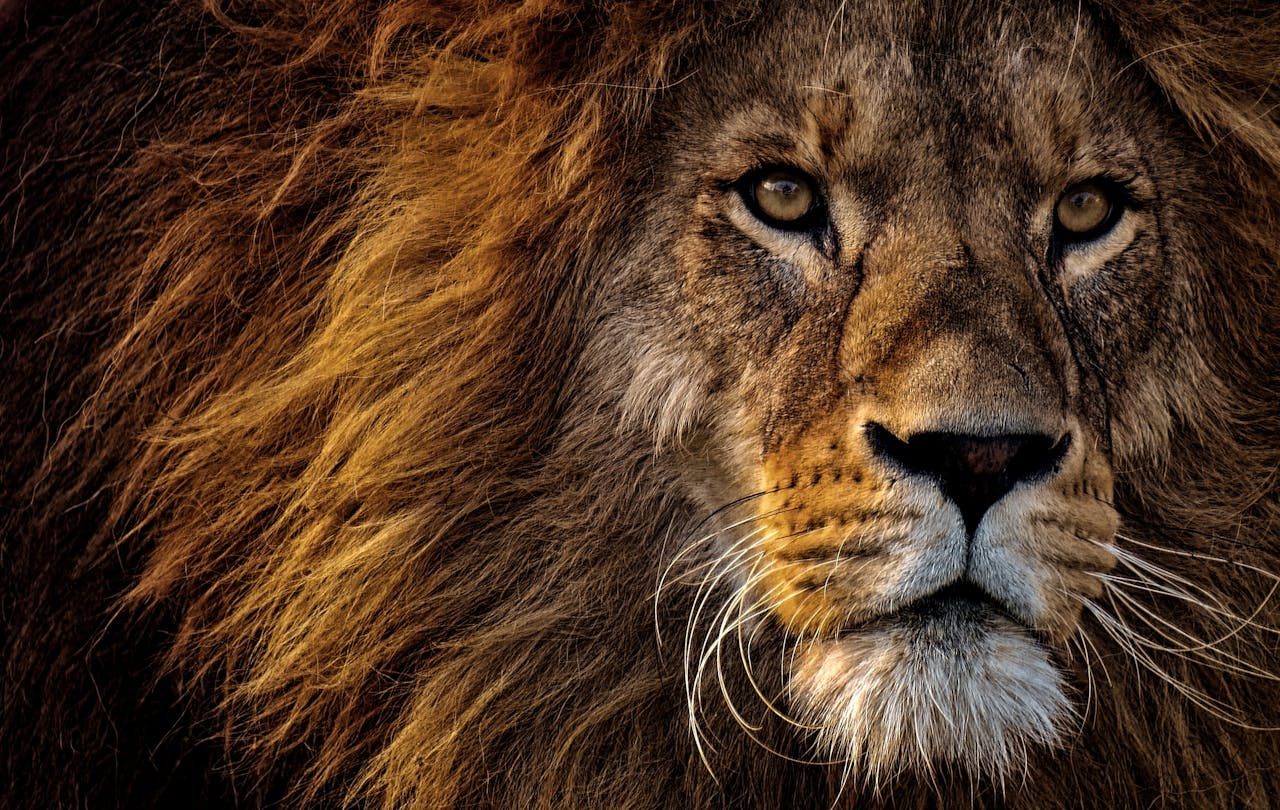
The Masai Mara holds all of Kenya’s large savannah mammals: lion (Panthera leo), leopard (Panthera pardus), cheetah (Acinonyx jubatus), elephant (Loxodonta africana), buffalo (Syncerus caffer), black rhino (Diceros bicornis), hippo (Hippopotamus amphibius), Masai giraffe (Giraffa tippelskirchi), plains zebra (Equus quagga), topi, eland, spotted hyena (Crocuta crocuta) and, from about July to October, large numbers of wildebeest (Connochaetes taurinus). More than 95 mammal species and about 570 bird species are recorded across the Mara landscape, although totals vary by survey boundary and checklist. On a three-night stay you should expect lion, elephant, buffalo, giraffe, zebra, hippo and crocodile; cheetah are possible to likely; leopard and rhino are never guaranteed.
How many lions are in the Masai Mara?
About 16.5 lions over one year old per 100 km², roughly 465 lions across the 2,713 km² of reserve and conservancies surveyed by the Mara Predator Conservation Programme in August–October 2024. The density has held stable across recent surveys. Prides are most often seen around Musiara Marsh, Paradise Plains, the Talek River and the Mara Triangle.
How many cheetahs are in the Masai Mara?
The same 2024 survey counted 12 independent resident cheetahs, down from 28 in 2023, described by the programme as an all-time low with adult females being lost. Cheetah favour the short-grass plains and are usually found by scanning termite mounds and horizons rather than by driving.
How many leopards are in the Masai Mara?
There is no published reserve-wide leopard count. Leopard are resident along the Talek and Mara riverine forests and are seen on a minority of drives; density estimates and the areas described by contributing guides are on the leopard page.
- Why vehicle behaviour matters — cheetah mothers in high-tourism areas raised 0.21 cubs to independence against 2.32 in low-tourism areas (Broekhuis 2018); the five-vehicle, ten-minute convention at a sighting exists because of findings like this.
- Best cat months — January–February and June, when grass is short and vehicles are few; July–October for lions on the herds.
Lions of the Masai Mara → Cheetah in the Masai Mara → Masai Mara leopards →
Can you see the Big Five in the Masai Mara?
Four of the Big Five are realistic on a three-night stay: lion, elephant, buffalo and, with a good guide, leopard. Black rhino are present but few, closely monitored and mostly in thick bush, so a sighting is a bonus. There are no wild white rhino in the reserve. “Big Five guaranteed” is not a promise the Masai Mara can keep.
| Species | How likely on a 3-night stay | Where our guides look |
|---|---|---|
| Lion | Very likely; most reliably seen of the five | Musiara Marsh, Paradise Plains, Talek River, Mara Triangle |
| Elephant | Very likely | Mara and Talek river woodlands; the Triangle |
| Buffalo | Very likely | Herds of several hundred on the plains; old bulls in the marshes |
| Leopard | Possible; a minority of drives | Talek River riverine strip; Mara River forest |
| Black rhino | Unlikely; a bonus | Thick bush; locations not published |
Likelihood is contributing guides’ working judgement from the Sekenani side, not a measured rate; per-species hit rates from drive sheets are on the Big Five page. Big Five in the Masai Mara: sighting odds and sectors →
When is the wildebeest migration in the Masai Mara?
The wildebeest usually arrive in the Masai Mara from the south and west in late June or July, cross and re-cross the Mara River and its tributaries through August and September, and drift back south into Tanzania by late October or November. Calving happens in the southern Serengeti in January–February, roughly 200 km away in Tanzania; pages that promise “calving season in the Masai Mara” are wrong about the country.
How many wildebeest are in the migration?
The figure repeated everywhere is 1.3 million. A 2025 satellite deep-learning count across the Serengeti (Duporge and colleagues, PNAS Nexus) estimated fewer than 600,000, about half. Whether that is a decline or a counting-method dispute is unresolved; both numbers are printed here so you know the gap exists.
- Drownings — an average of about 6,250 wildebeest drown in the Mara River each year during crossings (Subalusky and colleagues, PNAS 2017; one summary gives 6,200), feeding fish, crocodiles and scavengers for months.
- Crossing points — the best-known are on the Mara River between the Triangle and the Narok sector; a crossing cannot be scheduled, and herds may stand on a bank for hours or days.
- Crowds — well over a hundred vehicles have been counted waiting at one crossing point on an August morning.
How many bird species are in the Masai Mara?
More than 500 bird species are recorded, including some 55 raptors. Palearctic migrants arrive with the short rains from November and leave by April, which makes the low-fee months the strong birding months. Six vulture species occur, two of them Critically Endangered after East African declines driven by poisoning rather than habitat loss.
Which other animals are common?
- Topi — the Mara is one of the few Kenyan strongholds.
- Coke’s hartebeest, eland, Thomson’s and Grant’s gazelle, impala, warthog — on every drive.
- Masai giraffe — widespread in the acacia woodland.
- Hippo and Nile crocodile — every permanent pool on the Mara and Talek rivers.
- Spotted hyena, jackal, bat-eared fox — hyena by day; fox, aardvark and serval on conservancy night drives.
Is wildlife in the Masai Mara declining?
Resident (non-migratory) wildlife across the wider Mara has declined steeply since the late 1970s, with land-use change on the land outside the reserve identified as the main driver. A 2026 study of the surrounding rangelands reported wild herbivore numbers down about 70% over that period while sheep and goats rose sharply. Masai Mara animals, sector by sector → Masai Mara bird checklist →
When is the best time to visit the Masai Mara?
The best time to visit the Masai Mara is July to October for the wildebeest herds and river crossings; January to February or June for short grass, easy predator viewing and half the entry fee; and November or April–May for the lowest prices if you accept rain and mud. There is no month with nothing to see.
What is the weather like in the Masai Mara?
The Masai Mara has no temperature seasons, only rain seasons. Daytime highs sit between about 27 and 30 °C all year; dawn game drives run at 12–15 °C in an open vehicle, so a fleece is the most-forgotten item. The long rains fall roughly March to May and the short rains November to December.
Is the dry season really dry?
No. The fifty-year gauge record analysed by Bartzke and colleagues (PLOS ONE, 2018) shows dry-season rainfall has increased in the Mara, and it is that rain, falling while the Serengeti plains have browned off, that draws the herds north. There is also no single “Mara rainfall”: the south-east of the reserve gets roughly half the annual rain of the north-west.
When is the cheapest time to visit?
The reserve fee is USD 100 per 12 hours from 1 January to 30 June and doubles to USD 200 from 1 July to 31 December, so the migration months are the most expensive and the most crowded. Camp rates are lowest in April–May and November. Best time to visit the Masai Mara, month by month → Masai Mara weather →
| Months | What you get | Fee (non-resident adult) |
|---|---|---|
| Jan–Feb | Short grass, predators easy to see, migrant birds, few vehicles | USD 100 / 12 h |
| Mar–May | Long rains; green, quiet, some tracks closed, lowest camp rates | USD 100 / 12 h |
| Jun | Drying out; first herds possible late in the month | USD 100 / 12 h |
| Jul–Oct | Wildebeest in the reserve; river crossings Aug–Sep; peak vehicles and camp rates | USD 200 / 12 h |
| Nov–Dec | Short rains, herds leaving, birds arriving, festive-season rates from mid-Dec | USD 200 / 12 h |
Fee levels as read from the Narok County board at Sekenani Gate (January 2025) and corroborated against published 2026 schedules; the fee schedule page carries every residency category. Herd timing is a typical pattern, not a promise.
How do you get to the Masai Mara National Reserve?
You reach the Masai Mara by road from Nairobi in about 230 km and 5–6 hours via Narok to Sekenani Gate, or by air in about 45–60 minutes from Wilson Airport to one of a dozen airstrips in and around the reserve. Most first-time visitors drive in and, if the budget allows, fly out.
How far is the Masai Mara from Nairobi?
About 230 km from central Nairobi to Sekenani Gate: roughly 145 km of tarmac from Nairobi through Mai Mahiu to Narok, then 83.6 km on the C12 from Narok town to the gate according to a contributor-supplied odometer record. Talek Gate is about 250 km and Oloololo Gate about 280 km.
How many hours is Nairobi to the Masai Mara by road?
Plan five to six hours to Sekenani Gate with a stop in Narok, and more in the rains. The C12 has been progressively tarmacked, but the final approach and every road inside the reserve is murram, and after rain it is 4WD territory.
- To Sekenani Gate — Nairobi → Mai Mahiu → Narok → C12 → Sekenani.
- To Talek Gate — usually Narok → Ewaso Ngiro → Aitong → Talek.
- To Ololaimutia Gate — a branch off the Sekenani road.
- To Oloololo Gate (Triangle) — around the north of the reserve through Aitong and Mara Rianta, or from the west via Kilgoris.
Which vehicle do you need?
Since June 2024 private cars may not be used for game drives inside the reserve, so the vehicle you arrive in matters. A pop-up-roof Land Cruiser handles the wet season and the rough Triangle tracks; a Toyota Noah or safari van is cheaper and adequate in the dry months on the Sekenani–Talek circuits. The Nairobi to Masai Mara drive, leg by leg → Which safari vehicle to book →
Contributing driver-guides bring practical experience of the Sekenani side and the Narok–Sekenani road. Plan an early departure from Nairobi, allow time for stops and variable road conditions, and check the applicable entry-ticket rules before adding a departure-day game drive. Field observations are useful planning context; they do not guarantee a fixed journey time or replace current management notices.
Which airport serves the Masai Mara?
Scheduled flights to the Masai Mara leave Wilson Airport in Nairobi, not JKIA; international arrivals need a timed road transfer across the city between the two. Flights take roughly 45 minutes to an hour depending on routing, since most touch two or three strips.
Which airstrips are in the Masai Mara?
- Inside the reserve — Keekorok, Ol Kiombo, Musiara; Mara Serena and Kichwa Tembo for the Triangle.
- Sekenani side — Siana.
- Conservancies — Olare Orok, Mara North, Ngerende, Angama, Ol Seki, Cottar’s.
Your camp normally names the strip and a fly-in package includes the vehicle that meets you there. Flying in does not remove the reserve entry fee; it is paid at the first gate your vehicle passes or through your camp, and airstrip landing fees are separate. For strip-by-strip detail, schedules and which camps each strip serves, the sister site Masai Mara airstrips owns that subject.
What are the entry gates to the Masai Mara?
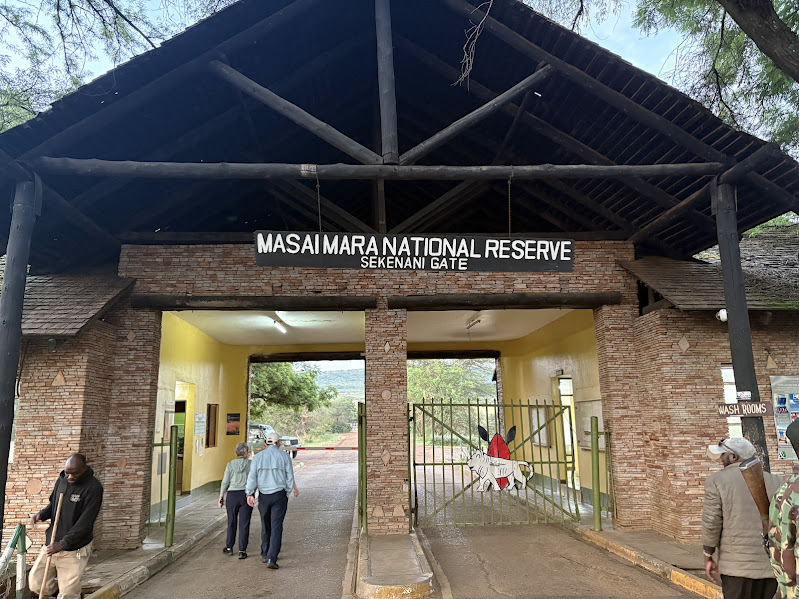
The Masai Mara has six entry gates: Sekenani, Talek, Ololaimutia, Musiara and Sand River on the Narok sector, and Oloololo on the Mara Triangle, plus the internal Purungat (Mara) Bridge fee point between the two sectors. All gates open 06:00 to 18:00.
| Gate | Sector it opens onto | Best for | Hours |
|---|---|---|---|
| Sekenani | Narok sector, south-east; Keekorok road | Road arrivals from Nairobi; camps along the Sekenani road; central plains | 06:00–18:00 |
| Talek | Narok sector, central; Talek River | Talek-town camps and the conservancies to the north; leopard country | 06:00–18:00 |
| Ololaimutia | Narok sector, east | Camps on the eastern boundary; a quieter entry to the same plains | 06:00–18:00 |
| Musiara | Narok sector, north; Musiara Marsh | Northern camps and Mara North / Olare Motorogi arrivals; marsh lions | 06:00–18:00 |
| Sand River | Narok sector, south; Tanzanian border | Rarely used; the border crossing into the Serengeti is closed to tourists | 06:00–18:00 |
| Oloololo | Mara Triangle, north-west, below the escarpment | Triangle camps and Angama / Kichwa Tembo arrivals; cashless payment only | 06:00–18:00 |
Hours as published by Narok County and the Mara Conservancy; the ticket runs 06:00–18:00 whatever time you enter. Which gate to choose is decided by your camp, not the other way round. All six gates compared → Sekenani Gate →
How much does it cost to enter the Masai Mara?
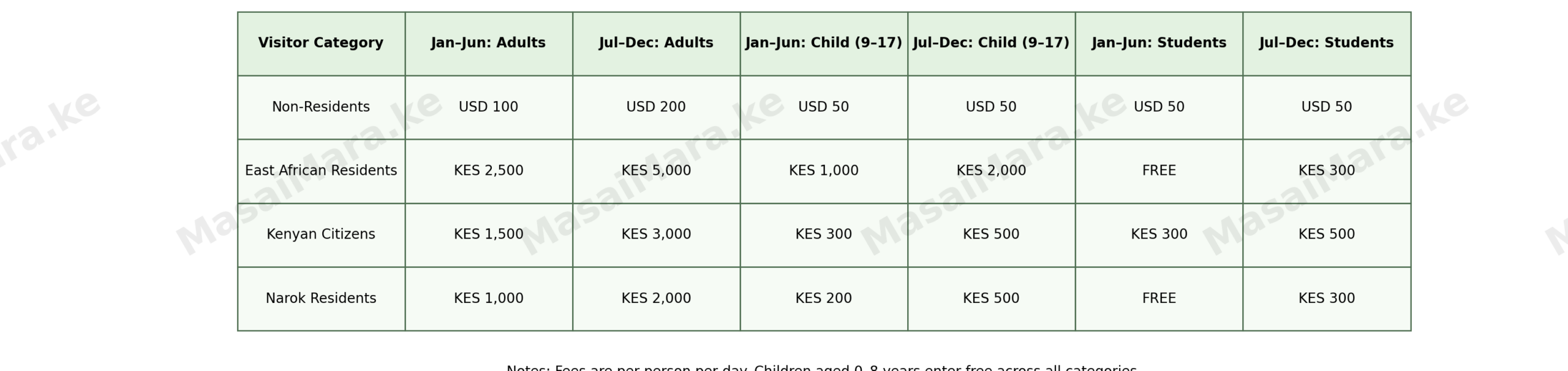
A non-resident adult pays USD 100 per 12 hours from January to June and USD 200 per 12 hours from July to December; a child aged 9–17 pays USD 50 in either season and under-nines enter free. Kenyan citizens pay KES 1,500 / 3,000 and East African residents KES 2,500 / 5,000 by the same seasons. Reserve entry is never included in a camp rate or package price unless it says so in writing.
| Non-resident adult | USD 100 (1 Jan–30 Jun) · USD 200 (1 Jul–31 Dec), per 12 hours |
| Non-resident child 9–17 | USD 50, both seasons; under 9 free |
| Kenyan citizen adult | KES 1,500 (Jan–Jun) · KES 3,000 (Jul–Dec) |
| East African resident adult | KES 2,500 (Jan–Jun) · KES 5,000 (Jul–Dec) |
| Ticket validity | 12 hours, 06:00–18:00, whatever time you enter; a second calendar day is a second ticket |
| Conservancy fees | Separate, per night, set by each conservancy; not covered by the reserve ticket |
Read from the Narok County fee board at Sekenani Gate (photographed 24 January 2025 by contributing guide Alan) and checked against the published 2026 schedule on 5 September 2026. Confirm at the gate; the county can change the schedule with little notice.
Are Masai Mara park fees per day or per 12 hours?
Per 12 hours. Narok County replaced the old 24-hour ticket with a 12-hour ticket in 2024, valid 06:00–18:00 on the day of entry regardless of the time you enter. An early exit does not carry credit to the next day.
Are park fees included in safari packages?
Usually not. Many operators list Masai Mara reserve entry and conservancy fees as excluded and collect them at the gate or through the camp. Always check the inclusions line before comparing two package prices. Masai Mara entry fees, every category → The full cost of a Masai Mara safari →
What are the rules inside the Masai Mara?
- Gate hours — 06:00 to 18:00; no driving in the reserve after dark.
- The 12-hour ticket — introduced in 2024 in place of the old 24-hour ticket.
- Cashless in the Triangle — Oloololo Gate and Purungat Bridge take M-Pesa or card only; Narok-sector gates take cash in USD or KES as well as cashless.
- No private cars on game drives — Narok County’s June 2024 directive limits driving inside the reserve to registered safari vehicles.
- At a sighting — operators publish a five-vehicle limit, a ten-minute stay when five or more are present, and a 25 m minimum distance; fines for off-road driving and harassment are issued at the gate.
- Speed — the Triangle posts 50 km/h; inside the reserve everywhere, slower is what finds animals.
- Drones — need Kenya Civil Aviation Authority and management authorisation, which visitors do not get; the conservancies publish the same prohibition.
- Walking and night drives — not offered inside the reserve; both are conservancy activities. Night game drives →
Does tourism harm wildlife in the Masai Mara?
Vehicle pressure at sightings does: cheetah mothers in high-tourism areas raised 0.21 cubs to independence against 2.32 in low-tourism areas (Broekhuis 2018), and lion density is highest where there are no camps (Mogensen et al. 2025). Fewer visitors overall is not the same thing as fewer vehicles at a cheetah, and the county’s 2024 fee rise changed the first without measuring the second.
What did the cheetah study find?
The finding. In the only Mara study to measure it directly, Femke Broekhuis followed cheetah mothers across the reserve and conservancies and found that females in high-tourism areas raised on average 0.21 cubs to independence, against 2.32 in low-tourism areas, while lion and hyena abundance had no measurable effect (Ecology and Evolution, 2018, 8:6748–6755). The mechanism is vehicle pressure: a mother surrounded at a kill or a den hunts less, moves cubs more, and loses them.
Did the 2024 fee rise reduce pressure on wildlife?
The second figure. The Mara Predator Conservation Programme’s 2024 survey counted 12 independent resident cheetahs across 2,713 km², down from 28 in 2023. At the same time, the Kenya National Bureau of Statistics recorded reserve visitors falling from 420,000 in 2023 to 213,000 in 2025. Divide one by the other and the county’s argument looks strong: half the people, the same cats, a better ratio.
Why it does not follow. Broekhuis measured tourism intensity as vehicles around cheetahs, not gate receipts. The reserve publishes no vehicle counts at sightings and no monthly visitor figures, so nobody can show that halving annual visitors halved the crowd at a cheetah in August, when both the herds and the vehicles concentrate. The one thing that has been measured on the supply side points the other way: Niels Mogensen and colleagues found lion density highest where there are no camps and falling as camp density rises across 2,363 km² of the Mara, with 24 new camps opened between 2016 and 2022 (Conservation Science and Practice, online December 2025, e70210). The fee changed the number of people; it did not change where the vehicles go or how many beds sit next to the cats.
What can a visitor do about it?
What this means for your booking. The variable you control is not the fee you pay but the behaviour of your vehicle: stay in the conservancies or the Low Use zones for cat time, accept the ten-minute limit at a busy sighting, and ask your guide to leave when the animal changes its behaviour. That does more for the 12 remaining cheetahs than the county’s price list does. Conservation in the Masai Mara →
Two numbers that do not match
Sources: Broekhuis 2018 (doi:10.1002/ece3.4180); KNBS Economic Survey 2026 as reported by Business Daily, 6 May 2026; MPCP Q1 2025 Technical Report (survey Aug–Oct 2024). Bar lengths are proportional within each pair.
Wildlife health also connects the reserve to its edges
The spotted hyena (Crocuta crocuta) sits between wild carnivores and domestic animals in the Mara landscape. A peer-reviewed serosurvey of hyenas in the reserve, based on samples collected from 1993 to 2001, found antibodies to canine distemper virus in 47% of the study animals. Low-ranking hyenas were about 2.85 times more likely to carry CDV antibodies than high-ranking animals. These are historical antibody findings, not a current outbreak or a current prevalence estimate; they show why disease ecology, social behaviour and community edges belong in a serious destination guide. Read the spotted hyena guide →
Annual visitor totals and vehicle pressure at individual sightings measure different things. MasaiMara.ke’s conservation coverage distinguishes between them and identifies where published monitoring is still missing. Local observations can add context, but they should not be presented as a reserve-wide count.
— Masai Mara Kenya (MasaiMara.ke)The future of the reserve depends on what happens beyond its boundary
The Masai Mara’s conservation problem is larger than a gate or a single sighting. Long-term monitoring links declining resident wildlife to land-use change around the reserve, while the community-conservancy model tries to keep dispersal areas open by making wildlife compatible with Maasai land ownership and livelihoods.
What pressures the Greater Mara?
Research covering the Mara region since the late 1970s found that populations of almost all wild species had fallen to a third or less of their former abundance by the end of the study period, inside the reserve and on adjoining pastoral land. The finding is historical, not a current census, but it explains why a wildlife-rich reserve can still be ecologically vulnerable.
- Habitat conversion — settlement, fencing and mechanised or small-scale cultivation remove the open dispersal land that animals use seasonally.
- Livestock competition — more sheep, goats and cattle compete with wild herbivores for grass and water, especially through dry periods.
- Climate and water stress — drought and land-use change affect forage, while upstream pressure in the Mau Forest and water abstraction threaten dry-season river flow.
- Tourism concentration — too many vehicles at a kill, den or crossing can change animal behaviour even when annual visitor totals fall.
How does the community-conservancy model work?
Maasai landowners retain the relationship to their land while conservancy agreements set aside habitat and connect it with tourism partners. Lease payments, employment and related community benefits create an economic reason to keep land open; the exact terms vary by conservancy and contract. The Maasai Mara Wildlife Conservancies Association (MMWCA) describes this as a partnership between landowners and tourism partners, with landscape-level coordination.
MMWCA’s current public figures list 24 conservancies and 16,530 landowners; older reports and planning documents use different totals because the network changes and sources count different stages of development. Read the MMWCA’s current conservancy model alongside our conservancy guide.
What the long-term signal tells a visitor
| Signal | Why it matters on safari |
|---|---|
| Resident wildlife has declined since the late 1970s | Migration herds can make a landscape look full while non-migratory species and their habitat remain under pressure. |
| More wildlife uses land outside the reserve | The camp’s location, conservancy choice and corridor protection affect the same animals seen inside the reserve. |
| Vehicle pressure is localised | A lower annual visitor total does not prove that a busy August sighting has become less crowded. |
| Conservancy benefits depend on agreements | Ask how landowner payments, employment and visitor fees are connected instead of treating every conservancy as identical. |
The Masai Mara is recognised as an Important Bird Area and a Key Biodiversity Area, and appears on UNESCO’s World Heritage Tentative List as part of the wider Serengeti–Mara landscape. These designations signal ecological importance; they do not replace Narok County’s management role or guarantee access to every area.
How the reserve is managed → KBA factsheet
What can a visitor do to reduce pressure?
Consider green-season travel or a conservancy stay when it fits your priorities; both can reduce concentration and often cost less.
Stay on tracks, keep the published distance and time limits, and leave when behaviour changes rather than waiting for a photograph.
Ask who receives community and cultural-visit fees, and choose operators that explain their vehicle and conservation practices.
Our low-density safari guide explains the trade-offs between reserve access, conservancy rules, cost, privacy and wildlife pressure.
Where should you stay in the Masai Mara?
Masai Mara accommodation falls into three types: camps and lodges inside the reserve (closest to the crossings, highest vehicle density, reserve fee every day), camps in a conservancy (capped vehicles, night drives and walks, a per-night conservancy fee) and camps outside the gates at Sekenani, Talek and Ololaimutia (most mid-range and budget options, reserve fee only on days you enter). We group the choices by location and management area because access, drive time, crowding and fee structure often affect a safari more than a star rating. Which fits depends on whether you value being first at the crossings, having a cat to yourself, or keeping the total under control.
Camps inside the reserve
The lodges at Keekorok, along the Mara and Talek rivers and on the Triangle side of the escarpment sit on the plains themselves: no gate drive before dawn, the crossings on your doorstep, and the highest vehicle density in the ecosystem in August. Reserve fee applies every day you are inside.
Camps in a conservancy
Mara North, Naboisho, Olare Motorogi and their neighbours cap vehicles per sighting and beds per acre, allow night drives and walking, and charge a conservancy fee per night on top of the camp rate. Reserve entry is paid only on the days you drive into it. Reserve vs the conservancies →
Camps outside the gate
The Sekenani, Talek and Ololaimutia approaches carry most of the mid-range and budget camps. You pay the reserve fee only for the days you enter, drive in through the gate each morning, and keep the largest share of the budget for time in the vehicle. The accommodation guide → compares options by area and access.
Which area of the Masai Mara is best to stay in?
- For the migration and crossings — inside the reserve near the Mara River, or the Mara Triangle.
- For big cats with few vehicles — Mara North, Naboisho or Olare Motorogi conservancies.
- For budget and mid-range — the Sekenani and Talek approaches outside the gates.
- For a first visit by road — the Sekenani side, which is the shortest drive from Nairobi and opens onto the central plains.
Are there budget camps in the Masai Mara?
Yes. Most budget and mid-range tented camps sit just outside Sekenani, Talek and Ololaimutia gates on land, where there is no reserve fee for sleeping and no conservancy fee. Compare camp locations, access arrangements and inclusions before booking.
Two cautions that belong here rather than on a booking page. First, a camp’s address is not its game-drive area: several “Masai Mara” camps are 30–45 minutes of murram from the nearest gate, which is fine on a three-night stay and a waste on a one-night stay. Second, new camps keep opening. The Mogensen study above counted 24 new camps between 2016 and 2022, and the reserve’s management plan explicitly caps new development in the Low Use zones; a camp’s conservation claims are worth checking against where it actually sits. For the full comparison of every accommodation band, read Masai Mara accommodation →

What can you do in the Masai Mara National Reserve?
Inside the reserve the activities are game drives (06:00–18:00) and dawn hot-air balloon safaris. Night game drives, walking safaris, horse riding and Maasai village visits happen on conservancy or private land outside the reserve boundary. The rule that governs an activity is the management unit you are standing in, not the brochure you booked from.
- Game drives — dawn and late-afternoon drives, or a full day with a packed lunch, on established tracks in the High Use zone. Game drives →
- Hot-air balloon — one-hour dawn flights from launch sites inside and beside the reserve, followed by a bush breakfast; a landing fee is charged. Depth on operators and prices lives at BalloonMara.com
- Night game drives — conservancy-only; not permitted in the reserve. Night drives →
- Walking safaris — conservancy-only, with an armed ranger; Naboisho and Mara North are the usual venues.
- Maasai village visits — community-run, with a fee paid at the village; ask who receives it. Maasai village visit →
- Birding — strongest November to April when the Palearctic migrants are in. Bird checklist →
- Horse riding — conservancy-only, through licensed equestrian yards; not permitted in the reserve.
Is the Masai Mara better than the Serengeti?
Neither is better; they are two halves of one ecosystem divided by an international border. The Masai Mara is about one-tenth the size of the Serengeti (~1,510 vs 14,763 km²), is closer to an international airport (5–6 hours by road or under an hour by air from Nairobi), and hosts the herds from July to October; the Serengeti holds them the rest of the year, including calving. Masai Mara vs Serengeti →
Who are the Maasai of the Mara?
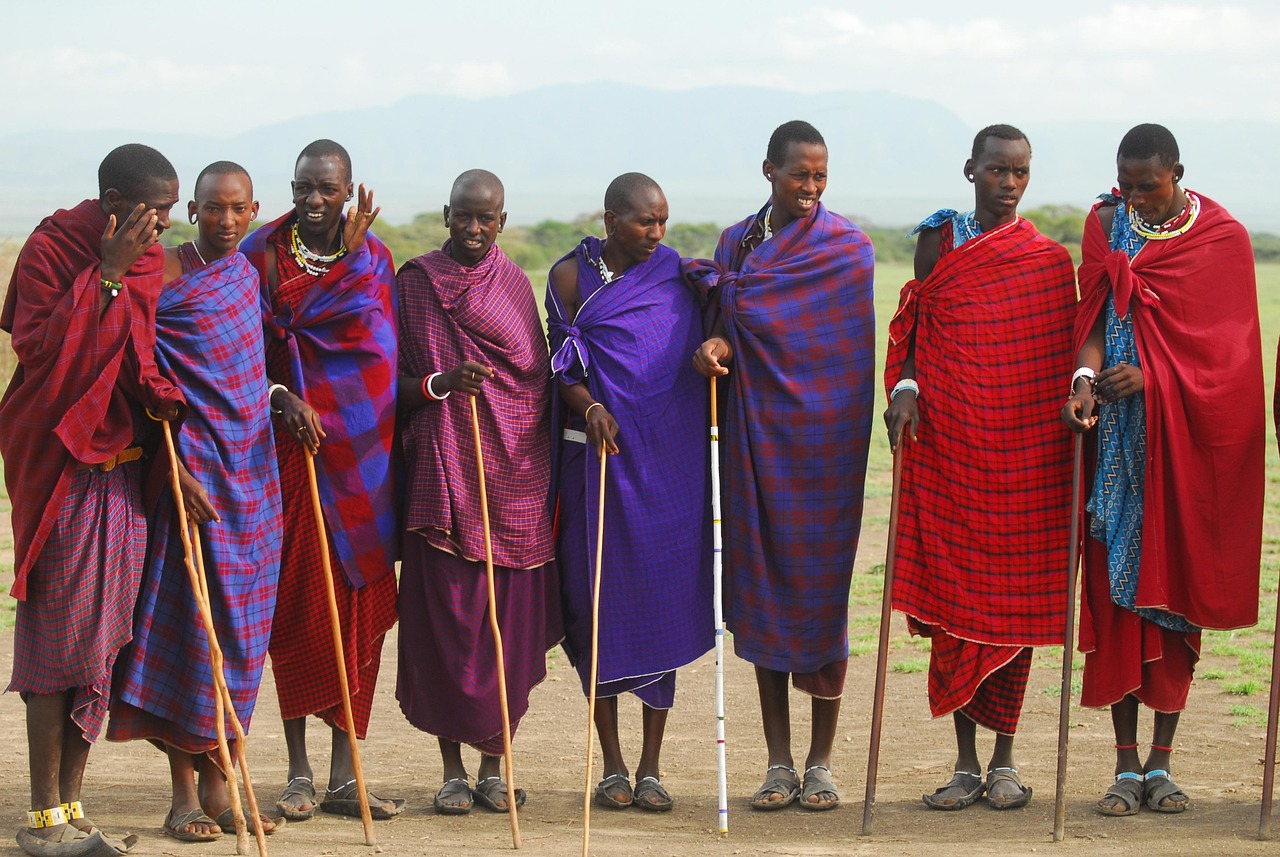
The reserve is named for the Maasai, whose grazing land it was and whose group ranches became the conservancies around it. The land question is not history: conservancy leases pay landowners per acre per month for keeping cattle out of wildlife areas, group-ranch subdivision has fenced parts of the old dispersal areas, and the 2 km buffer zone in the management plan is drawn across private leased land. A visitor who understands that the reserve is one piece of a Maasai landscape reads everything from the fee board to the village visit differently. The Maasai of the Mara →
How many days do you need in the Masai Mara?
Three nights is the honest minimum for a road safari: one day is lost to the drive in each direction, which leaves two full days on the plains. Two nights works if you fly both ways. One night is a drive-through with a fee attached.
What does a Masai Mara safari cost?
A Masai Mara safari price is a stack of four items: reserve entry (USD 100 or 200 per adult per 12 hours), any conservancy fee per night, accommodation, and vehicle, guide and fuel (shared or private). Packages usually quote the last two and exclude the first two, which is why two “from” prices are rarely comparable. Package comparisons by party size and season are on the packages page; the itemised stack is on the cost page.
Is the Masai Mara safe to visit?
Yes, with the ordinary safari rules. Stay in the vehicle except at designated points, keep to gate hours, follow your guide at camp after dark, and treat the Narok road as the main risk of the trip rather than the animals. Health and entry formalities (the Kenya eTA, malaria precautions, tipping) are covered in the preparation guide. Is the Masai Mara safe? →
How should you structure the days?
A practical road-safari structure is to arrive in the afternoon, keep the middle days for game viewing and allow sufficient time for the return journey. Compare the Masai Mara safari packages → by travel mode, nights in the Mara, game-drive time and stated inclusions. Confirm reserve and conservancy fees separately with the provider; a quoted package price is not necessarily the full trip cost.
What no page on this site will promise: a river crossing, a leopard, a rhino, a fixed drive time on the C12, or a quiet sighting in August. What it will tell you is what the last season looked like from the Sekenani side, which gate the road conditions favour this month, and what the board at the gate says today. Before you fly, the pre-departure list covers the eTA, health, kit and tipping in one place. Preparing for a Masai Mara safari →
Masai Mara safari packages
Three- and four-day road safaris and two-night fly-ins, priced by party size and season, fees excluded and shown.
See the packages →Kambu Mara Camp
A tented camp on the Sekenani side of the reserve. Read the accommodation profile for its location and facilities.
The camp →Which Masai Mara safari format fits your trip?
Fly-in safari
2–3 days: save road time and put more of the trip into game viewing; useful for short holidays and honeymoons.
Compare fly-in options →Road safari
3–5 days: take the classic Nairobi–Narok route and use the journey to connect the Rift Valley with the Mara.
Compare road safaris →Combined circuit
4–6 days: pair the Mara with Lake Nakuru, Lake Naivasha or Amboseli when a wider Kenya itinerary matters.
See combined circuits →Conservancy stay
Choose capped vehicle numbers, night drives and walking safaris when privacy and community-land conservation are priorities.
Reserve versus conservancies →Custom safari
Tell us your dates, interests, party size and preferred vehicle; we can build the route around migration, cats, birds or time.
Request a recommendation →Prepare for cool mornings, changing tracks and a shared landscape
A Masai Mara safari is easier when the practical details are settled before you reach the gate. Pack for an open vehicle, confirm which management area your camp uses, and understand the visitor code that protects both wildlife and the people whose land surrounds the reserve.
What should you pack for the Masai Mara?
- Warm layers — dawn drives can feel like 12–15 °C in an open vehicle; add a fleece or light jacket.
- Sun and rain protection — a wide-brimmed hat, sunglasses, sunscreen and a light rain jacket, especially for March–May and November.
- Field essentials — closed shoes, insect repellent, binoculars, camera, spare batteries or cards, refillable water bottle and power bank.
- Documents and small health kit — passport copy, Kenya eTA or entry documents, personal medicines and a compact first-aid kit.
For current entry preparation, health advice, malaria precautions, insurance and tipping, use the Masai Mara safari preparation guide. Requirements and fees can change, so re-check them close to departure.
Masai Mara National Reserve: frequently asked questions
Is the Masai Mara a national park or a national reserve?
It is a national reserve. The land is held by Narok County on behalf of its residents and managed by the county government, with the Mara Triangle sector run under contract by the Mara Conservancy. Kenya’s national parks, by contrast, are state land managed by the Kenya Wildlife Service. The name “Masai Mara National Park” is common online and has never been correct.
Where is the Masai Mara National Reserve located?
In Narok County, south-western Kenya, on the border with Tanzania, about 230 km west of Nairobi by road. Its southern boundary meets the Serengeti National Park; the Oloololo Escarpment forms its western edge and the Loita Hills lie to the east. The centre of the reserve is near 1°29′S, 35°08′E.
How big is the Masai Mara National Reserve?
About 1,510 km² in most references, including UNESCO’s Tentative List entry; the 2023–2032 Management Plan gives 1,530 km². The Mara Triangle west of the river is variously published as 488, 510 or 520 km². The surrounding community conservancies add a large further area of wildlife land outside the reserve boundary; published totals for that ring differ by source.
How much is the Masai Mara entry fee in 2026?
For non-resident adults, USD 100 per 12 hours from January to June and USD 200 per 12 hours from July to December; children aged 9–17 pay USD 50 and under-nines are free. Kenyan citizens pay KES 1,500 or 3,000 and East African residents KES 2,500 or 5,000 by the same seasons. Conservancy fees are separate. Fees are set by Narok County and should be confirmed at the gate.
When is the wildebeest migration in the Masai Mara?
Typically from late June or July to October, with river crossings most likely in August and September. The herds then move back south into Tanzania, where calving takes place in the southern Serengeti in January and February. Calving does not happen in the Masai Mara.
Can you see the Big Five in the Masai Mara?
Lion, elephant and buffalo are seen on most stays and leopard on a good share of them. Black rhino are present but few and rarely seen, and there are no wild white rhino in the reserve, so the Big Five cannot be guaranteed on any length of stay.
Which gate should I use to enter the Masai Mara?
The gate is decided by where you are staying. Road arrivals from Nairobi for camps along the Sekenani road use Sekenani Gate; Talek-area camps use Talek Gate; northern camps and Mara North or Olare Motorogi arrivals use Musiara Gate; the Mara Triangle is entered at Oloololo Gate or across Purungat Bridge. All gates open 06:00 to 18:00.
Can I drive my own car in the Masai Mara?
Not for game drives. Since June 2024 Narok County has restricted driving inside the reserve to registered safari vehicles such as Land Cruisers, safari vans and safari trucks. You can still arrive by private car and switch to a safari vehicle at your camp or the gate.
How do I get from Nairobi to the Masai Mara?
By road: Nairobi to Narok on tarmac, then the C12 to Sekenani Gate, about 230 km and five to six hours in total. By air: scheduled flights from Wilson Airport take roughly 45 minutes to an hour to airstrips such as Keekorok, Ol Kiombo, Musiara, Mara Serena or Siana, with a camp vehicle meeting you on landing.
What is the difference between the Masai Mara reserve and the conservancies?
The reserve is county land with a per-12-hour entry fee, no walking or night drives, and open access to all licensed safari vehicles. The conservancies are private Maasai land leased from landowners, with a per-night conservancy fee, capped vehicle and bed numbers, and night drives and walks permitted. Many safaris combine both.
Plan your visit with the Masai Mara guide
Compare road and fly-in options, reserve and conservancy stays, and the full cost of entry, accommodation, vehicle and guide. Write to Bookings@MasaiMara.ke, WhatsApp +254 769 103 670, or explore the safari packages below.
Compare safari options and their published inclusions below. ↓
Find the safari that fits your plans
Compare travel options, time in the Mara and package inclusions before making an enquiry.
Which Masai Mara guide do you need next?
Masai Mara entry fees
Every residency category and season, read from the board at the gate.
Read →Best time to visit
Twelve month verdicts across herds, cats, crowds and cost.
Read →All six gates compared
Which gate serves which camp, and what the queues look like.
Read →The wildebeest migration
Arrival, crossings and departure, month by month, with the calving correction.
Read →Reserve vs the conservancies
Rules, fees, crowds and night drives compared side by side.
Read →Masai Mara safari packages
Road and fly-in packages by party size and season, fees itemised.
Read →