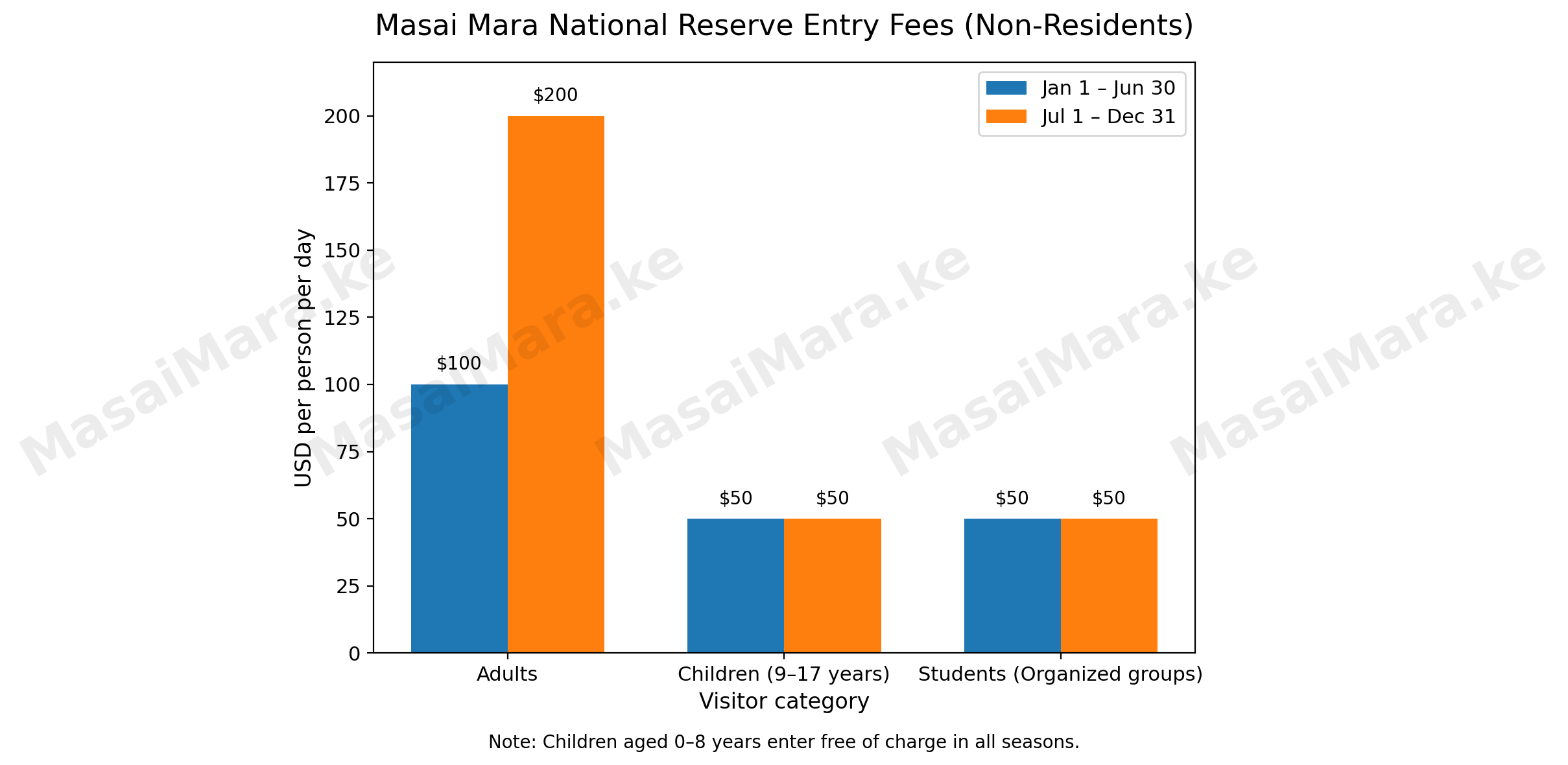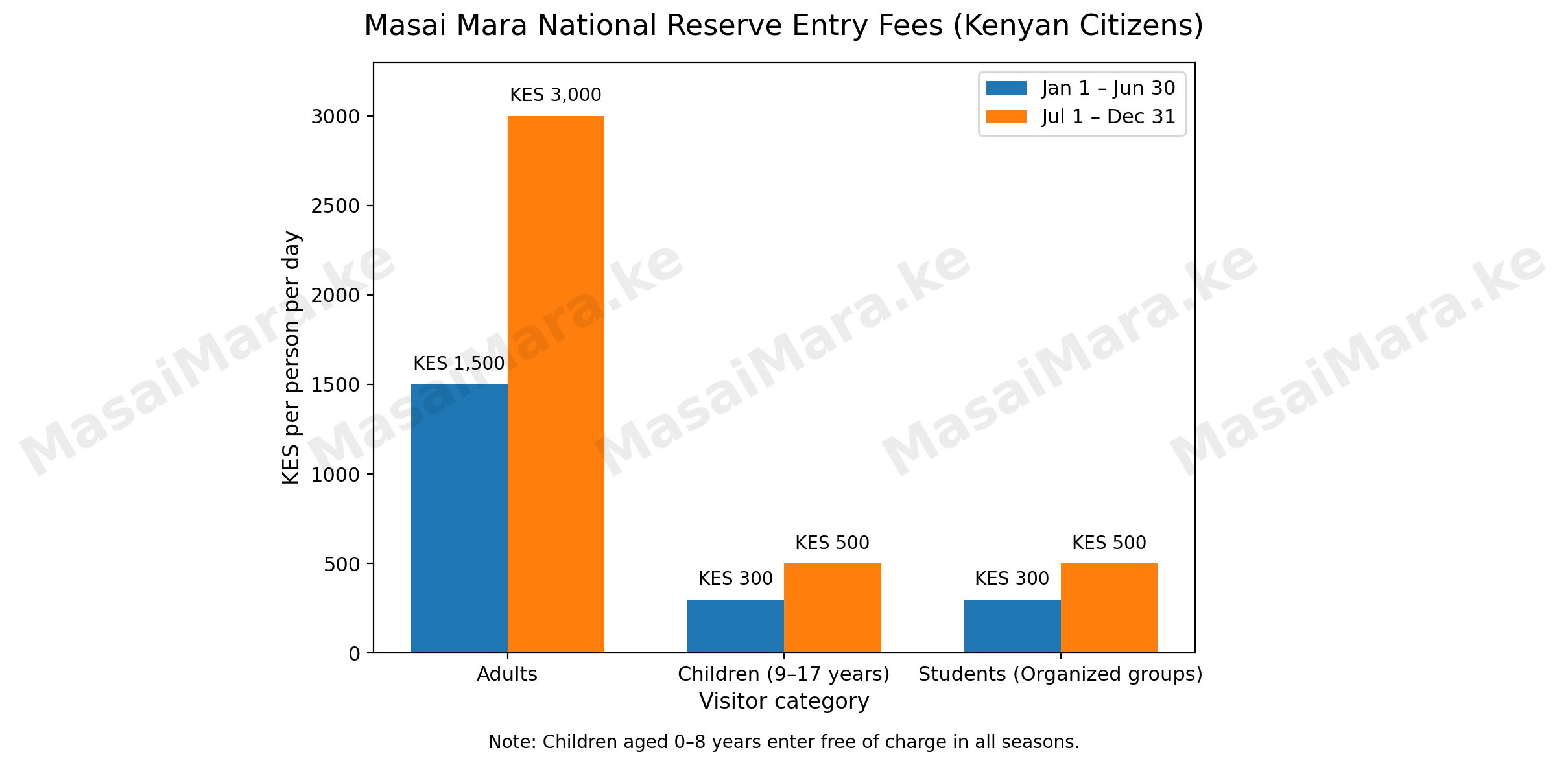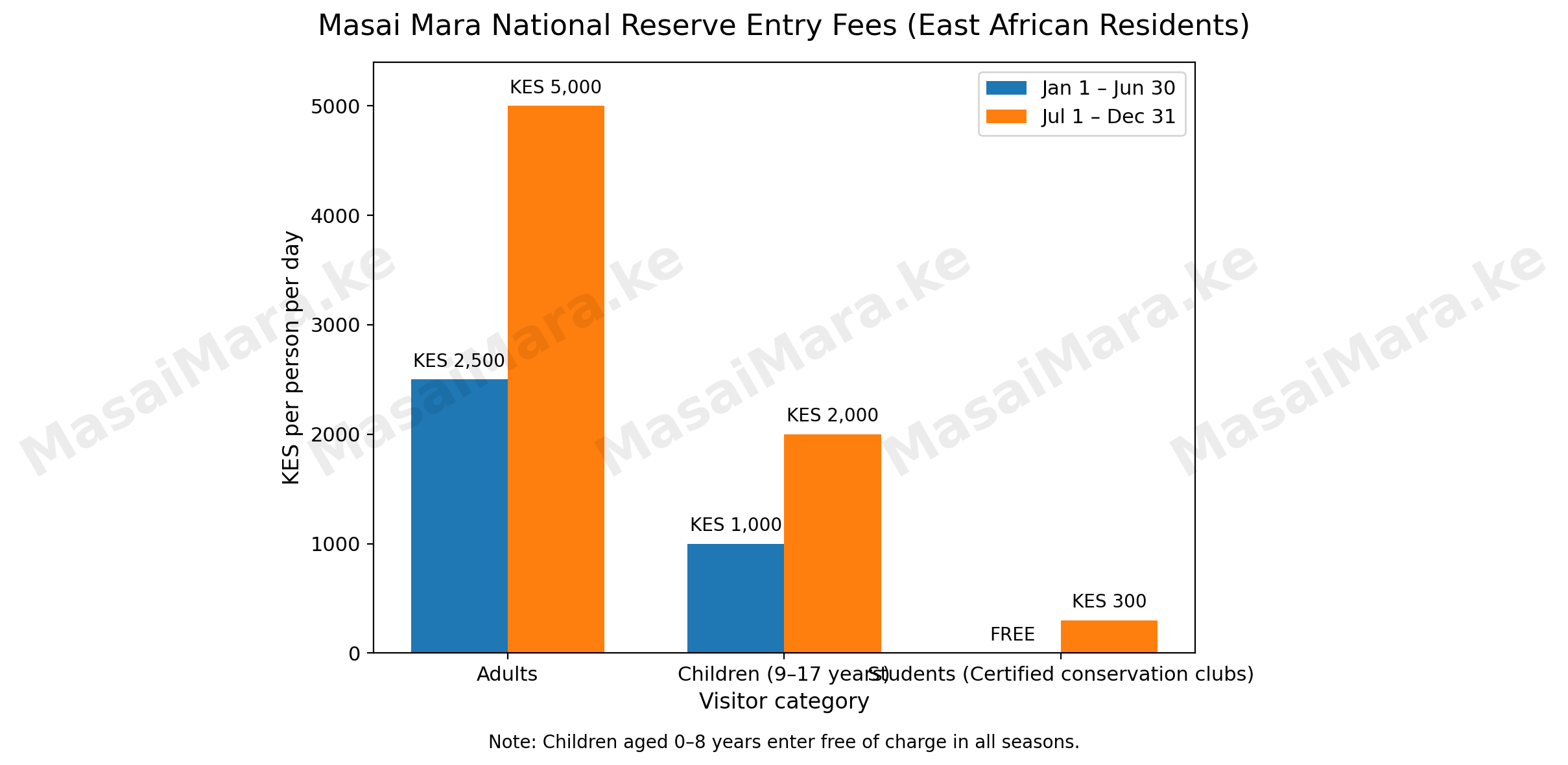
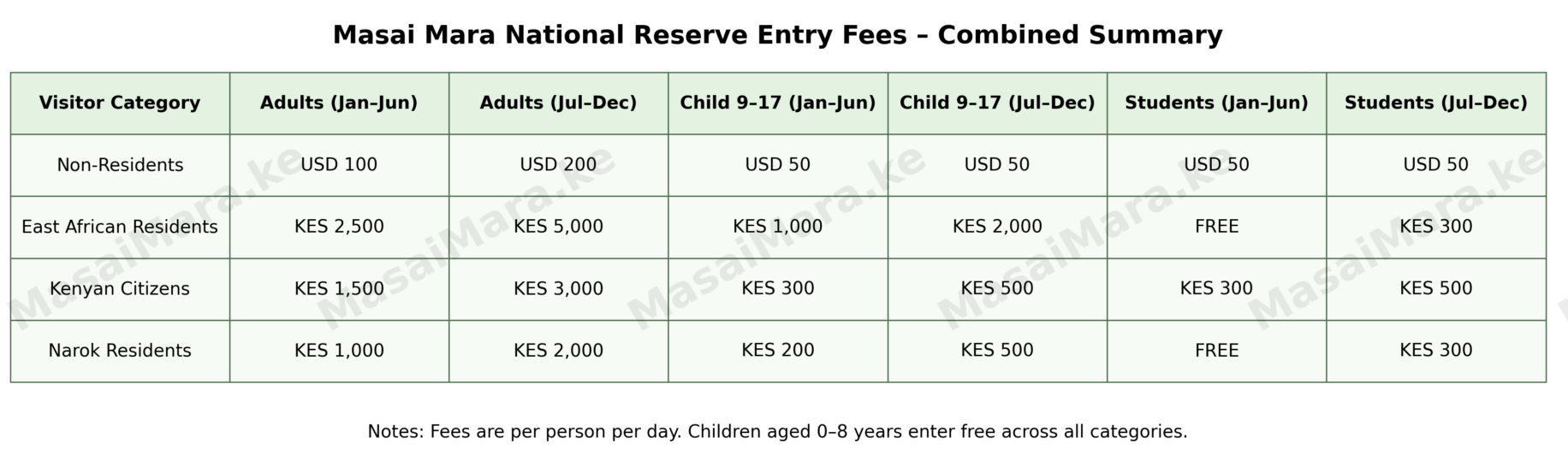
The current applicable Masai Mara park entry costs depend on the visitor category, age, and season. As of 2026, non-resident adults pay USD 100 from January to June and USD 200 from July to December, while non-resident children aged 9–17 and eligible students pay USD 50 year-round. *East African resident adults pay KES 2,500 in January–June and KES 5,000 in July–December, while Kenyan citizen adults pay KES 1,500 in January–June and KES 3,000 in July–December. Children aged 0–8 years enter free, and child or student rates apply to visitors aged 9–17 where eligible.
If you’re planning a visit in 2026, it’s important to be aware of significant changes to the entrance fees and how they might affect your trip. This guide provides a comprehensive overview of the new fees, comparisons with previous years, potential impacts, and tips for making the most of your safari experience.
If you’re still in the planning stage and would like to begin organizing your Masai Mara safari, we recommend starting with our comprehensive Masai Mara National Reserve guide for an in-depth overview. You can also explore our Masai Mara Safari Packages — available by flight or by road — to review itinerary options and begin shaping your trip.
Let’s proceed with this guide on entry ticket fees you can expect to pay today for a safari/game drive in Masai Mara NR:
Overview of Masai Mara Entry Fees 2026 (Apply to Sekenani, Talek, Oloolaimutia, Musiara, Purungat Gates)
| Visitor Category | Adult (Jan–Jun) | Adult(Jul–Dec) | Child 9–17 (Jan–Jun) | Child 9–17 (Jul–Dec) | Student (Jan–Jun) | Student (Jul–Dec) |
|---|---|---|---|---|---|---|
| Non-Residents | USD 100 | USD 200 | USD 50 | USD 50 | USD 50 | USD 50 |
| East African Residents | KES 2,500 | KES 5,000 | KES 1,000 | KES 2,000 | *KES 300 | KES 300 |
| Kenyan Citizens | KES 1,500 | KES 3,000 | KES 300 | KES 500 | *KES 300 | KES 500 |
Note: Children aged 0–8 years enter free across all categories.
*Student rates: Read More>
Student rates apply only to eligible students aged up to 17 years who are sponsored by a recognized learning institution and visiting on a pre-arranged school trip, club visit, educational field trip, or approved research/data-collection activity. Students must be wearing uniform and using institution bus/vehicle (Bus Load).
During the January–June low season, organized student groups aged 0–17 years may qualify for free entry, but only with prior approval from the Narok County Department of Tourism or the Chief Clerk at Sekenani Main Gate. Approval should be requested at least two weeks before the visit; otherwise, normal child or visitor-category rates may apply.
Starting July 1, 2024, the Masai Mara National Reserve implemented a new fee structure that significantly increases the cost of entry for non-resident visitors.
The Masai Mara entry fees are designed with a tiered structure, catering to Kenyan citizens, East African residents, and non-residents, each with substantially different pricing levels. Kenyan citizens benefit from the lowest rates, with fees as low as KSH 1,500 off-peak for adults, while East African residents pay 67% more at KSH 2,500.
Non-residents, however, face dramatically higher fees, paying USD 100-200, which equates to a 900% to 1,000% increase compared to Kenyans. For children, the disparities are even greater, with non-residents paying 700% to 1,100% more than their Kenyan counterparts.
The fees also escalate during the peak season from July to December, further widening the gap. This pricing strategy ensures that the reserve remains affordable for local communities, while foreign tourists contribute significantly more to the park’s revenue and conservation efforts, reflecting both economic realities and the global importance of the Masai Mara.
Masai Mara Entry Fees for Non-Residents 2026
Non-resident visitors pay Masai Mara entry fees in US dollars, with a major seasonal difference for adults. The lower rate applies from 1 January to 30 June, while the higher peak-season rate applies from 1 July to 31 December. Children aged 0–8 years enter free, while children aged 9–17 years pay a fixed child rate throughout the year:
| Non-Resident Visitor Category | Unit | Jan 1 – Jun 30 | Jul 1 – Dec 31 |
|---|---|---|---|
| Adult | Per person | USD 100 | USD 200 |
| Child, 0–8 years | Per person | Free | Free |
| Child, 9–17 years | Per person | USD 50 | USD 50 |
| Student, organized group | Per person | USD 50 | USD 50 |
Visitor note: Non-resident adult fees are the most expensive visitor category in the Masai Mara. Travellers should budget carefully if visiting in peak season, especially from July to October during the migration period.

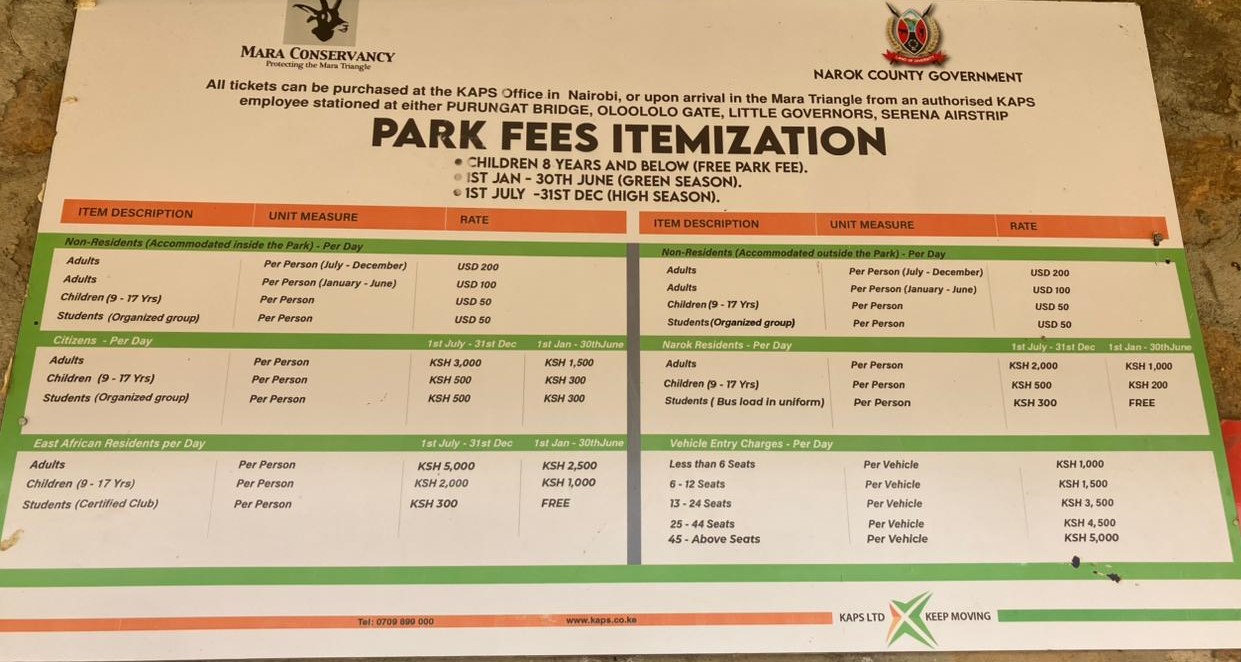
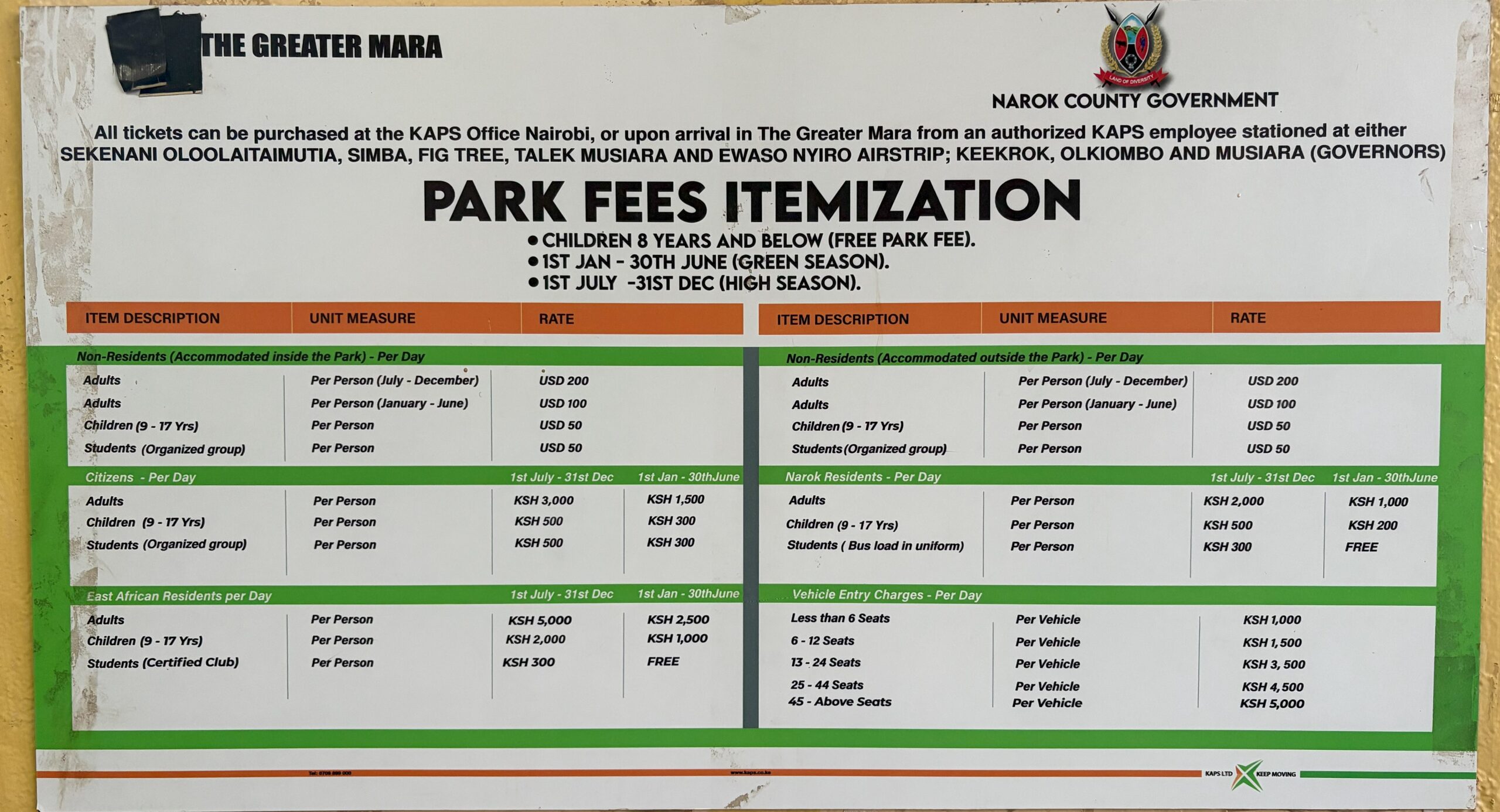
Below is a print-out of the updated entrance fees to Masai Mara National Reserve posted at Sekenani gate next to the ticketing window;
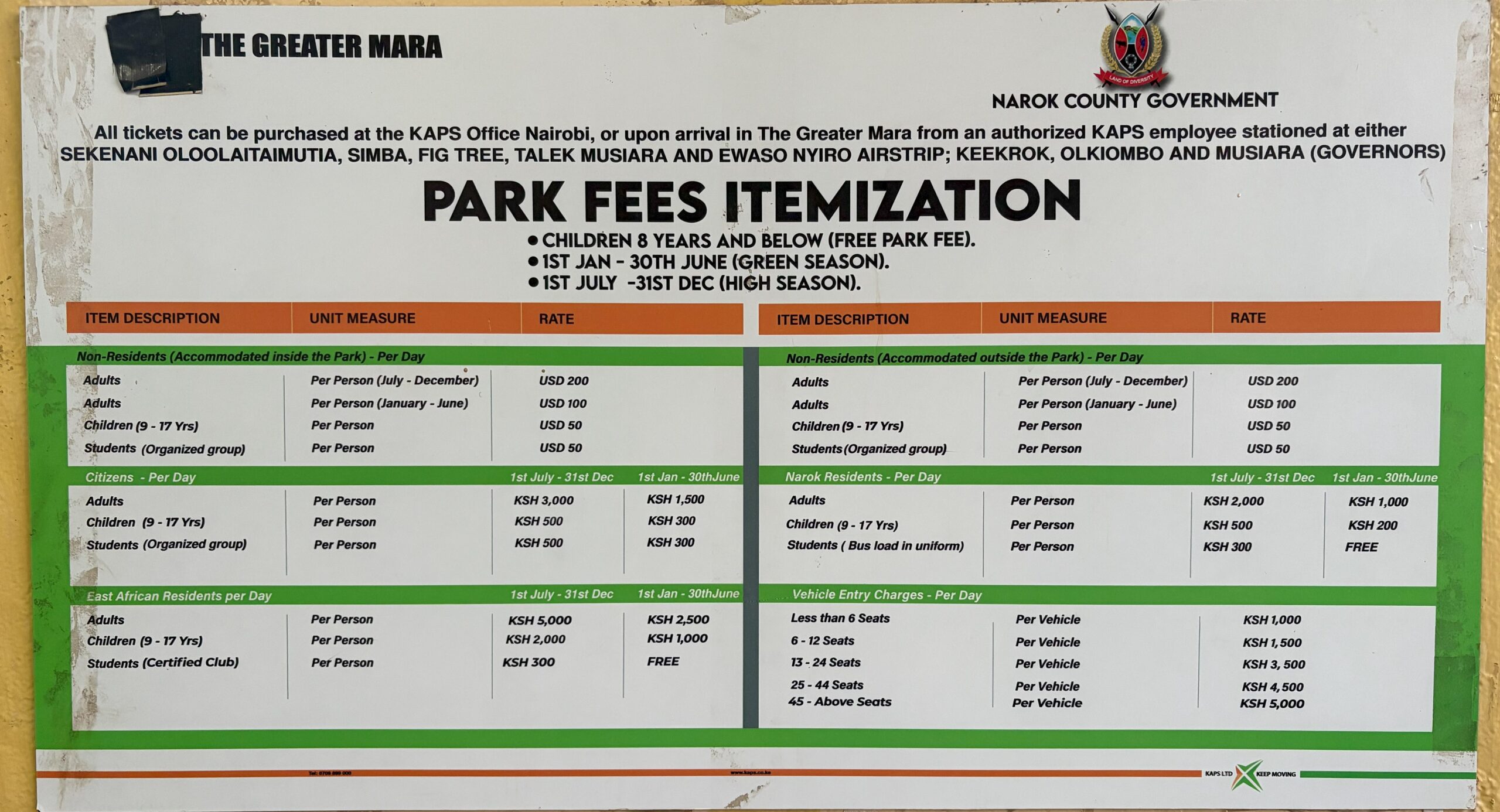
Here’s the updated table with 2025-2026 entry fees for non-residents with percentage increase for 12 and 24-hour period, comparing the 2023 and 2024 fees:
| Category | 2023 Fee (USD) (24 hrs) | 2025 & 2026 Fee (USD) (12 hrs) | Percentage Increase (12 hrs) | 2025 & 2026 Fee (USD) (24 hrs) | Percentage Increase (24 hrs) |
|---|---|---|---|---|---|
| Adult | $80 (24 hrs) | $200 (12 hrs) | 150% | $400 (24 hrs) | 400% |
| Child (ages 9-17) | $45 (24 hrs) | $50 (12 hrs) | 11.11% | $100 (24 hrs) | 122.22% |
| Child (under 9 years) | Free | Free | No Change | Free | No Change |
Explanation and Analysis:
- The entrance fees for non-resident adults in 2023 were $80 for a 24-hour period. In 2024, the fee is $200 for a 12-hour period, which translates to $400 for 24 hours, representing a 400% increase for a full-day ticket.
- For children aged 9-17, the price increased from $45 for 24 hours in 2023 to $50 for 12 hours in 2024. For a 24-hour period in 2024, the fee would be $100, reflecting a 122.22% increase.
- Validity Period: Note that the ticket validity has been reduced from 24 hours to 12 hours.
- Peak Seasons: The higher fees are particularly applicable during the peak migration season from July 1 to December 31, 2024.
Non-residents pay substantially more than Kenyan citizens for Masai Mara entry. Adults are charged USD 100-200, compared to KSH 1,500-3,000 for Kenyans, a 900% to 1,000% increase. For children, non-residents pay USD 50, while Kenyan children pay KSH 300-500, a 700% to 1,100% difference. This highlights the significant cost disparity favoring Kenyan citizens.
Tip for budget safari in the Mara to make up for high ticket prices
One effective way to keep your Masai Mara safari budget-friendly—especially with rising park entry fees—is by choosing more affordable accommodation like Kambu Mara Camp. This highly rated camp (9.6/10 on Booking.com) offers excellent value and flexibility, including a self-catering option for guests who want to save even more on meal costs.
Masai Mara Entry Fees for Kenyan Citizens 2026
How much do Kenyan citizens pay to enter Masai Mara?
As of 2026, Kenyan citizens pay KES 1,500 per adult per day from January to June 2026 and KES 3,000 per adult per day from July to December 2026 to enter the Masai Mara National Reserve or Mara Triangle. Kenyan citizen children aged 9–17 years pay KES 300 until June and KES 500 from July. Children aged 8 years and below enter free.
| Kenyan Citizen Visitor Category | Unit | Jan 1 – Jun 30 | Jul 1 – Dec 31 |
|---|---|---|---|
| Adult | Per person | KSH 1,500 | KSH 3,000 |
| Child, 0–8 years | Per person | Free | Free |
| Child, 9–17 years | Per person | KSH 300 | KSH 500 |
| Student, organized group | Per person | KSH 300 | KSH 500 |
Kenyan citizens pay Masai Mara entry fees in Kenya shillings and receive the lowest national-rate pricing outside Narok resident rates.
Visitor note: Kenyan citizens should carry a valid national ID or Kenyan passport. Children may be asked for age proof, especially where child or free-entry categories apply.

Kenyan citizens are required to carry identification to access the cheaper Kenyan citizen rate. A valid Kenyan national ID is the standard document used to prove citizen status at the reserve gate.
How much do Kenyan children pay to enter Masai Mara?
Kenyan citizen children aged 9–17 years pay KES 300 per day from January to June 2026 and KES 500 per day from July to December 2026. Children aged 8 years and below enter the Masai Mara free.
| Kenyan Child Category | Jan–Jun 2026 | Jul–Dec 2026 |
|---|---|---|
| Child, 9–17 years | KES 300 | KES 500 |
| Child, 8 years and below | Free | Free |
Families should carry proof of age where needed, especially for children close to the age boundary. You pay for your child when you go to the Reserve for your game drive. You’ll just be asked to share your child’s details such as full names and way to verify their age.
Masai Mara Entry Fees for East African Residents 2026
East African residents pay in Kenya shillings, but at higher rates than Kenyan citizens. The resident adult rate is KSH 2,500 from January to June and KSH 5,000 from July to December. Children aged 9–17 years pay KSH 1,000 in low season and KSH 2,000 in high season.
| East African Resident Visitor Category | Unit | Jan 1 – Jun 30 | Jul 1 – Dec 31 |
|---|---|---|---|
| Adult | Per person | KSH 2,500 | KSH 5,000 |
| Child, 0–8 years | Per person | Free | Free |
| Child, 9–17 years | Per person | KSH 1,000 | KSH 2,000 |
| Student / certified conservation club | Per person | Free | KSH 300 |
Who Qualifies for the Resident Rates? Read More>
To qualify for the resident rate, visitors must provide valid proof that they reside in Kenya, Uganda, Tanzania, Rwanda, or Burundi. You do not need to be a citizen of these East African countries, but you must be legally resident there. At the gate, you should present a passport showing a valid work permit, residence permit, or appropriate visa. Visitors who cannot verify their residency may be charged the non-resident rate.
If your residency paperwork is still pending and you are unsure whether you qualify, please email us at Bookings@MasaiMara.ke and we can check with the gate clerks in advance
East African residents pay 67% more than Kenyan citizens for Masai Mara entry. Adults are charged KSH 2,500 off-peak and KSH 5,000 peak, compared to KSH 1,500 and KSH 3,000 for Kenyans. For children (9-17 years), East Africans pay KSH 1,000 off-peak and KSH 2,000 peak, while Kenyans pay KSH 300 and KSH 500, a 233% to 300% increase for East African residents. This highlights a significant cost difference favoring Kenyan citizens.
A visitor claiming the Kenya resident or East African resident rate should carry a passport showing a valid work permit or appropriate visa. The fee guidance says residents of Kenya, Uganda, Tanzania, Rwanda, and Burundi must present proof of residence at the reserve entrance, while visitors without valid proof must pay non-resident rates.
Useful documents include:
- Passport
- Valid work permit
- Valid resident permit
- Appropriate visa or residence document
- Matching ticket or payment confirmation
The name and document details should match the ticket category selected.
A foreigner living in Kenya may pay the resident rate if they can prove valid residence status. The fee guidance states that residents should present a passport displaying a work permit or appropriate visa to prove resident status upon entry into the reserve. Visitors without valid proof are required to pay non-resident rates.
The 2026 East African resident adult rate is KES 2,500 until June and KES 5,000 from July.
How much do Kenyan children pay to enter Masai Mara?
Kenyan citizen children aged 9–17 years pay KES 300 per day from January to June 2026 and KES 500 per day from July to December 2026. Children aged 8 years and below enter the Masai Mara free.
Families should carry proof of age where needed, especially for children close to the age boundary.

What is the difference between citizen and resident rates?
The citizen rate applies to Kenyan citizens, while the resident rate applies to qualifying residents of Kenya, Uganda, Tanzania, Rwanda, and Burundi. Kenyan citizens pay KES 1,500 until June and KES 3,000 from July, while East African residents pay KES 2,500 until June and KES 5,000 from July.
| Category | Adult Jan–Jun 2026 | Adult Jul–Dec 2026 |
|---|---|---|
| Kenyan citizen | KES 1,500 | KES 3,000 |
| East African resident | KES 2,500 | KES 5,000 |
Masai Mara Entry Fees for Narok Residents 2026
Narok residents receive the most locally discounted Masai Mara entry rates because the Reserve is located in Narok County and directly affects surrounding communities. Adults pay KSH 1,000 from January to June and KSH 2,000 from July to December.
| Narok Resident Visitor Category | Unit | Jan 1 – Jun 30 | Jul 1 – Dec 31 |
|---|---|---|---|
| Adult | Per person | KSH 1,000 | KSH 2,000 |
| Child, 0–8 years | Per person | Free | Free |
| Child, 9–17 years | Per person | KSH 200 | KSH 500 |
| Student, organized group / bus in uniform | Per person | Free | KSH 300 |
Visitor note: Narok resident rates usually require proof of local residence. Visitors should carry identification and any supporting local-residence documentation requested at the gate.

Narok County residents benefit from substantially lower entry fees to the Masai Mara compared to other Kenyan citizens, with notable percentage differences. Adults from Narok pay 33% less in the off-peak season (KSH 1,000 vs. KSH 1,500) and 50% less during the peak season (KSH 2,000 vs. KSH 3,000).
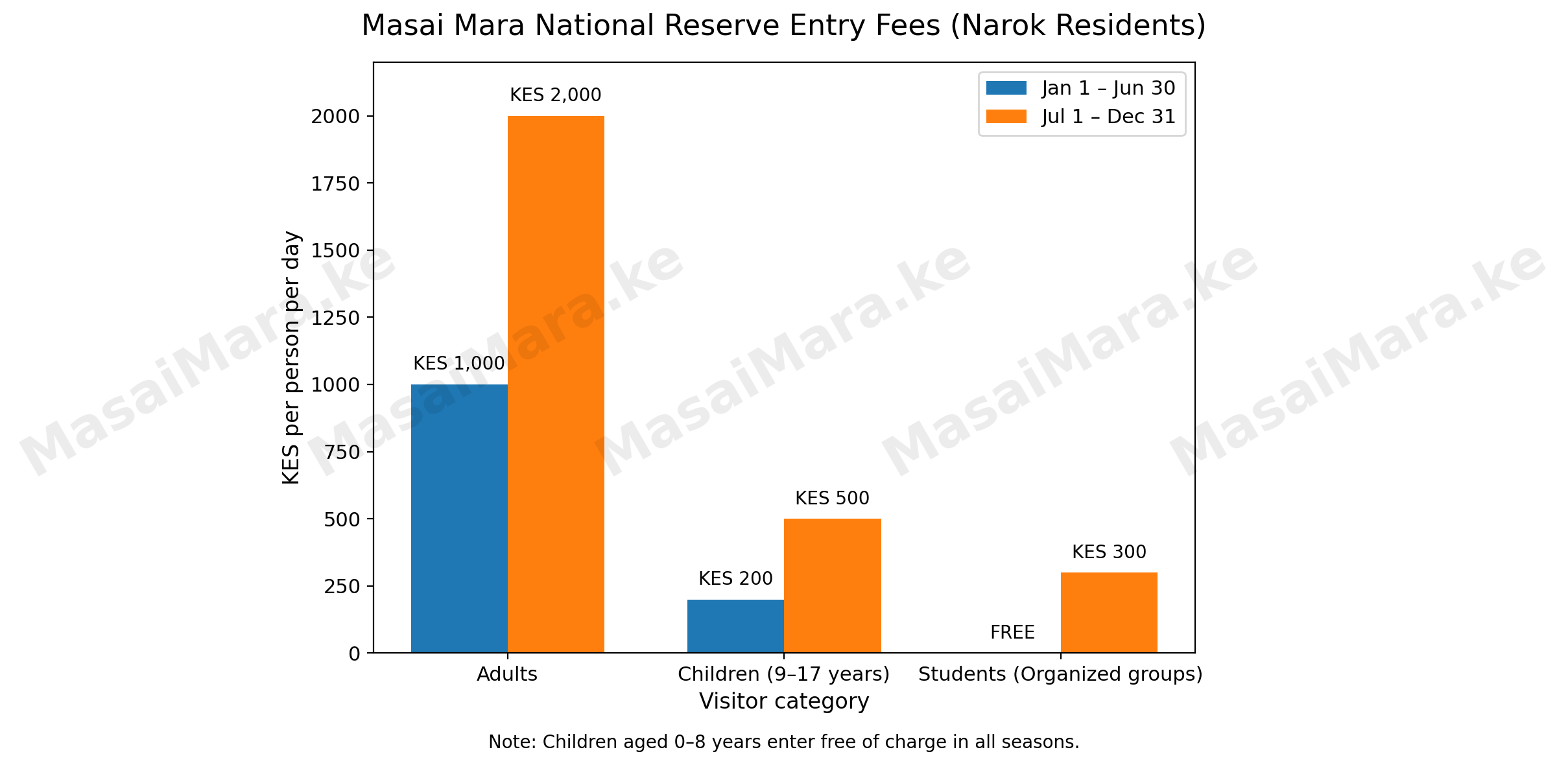
For children (9-17 years), the off-peak fee is 33% lower for Narok residents (KSH 200 vs. KSH 300), while the peak season fee remains the same at KSH 500 for both. These significant discounts highlight the economic consideration given to Narok residents, recognizing their direct connection and proximity to the Masai Mara.
How much do children pay to enter Masai Mara?
Children aged 9 to 17 years pay a reduced Masai Mara entry fee. In 2026, non-resident children pay USD 50 per day throughout the year. East African resident children pay KES 1,000 from January to June and KES 2,000 from July to December. Kenyan citizen children pay KES 300 from January to June and KES 500 from July to December. Children aged 8 years and below enter free.
| Child Category | Jan–Jun 2026 | Jul–Dec 2026 |
|---|---|---|
| Non-resident child, 9–17 years | USD 50 | USD 50 |
| East African resident child, 9–17 years | KES 1,000 | KES 2,000 |
| Kenyan citizen child, 9–17 years | KES 300 | KES 500 |
| Child, 8 years and below | Free | Free |
2026 Camping Fees at Masai Mara and Mara Triangle
Below is a table showing for current camping rates for Masai Mara National Reserve and the Mara Triangle
Camping Fee (Per Person / Per Day)
| Camping Fee | Kenyan Citizen | East African Citizen / Residents | Non-Residents |
|---|---|---|---|
| Adults | KSH 1,000 | KSH 2,000 | USD 40 |
| Child (9-17 Yrs) | KSH 200 | KSH 1,000 | USD 20 |
| Students | KSH 200 | KSH 1,000 | USD 20 |
When comparing the rates for Kenyan citizens and East African residents for Masai Mara entry and activities, there are notable differences in costs. For camping fees, East African residents pay 100% more than Kenyan citizens, with adults charged KSH 2,000 compared to KSH 1,000 for Kenyan citizens.
For children (9-17 years), East African residents pay KSH 1,000, which is 400% higher than the KSH 200 fee for Kenyan citizens. These differences reflect the preferential pricing structure for Kenyan citizens, offering them significantly reduced rates while East African residents, though receiving discounts compared to non-residents, face much higher fees in percentage terms across most categories.
Campsite Booking Fee
| Campsite | Booking Fee (Non-Refundable) | Maximum Stay | Cancellation |
|---|---|---|---|
| Public Campsites | |||
| Oloololo, Iseiya, Eluai | FREE | NONE | NONE |
| Private Campsites | |||
| Dirisha, Enkishui, Kiboko, Hornbill, Ndovu, Olarro, Ratpanat | |||
| Professional | KSH 50,000 | 14 DAYS | USD 1,000 |
| Non-Professional | KSH 15,000 | 7 DAYS | USD 1,000 |
| Special Private Campsites | |||
| Kampi Ya Mungu, Kishangaa, Kijito | USD 1,000 / Day | NONE | USD 1,000 |
Mara Triangle Conservancy Entrance Fees (Purungat, Serena Airstrip & Oloololo Gates)
he Mara Triangle entry fees for 2026 are USD 100 per non-resident adult from January to June and USD 200 from July to December. Non-resident children aged 9–17 pay USD 50. East African resident adults pay KES 2,500 until June and KES 5,000 from July, while Kenyan citizen adults pay KES 1,500 until June and KES 3,000 from July.
| Mara Triangle Visitor Category | Jan–Jun 2026 | Jul–Dec 2026 |
|---|---|---|
| Non-resident adult | USD 100 | USD 200 |
| Non-resident child, 9–17 | USD 50 | USD 50 |
| East African resident adult | KES 2,500 | KES 5,000 |
| East African resident child | KES 1,000 | KES 2,000 |
| Kenyan citizen adult | KES 1,500 | KES 3,000 |
| Kenyan citizen child | KES 300 | KES 500 |
Mara Triangle entry is through Purungat Bridge Gate, Oloololo Gate, or Serena Airstrip, and payment is cashless only by Visa, Mastercard, or M-Pesa.

Non-Residents:
For non-residents, the fees differ depending on whether they are accommodated inside or outside the park. During the high season (1st July – 31st December), the fee for adults is USD 200 per day, while in the green season (1st January – 30th June), it drops to USD 100 per day. Children aged 9-17 years and students in organized groups are charged USD 50 per day throughout the year. Notably, children under 8 years enjoy free entry.
East African Residents:
East African residents (citizens of Kenya, Uganda, Tanzania, Rwanda, and Burundi) are charged in Kenyan Shillings. The fee is KES 5,000 per day during the high season and KES 2,500 per day in the green season for adults. Children are charged KES 2,000 in the high season and KES 1,000 during the green season. Certified students benefit from a discounted rate of KES 300 per day, with free entry during the green season.
Kenyan Citizens and Narok County Residents:
Kenyan citizens enjoy significantly reduced rates. Adults pay KES 3,000 (high season) and KES 1,500 (green season), while children are charged KES 1,500 and KES 500 respectively. Students in organized groups are charged KES 500 during the high season and KES 300 in the green season. Narok County residents have an even more discounted rate, with adults paying KES 2,000 (high season) and KES 1,000 (green season). Children pay KES 500 during the high season and enter free in the green season, while students (in uniform) also enjoy free entry during the green season.
Vehicle Entry Charges:
Vehicle entry fees are also tiered based on the size of the vehicle. Private safari vehicles with less than 6 seats are charged KES 1,000 per day, while larger vehicles with 6-12 seats pay KES 1,500. Vehicles with 13-24 seats are charged KES 3,000, those with 25-44 seats pay KES 4,000, and the largest vehicles with 45+ seats are charged KES 5,000 per day.
Key Takeaways:
The Mara Triangle’s fee structure is designed to encourage local tourism while generating revenue from international visitors, whose fees are significantly higher. The seasonal pricing model also incentivizes travel during the green season when wildlife viewing remains exceptional but with fewer tourists. Additionally, the free entry for children under 8 years and discounts for students support family and educational visits, making the Mara Triangle accessible to a broader audience.
Other Masai Mara Conservation Fees
It is worth noting that Mara Triangle conservancy fees are higher than entry fees for other conservancies. For example, Nashulai Maasai Conservancy charges USD 60 per person from January to June and USD 80 from July to December for non-residents, compared to the Mara Triangle’s USD 200 in the high season and USD 100 in the green season. For Kenyan residents, Nashulai’s fees are KES 1,500 and KES 3,000 depending on the season, significantly lower than the Mara Triangle’s KES 2,000–3,000. This price difference makes Nashulai a more budget-friendly option, while still offering rich wildlife experiences and community-led conservation efforts.
Ticket Validity Changed from 24 hours to 12 hours
While camping fees remain the same, the reduced ticket validity means that overnight stays within the reserve now require an additional entry fee for the next 12-hour period.
| Category | Public Campsite (USD) | Private Campsite (USD) |
|---|---|---|
| Adult | $30 | $40 |
| Child/Student | $20 | $20 |
- Additional Entry Fees: Non-residents camping overnight inside the reserve during peak season will need to pay an extra $200 per person for the additional 12-hour period.
- Exemptions: This additional fee does not apply to campsites in the Mara Triangle or those located outside the reserve.
Vehicle Entry Fees
| Ticket | Fee |
|---|---|
| Vehicle ≤ 5 seats | KES 1,000 |
| Vehicle 6–12 seats | KES 1,500 |
| Vehicle 13–24 seats | KES 3,500 |
| Vehicle 25–44 seats | KES 4,500 |
| Vehicle ≥ 45 seats | KES 5,000 |
Truck and Pick-Up Entry Fees
| Ticket | Fee |
|---|---|
| Truck 1–3 tonnes / pick-up | KES 1,500 |
| Truck 4–7 tonnes | KES 3,000 |
| Truck over 8 tonnes | KES 4,000 |
Annual and Half-Year Vehicle Passes
| Ticket | Fee |
|---|---|
| Annual Vehicle Pass – saloon | KES 40,000 |
| Half-Year Annual Vehicle Pass – saloon | KES 20,000 |
| Annual Vehicle Pass – 2–5 tonnes lorry | KES 70,000 |
| Half-Year Vehicle Pass – 2–5 tonnes lorry | KES 35,000 |
| Annual Vehicle Pass – above 5 tonnes lorry | KES 100,000 |
| Annual Vehicle Pass – balloon trucks | KES 300,000 |
Masai Mara Camping-Only Tickets
Citizen Camping Fees
| Ticket | Fee |
|---|---|
| Adult Citizen – Camping Only | KES 1,000 |
| Child Citizen – Camping Only | KES 200 |
| Student Citizen – Camping Only | KES 200 |
Resident Camping Fees
| Ticket | Fee |
|---|---|
| Adult Resident – Camping Only | KES 2,000 |
| Child Resident – Camping Only | KES 1,000 |
| Student Resident – Camping Only | KES 1,000 |
Non-Resident Camping Fees
| Ticket | Fee |
|---|---|
| Adult Non-Resident – Camping Only | USD 40 |
| Child Non-Resident – Camping Only | USD 20 |
| Student Non-Resident – Camping Only | USD 20 |
Private Camp Reservation Fees
| Ticket | Fee |
|---|---|
| Private Camp Reservations | KES 50,000 |
| Private Camp Reservations | KES 15,000 |
Ranger Guide and Security Fees
| Ticket | Fee |
|---|---|
| Ranger Guide under 6 hours | KES 1,500 |
| Ranger Guide over 6 hours | KES 3,000 |
| Ranger Full Night | KES 5,000 |
Activity and Special-Use Tickets
| Ticket | Fee |
|---|---|
| Horse Riding | KES 1,500 |
| Net Game Drive | USD 20 |
| NRA – Discounted Rate | USD 40 |
| Annual Research Permit | USD 400 |
Filming Fees
| Ticket | Fee |
|---|---|
| Filming 1–5 persons | KES 1,000,000 |
| Filming 6–10 persons | KES 1,500,000 |
| Filming 11–20 persons | KES 5,000,000 |
Other Fees
| CATEGORY | ADULT | CHILD |
|---|---|---|
| Balloon Landing Fee (Per Person Per Landing) | USD 80 | USD 35 |
| Horse Riding Fee (Per Horse Per Day) | KSH 1,500 | — |
| Semi-Annual Research Permit (Citizen) | USD 400 | — |
| Semi-Annual Research Permit (Non-Resident) | USD 4,000 | — |
| Research Vehicle Sticker (Citizen) | USD 500 | — |
| Research Vehicle Sticker (Non-Resident) | USD 250 | — |
Aircraft Landing Fees
| Ticket | Fee |
|---|---|
| Aircraft up to 3 seats | KES 1,000 |
| Aircraft with 4–6 seats | KES 2,000 |
| Aircraft with 7–14 seats | KES 3,000 |
| Aircraft with 15–20 seats | KES 4,000 |
| Aircraft with above 21 seats | KES 6,000 |
Park Rules and Ticket Regulations:
Below are the rules that apply once you have purchased your ticket and entered the Masai Mara National Reserve for a game drive:
- Keep to the speed limits: 50 km/h on graded roads and 30 km/h on all others.
- Always slow down for animals.
- Do not off-road in High Use Zones and River Zones.
- Keep to graded roads and cut tracks in the above zones.
- Off-roading in Low Use Zones is allowed only to view big cats.
- Always stay more than 25 metres away from animals.
- Do not shout, clap, or cheer.
- Do not sit or stand on a vehicle’s roof at any time.
- No more than 5 vehicles at wildlife sightings.
- Do not alight from vehicles at river crossing points.
- Do not cross the Tanzanian border.
- Do not chase, follow, or harass animals.
- No littering.
- Leave the park or be in camp/lodge by 7:00 pm.
Park Hours:
- Opening time: Masai Mara gates generally open at 6:00 AM.
- Closing time for entry: Gates generally close for entry at 6:30 PM.
- Evening cut-off: Visitors should plan to finish game drives and reach their lodge, camp, or exit gate before the evening cut-off.
- Night game drives: Night game drives are not allowed inside the Masai Mara National Reserve or Mara Triangle.
- Conservancy exception: Night drives may be available only in selected private conservancies or lodge-managed areas where they are specifically permitted under separate rules.
Additional Notes
- When more than 5 vehicles are waiting to see an animal, viewing time is restricted to 10 minutes.
- Vehicles waiting to see the sighting must wait at a distance of 100 metres.
- During the migration, never block a river crossing by parking too close to the crossing point.
- Do not drive through animal herds.
- Respect the rules and rangers, who are there to protect wildlife and the environment.
Penalties
If rules are broken, rangers have the legal right to:
- Impose an on-the-spot fine of Ksh 10,000.
- Remove a vehicle and/or people from the park immediately.
- Ban a vehicle and/or people from the park.
Mara Triangle Rules:
The Mara Triangle rules are slightly stricter than those of the main Masai Mara National Reserve, as outlined below:

Penalties, Fines and Replacements
Masai Mara Main Reserve Penalties:
| Violation / Ticket | Fee |
|---|---|
| Animal harassment | KES 30,000 |
| Off-road driving | KES 50,000 |
| Littering the park | KES 10,000 |
| Illegal grazing | KES 10,000 |
| Possession of invalid ticket | KES 100,000 |
| Entering / exiting illegally | KES 100,000 |
| Default on payment – driver | KES 30,000 |
| Default on payment – motor vehicle | KES 30,000 |
| Default on payment – repeat default | KES 50,000 |
| Default on payment – repeat defaulter driver | KES 60,000 |
| Barrier replacement | KES 18,000 |
Mara Triangle Park Rule Violation Fees
| Violation category | Penalty |
|---|---|
| Violating speed limit | Ksh 10,000 |
| Not slowing down for animals | Ksh 10,000 |
| Off-roading in high use and river zones | Ksh 10,000 |
| Shouting, clapping, cheering, chasing, or following animals | Ksh 10,000 |
| More than 5 vehicles at a wildlife sighting | Ksh 10,000 |
| Getting closer than 25 metres from animals | Ksh 10,000 |
| Sitting or standing on the car roof or windows at any time | Ksh 10,000 |
| Alighting from the vehicle, except at picnic trees | Ksh 10,000 |
| Crossing into the Tanzanian border | Ksh 10,000 |
| Littering inside the park | Ksh 500 |
| Defaulting on payment of conservation fee | Full park fee + Ksh 10,000 |
| Possession of invalid ticket | Full park fee + Ksh 10,000 |
| Illegal grazing | Cattle: Ksh 200 each; Sheep/Goats: Ksh 50 each |
Masai Mara Park Fee Now vs Previous Years
The entrance fee for non-resident adults has increased from $80 for a 24-hour period in 2023 to $200 for a 12-hour period in 2024, representing a 150% fee increase when adjusted for the reduced validity period. Children’s fees have seen a modest increase of 11.11%.
This significant hike positions the Masai Mara as the world’s most expensive wildlife reserve in terms of entry fees, surpassing even UNESCO World Heritage sites like Tanzania’s Serengeti National Park, which charges approximately $72 per adult for a 24-hour entry.
Reasons for the Entry Fee Increase
Several factors contributed to the substantial rise in entrance fees:
- Enhanced Conservation Efforts: Additional funds are likely needed to support more robust wildlife conservation programs and anti-poaching initiatives.
- Infrastructure Improvements: Upgrading park facilities, roads, and visitor amenities requires significant investment.
- Revenue Maximization: The fee increase may be an attempt to maximize revenue per visitor, especially targeting high-end tourists.
- Environmental Sustainability: Higher fees could help reduce visitor numbers, lessening the environmental impact on the reserve’s delicate ecosystems.
- Implementation of Management Plans: The increase aligns with the Maasai Mara Management Plan and the Greater Masai Mara Ecosystem Management Plan, aiming for long-term sustainability. As noted on Kambu blog about entry fees, the Management Plan aims to reduce the number of tourists which in turn reduces overtourism during peak season.
How to Pay for Masai Mara Park Entry
The most reliable and widely used way to pay Masai Mara National Reserve (MMNR) entry fees is directly at the park gates, using cash, card, or MPESA. All major access points—including Sekenani, Talek, Oloololo, and Musiara Gates—accept Visa and Mastercard (credit or debit), as well as MPESA, Kenya’s mobile money system.
We Recommend Paying USD with Card
From experience, we strongly recommend paying in USD by card or USD cash. While Kenya shillings (KES) are accepted, the gates typically apply a less favorable exchange rate (often around KES 140 per USD).
This means, for example, a USD 200 adult ticket may be charged at KES 28,000, instead of about KES 25,800 at the current market rate of roughly KES 129 per USD. A similar disadvantage applies to Euro payments, which is why USD card or cash is generally the most cost-effective and transparent option.
Exit the Vehicle and Make your Own Ticket Purchase!
When paying, we strongly advise guests to exit the vehicle and make the payment themselves. Present your passport or national ID at the counter and complete the transaction in person. Do not allow anyone else—driver or otherwise—to pay on your behalf.
There have been occasional cases of guests missing valid entry tickets due to unscrupulous gate clerks or intermediaries issuing fake or incomplete tickets. Always ask for your official receipt or park entry ticket and keep it with you at all times.
Keep your Entry Ticket with You. Don’t Lose it.
Importantly, retain your park ticket until you are back in Nairobi. There is a checkpoint at Ewaso Ngiro, where visitors may be required to present proof of park entry payment. Do not throw the ticket away or leave it behind at camp during check-out, as failing to produce it can cause unnecessary delays.
Should You Use KAPS Online Payment?
Previously, Kenya Airports Parking Services (KAPS), the entity responsible for ticketing and revenue collection for Masai Mara on behalf of Narok County, had an online payment platform for purchasing tickets in advance.
However, in 2025, the SSL certificate on their website is not secure, making online transactions highly risky. As a result, it is not recommended to input any credit card information on their platform, as it could expose users to security threats and potential fraud.
Avoiding Long Queues at the Gates
One common challenge at the gates is the morning rush, where long queues form as multiple visitors attempt to purchase tickets at the same time. You can avoid this issue by buying your park ticket the day before your planned entry.
For example, if you check in at a camp near Sekenani Gate (such as Kambu Mara Camp), you can quickly visit the gate before 6 PM on your arrival day to purchase your ticket in advance. This allows you to enter the park seamlessly the next morning without waiting in line.
Masai Mara Fees Payable at Gate (Cashless, Card & MPesa Options)
| Area | Gates / Access Points | Payment Mode | Is Pricing Similar? |
|---|---|---|---|
| Main Masai Mara National Reserve | Sekenani Gate, Talek Gate, Musiara Gate, Oloolaimutia Gate | Cash US dollars, Kenya shillings, and cashless options may be accepted. Confirm before arrival. | Yes. Pricing is similar to Mara Triangle is similar to Mara Reserve rates for 2026 entry fees. |
| Mara Triangle | Oloololo Gate, Purungat Bridge Gate, Serena Airstrip | Cashless only: Visa, Mastercard, or M-Pesa. | Yes. Mara Triangle Pricing is similar to the main reserve for 2026 entry fees. |
Simple note: The main difference is usually payment method and access side, not the headline entry fee. Choose the gate based on your lodge, route, or airstrip.
Tips for Visiting the Masai Mara on a Budget
Despite the fee increase, there are ways to experience the Masai Mara without overspending:
- Travel During Off-Peak Seasons: Visit between January and June or in November and December when entry fees are lower ($100 per adult).
- Choose Budget Accommodation: Stay at campsites or lodges outside the reserve boundaries to avoid additional entry fees for overnight stays. Camps like Greenwood in Talek and Kambu Mara Camp in Sekenani offer affordable options.
- Book Group Tours: Traveling in a group can reduce costs per person for transportation and guides.
- Early Booking: Secure deals by booking flights and accommodations well in advance.
- Self-Catering: Opt for accommodations that allow you to prepare your own meals to save on food expenses.
- Use Public Transport: Consider bus or shared shuttle services from Nairobi to the Masai Mara instead of costly flights.
- Shorter Stays: A two-day safari can still provide a rich experience without the expense of a longer trip.
- Look for Package Deals: Some tour operators offer all-inclusive packages that can be more cost-effective.
- Hire Local Guides: Local guides may offer more affordable rates and provide authentic insights.
- Monitor Discounts: Keep an eye out for special offers or discounts, especially for students or early bookings.
Alternative Options
- Mara Conservancy (Mara Triangle): Entrance fees for the Mara Triangle remain lower at $70 per adult per 24-hour period inside the park. Camping fees and other charges have also remained unchanged.
FAQs on Masai Mara Tickets:
Masai Mara entry fees may be included in safari packages, but visitors should confirm this before booking. Some operators include Reserve entry fees in the package price, while others list them separately as park fees excluded. Some of the lowest tour packages such as the 3-day budget option listed on this site for 3 days start as low as $207 per person with Mara entrance fees included and makes sense for such a price.
If you receive a safari package from tour operator with inflated rates make sure you confirm the following:
- Masai Mara National Reserve or Mara Triangle entry fees
- Vehicle entry fees
- Conservancy fees, if staying outside the reserve
- Driver-guide and vehicle
- Accommodation and meals
- Airstrip transfers for fly-in safaris
- Optional activities such as balloon safari or village visits
A Masai Mara safari package usually includes the safari vehicle, professional driver-guide, transport to and from the reserve, accommodation, meals, drinking water, and game drives. Some packages also include reserve entry fees, while others exclude them and require visitors to pay park fees separately. One uploaded package example lists a professional English-speaking safari driver-guide, 4WD Toyota Land Cruiser, round-trip transport, drinking water, extensive game drives, and a pre-tour itinerary document as inclusions.
| Package item | Usually included? | Confirm before booking |
|---|---|---|
| Safari vehicle | Yes | Vehicle type and whether private or shared |
| Driver-guide | Yes | Language and guiding experience |
| Transport | Yes | Nairobi, Narok, airstrip, or custom route |
| Accommodation | Usually | Camp or lodge name |
| Meals | Usually | Full board, half board, or meals listed |
| Drinking water | Usually | Quantity per person per day |
| Park entry fees | Sometimes | Included or paid separately |
| Vehicle entry fee | Sometimes | Included or excluded |
| Optional activities | Usually no | Balloon, village visit, night drive |
- Masai Mara tickets are time-sensitive. Since July 2023, a 12-hour ticket validity rule applies, especially for guests staying outside the reserve. The daily ticket is valid from 6:00 AM to 6:00 PM.
- Departure timing matters. Guests leaving by road should exit the reserve by 10:00 AM. Guests departing by air should arrive at the airstrip by 10:00 AM. Staying beyond these times may attract an additional daily entry fee.
- Tickets should match the correct date, category, gate, and reserve side. Visitors should confirm whether they are entering the Narok County side, Mara Triangle, or a conservancy before paying.
- Refunds, transfers, and rescheduling should not be assumed. The provided fee guidance does not give a clear general refund or rescheduling policy, so visitors should confirm changes directly with the relevant reserve authority, gate office, lodge, or tour operator before payment.
- Invalid tickets can attract penalties. Possession of an invalid ticket is listed with a KES 3,000 per person penalty.
- Rule-breaking can lead to fines or removal. Off-road driving and animal harassment are each listed at KES 10,000, while littering inside the park is listed at KES 500.
| Question Visitors Ask | Summary Answer |
|---|---|
| How long is a Masai Mara ticket valid? | For guests staying outside the reserve, the daily ticket is valid from 6:00 AM to 6:00 PM. |
| Is a Masai Mara ticket valid for 24 hours? | No. Current guidance refers to a 12-hour validity rule, not a simple 24-hour ticket. |
| What time should visitors exit by road? | Visitors departing by road should exit by 10:00 AM to avoid an additional daily entry fee. |
| What time should fly-out guests reach the airstrip? | Guests departing by air should arrive at the airstrip by 10:00 AM. |
| Can Masai Mara tickets be refunded? | Refund rules are not clearly stated in the provided fee guidance. Confirm before paying. |
| Can a ticket be transferred to another person? | Do not assume transfer is allowed. Tickets should match the visitor category and identification. |
| Can a ticket be rescheduled? | Do not assume rescheduling is allowed. Confirm any date change with the relevant authority or operator. |
| What happens with an invalid ticket? | Possession of an invalid ticket may attract a KES 3,000 per person penalty. |
| What if I choose the wrong visitor category? | You may need to pay the correct rate, especially if ID or residence proof does not match the ticket. |
| What if I enter through the wrong gate? | It can cause access, payment, or routing problems, especially between the main reserve and Mara Triangle. |
| Are tickets date-specific? | Yes. Entry is tied to the paid date and daily access rules. |
| What park rules should visitors know? | Avoid off-road driving, animal harassment, littering, invalid tickets, and crowding around sightings. |
| Destination | Non-Resident Entry Fees |
|---|---|
| Masai Mara National Reserve / Mara Triangle | Adult: USD 100 Jan–Jun; USD 200 Jul–Dec Child: USD 50 |
| Amboseli National Park | Adult: USD 90 Child: USD 45 |
| Lake Nakuru National Park | Adult: USD 90 Child: USD 45 |
| Tsavo East National Park | Adult: USD 80 Child: USD 40 |
| Tsavo West National Park | Adult: USD 80 Child: USD 40 |
| Nairobi National Park | Adult: USD 80 Child: USD 40 |
- These comparisons are for the non-resident visitor category.
- Masai Mara is the most expensive, especially from July to December when the adult non-resident fee rises to USD 200 per day.
- Amboseli and Lake Nakuru are premium KWS parks at USD 90 per adult and USD 45 per child.
- Tsavo East, Tsavo West, and Nairobi National Park are lower-fee options at USD 80 per adult and USD 40 per child.
- Entry fees are only one part of total safari cost; vehicle, guide, accommodation, meals, transfers, conservancy fees, and optional activities can change the final price.
Yes. Balloon safari costs are separate from normal Masai Mara entry fees. The fee schedule lists a Hot Air Balloon Landing Fee of USD 50 per adult and USD 20 per child per landing, and notes that this fee is usually included in the balloon flight price.
Visitors should still confirm whether their balloon safari quote includes:
- Balloon flight
- Balloon landing fee
- Early morning transfer
- Breakfast
- Return transfer to camp or lodge
- Reserve entry fee, if applicable
- Any conservancy or airstrip-related fees
No. A standard Masai Mara National Reserve or Mara Triangle entry ticket should not be assumed to include access to nearby private conservancies. The National Reserve, the Mara Triangle, and surrounding conservancies operate as separate ticketing and management areas, each with its own fees, rules, and access arrangements.
If your itinerary includes both the main reserve and a conservancy such as Mara North, Naboisho, Olare Motorogi, or Ol Kinyei, confirm whether your package includes:
- Main reserve or Mara Triangle entry fees
- Conservancy fees
- Vehicle entry fees
- Transfers between areas
- Airstrip transfers
- Overnight conservancy charges
- Any special activity fees
Private conservancy fees can be worth paying for visitors who want lower vehicle density, quieter sightings, night-drive possibilities where allowed, walking or cultural activities where offered, and a more exclusive lodge-based safari experience. Conservancy fees are separate from the main reserve and can range from USD 80–120 for non-resident adults, depending on the conservancy.
Conservancy fees for Mara North Conservancy, Mara Naboisho Conservancy, Olare Motorogi Conservancy, Ol Kinyei Conservancy, and Enonkishu Conservancy vary by conservancy, lodge, camp, season, and visitor category. As a general planning guide, non-resident adults should budget about USD 80–120 per person per night, while non-resident children are commonly charged about USD 45–75 per child per night.
| Category | Non-Resident | East African Resident | Kenyan Citizen |
|---|---|---|---|
| Adult | USD 80–120 | KES 1,000–2,000 | KES 1,000–2,000 |
| Child | USD 45–75 | KES 500–1,500 | KES 300–1,000 |
These conservancy fees are separate from Masai Mara National Reserve or Mara Triangle entry fees. They are normally added to accommodation costs or included in lodge/camp packages, depending on how the safari is booked.
For Mara Naboisho Conservancy, 2026 conservation fees are often around USD 110–130 per adult per night for non-residents, with children aged about 5–16 years generally charged around USD 55–65 per child per night. Rates can vary by camp, season, and booking arrangement, so guests should confirm the exact fee with their lodge, camp, or safari operator before travel.
For Nashulai Conservancy, the listed planning rates are:
| Season | Non-Resident | Resident |
|---|---|---|
| January–June | USD 60 | KES 1,500 |
| July–December | USD 80 | KES 3,000 |
Conservancy fees usually support land leases, community payments, ranger operations, habitat protection, and wildlife management. Visitors should confirm whether the quoted safari or lodge rate includes conservancy fees, reserve entry fees, vehicle fees, airstrip transfers, and optional activities before booking.
The Mara Triangle entry fees for 2026 are USD 100 per non-resident adult from January to June and USD 200 from July to December. Non-resident children aged 9–17 pay USD 50. East African resident adults pay KES 2,500 until June and KES 5,000 from July, while Kenyan citizen adults pay KES 1,500 until June and KES 3,000 from July.
| Mara Triangle Visitor Category | Jan–Jun 2026 | Jul–Dec 2026 |
|---|---|---|
| Non-resident adult | USD 100 | USD 200 |
| Non-resident child, 9–17 | USD 50 | USD 50 |
| East African resident adult | KES 2,500 | KES 5,000 |
| East African resident child | KES 1,000 | KES 2,000 |
| Kenyan citizen adult | KES 1,500 | KES 3,000 |
| Kenyan citizen child | KES 300 | KES 500 |
Mara Triangle entry is through Purungat Bridge Gate, Oloololo Gate, or Serena Airstrip, and payment is cashless only by Visa, Mastercard, or M-Pesa.
Fly-in visitors still pay the applicable Masai Mara reserve entry fee, but airstrip logistics can affect when the fee is charged and whether an additional day may apply.
For fly-in safaris, guests usually pay their park entry fees upon landing at the airstrip. For departures by air, guests should aim to arrive at the airstrip by 10:00 AM. Staying in the reserve beyond that time may be treated as an additional park day, which can result in an extra entry fee.
When buying a Masai Mara entry ticket, visitors should be ready with the entry date, visitor category, names, identification documents, age category, residence proof, and gate or reserve side. Kenyan citizens and residents must carry identification and proof of residence to access cheaper local or resident rates.
Useful details to prepare include:
| Detail | Why it matters |
|---|---|
| Visitor names | Ticket and gate verification |
| Nationality or residence status | Determines fee category |
| Passport, ID, or permit | Proves visitor category |
| Child age | Confirms child or free-entry status |
| Gate or reserve side | Narok side and Mara Triangle have different payment handling |
| Travel date | Fees are charged daily |
| Vehicle details | Vehicle entry fee is charged separately |
| Accommodation location | Helps confirm route, gate, and ticket timing |
Final word:
The significant increase in entrance fees to the Masai Mara National Reserve reflects a strategic move to enhance conservation efforts and infrastructure. While this makes the reserve more expensive to visit, especially for non-residents, it also underscores the importance of sustainable tourism and preserving this unique ecosystem.
By planning carefully and utilizing budget-friendly strategies, travelers can still enjoy the breathtaking wildlife and landscapes of the Masai Mara. Whether opting for off-peak travel, affordable accommodations, or group tours, the magic of the Mara remains accessible to those who seek it.
Below is our recommendation for affordable accommodation in Masai Mara near Sekenani Gate with great reviews and spacious tents with rates ranging from $45 to $90 for a single-bed ensuite tent:

Check out our most popular Masai Mara safari packages:
| Package | Pricing from | Package code |
|---|---|---|
| 3 Days Masai Mara Budget Safari from Nairobi (2026) | From $207 per person | MMS11 |
| 4 Days Masai Mara Safari from Nairobi (2026) | From $308 per person | MMS22 |
| 3-Days Masai Mara Flying Safari | From $739 per person | MMFS10 |
Each tour option above has these inclusions and exclusions:
| Inclusions | Exclusions |
|---|---|
| Accommodation, full-board meals, pick-up and drop-off in Nairobi (including Airport), private safari transport, game drives as listed on the itineraries, professional driver-guide in 4WD Land Cruiser, fuel, driver-guide park entry fees, vehicle park entry fees and Keekorok airstrip transfers for flying package. | Masai Mara park/conservation fees, international flights, visas/eTA, travel insurance, drinks, tips, optional activities such as hot air balloon safari or Maasai village visit, personal expenses, and anything not listed as included. |
Click on each tour option above to view the accommodation, full itinerary, detailed pricing, and booking instructions.
For questions or booking assistance, email us at Bookings@MasaiMara.ke.