This is your definitive, practical, and deeply helpful guide to reaching the Masai Mara—whether you’re flying, taking a road transfer, self-driving, or looking for the cheapest possible transport as a backpacker.
Masai Mara sits in southwest Kenya, 225–280 km from Nairobi, depending on which gate you use. Getting there isn’t complicated, but the quality of your safari can depend heavily on how you travel. This guide helps you choose the fastest, safest, and smartest transport option based on your budget, schedule, and lodge location.
1) General Transport & Travel to Masai Mara
How to Get to Masai Mara
There are only two main ways to reach the Masai Mara:
- By road (5–6 hours from Nairobi)
- By flight (40–60 minutes from Wilson Airport)
Choosing the right method depends on your budget, comfort level, and how quickly you want to get into the park.
Masai Mara Transport Options Explained
Here is what each option offers:
Road Travel
- More affordable
- Flexible departure time
- Scenic Rift Valley views
- Bumpy final 2 hours depending on gate
- Best for groups traveling together
Flights
- Fastest way to reach the Mara
- Land directly near your lodge
- No long bumpy roads
- Costs 4–5× more than road travel
Combination
Many guests fly in, drive out, or vice versa, depending on cost and schedule.
Nairobi to Masai Mara Travel Guide
Travel Time Overview
| Route | Gate | Approx. Travel Time |
|---|---|---|
| Nairobi → Sekenani | Main tourist gate | 5 – 5.5 hours |
| Nairobi → Talek | For Talek River lodges | 5 – 6 hours |
| Nairobi → Oloolaimutia | Eastern side | 5.5 – 6 hours |
| Nairobi → Mara Triangle (Oloololo Gate) | Western side | 6 – 7 hours |
Where You’re Going Affects Your Route
- Talek Gate → for Talek River lodges, Basecamp, Fig Tree, Mara Simba, etc.
- Sekenani Gate → for many lodges along the main Narok road such as AA Lodge, Kambu Mara Camp, Mara Simba, and more(most popular).
- Oloololo Gate (Mara Triangle) → for Serena Lodge, Angama, Mara Engai.
Your lodge should always advise which gate is best. If not, ask MasaiMara.ke and we’ll guide you.
Masai Mara Road Conditions (Honest Overview)
No sugar-coating:
- Roads from Nairobi to Narok are smooth tarmac.
- Beyond Narok, expect rough, corrugated roads, occasional potholes, and dusty conditions.
- During rainy seasons (March–May, Nov), some sections become muddy and slow.
- 4×4 vehicles offer the most comfortable ride.
Still, tens of thousands of travelers make the trip safely every year.
Best Route to Masai Mara by Road
Most travelers take the Nairobi → Mai Mahiu → Narok → Sekenani/Talek route.
Why this route is preferred:
- It avoids long trucks on the old Limuru route
- Stunning scenic views at the Rift Valley viewpoint
- More fuel and rest stops
- Best balance of speed + safety
Distance From Nairobi to Masai Mara
- 225–280 km, depending on gate
- 5–7 hours, depending on weather and traffic
- Add extra time if traveling with kids, stopping for photos, or making lunch breaks
2) Flights to Masai Mara
Flying is the fastest and most comfortable way to access the Mara. It’s especially popular for:
- Honeymooners
- Families with young children
- Luxury lodge guests
- Visitors with limited time
Flights + Masai Mara Safari Packages
Most fly-in packages include:
- Return flights
- Airstrip transfers
- Full-board accommodation
- 2–3 game drives per day
They cost more but remove all travel hassle.
Nairobi to Masai Mara Flight Cost
Typical one-way fares:
- Low season: $150–$180
- Peak migration season: $230–$280
Return flights generally range from $300–$450 depending on demand.
Masai Mara Airstrips Guide
Over 10 airstrips service the region. The most commonly used:
| Region | Airstrips | Best For |
|---|---|---|
| Eastern Mara | Ol Seki, Olare Orok, Olkiombo | Naboisho, Olare Motorogi, Talek lodges |
| Central Reserve | Olkiombo | Centrally located camps |
| Mara Triangle | Serena, Musiara, Angama | Western lodges and Mara River access |
| Sekenani area | Keekorok Airstrip | Lodges around Sekenani Gate |
Choosing the correct airstrip reduces your transfer time by 30–90 minutes.
Best Airlines Flying to Masai Mara
- Safarilink
- AirKenya
- Fly540
- Scenic Air
These airlines operate daily schedules and use Cessna Caravan aircraft ideal for bush airstrips.
Masai Mara Flight Schedule
Flights operate:
- Morning: 7:30–11:00 am
- Afternoon: 2:00–4:00 pm
Return flights follow similar timings. Book early during migration (July–Oct).
3) Road Transfers, Private Hire & Safari Vehicles
Private transfers are ideal if you want comfort, flexibility, or door-to-door service.
Nairobi to Masai Mara Private Transfer
Private transfer benefits:
- No sharing with strangers
- Flexible departure time
- Easy pick-up at hotel or airport
- Better comfort than matatus or shuttles
Expect:
- Toyota Noah: $150–$200
- Land Cruiser: $250–$280
Land Cruiser Hire Masai Mara
The Land Cruiser is the gold standard for safaris:
- High ground clearance
- Pop-up roof
- Better shock absorption
- Safer on muddy terrain
- Best visibility for photography
Prices range from $200–$250 for game drives or transfers.
Toyota Noah Transfer
Ideal for:
- Budget travelers
- Small families
- Guests staying near Sekenani Gate
Not recommended in very wet conditions.
Masai Mara Safari Vehicle Hire
Fully equipped vehicles include:
- Pop-up roof
- Radio communication
- Cooler box
- Knowledgeable driver-guide
- Binoculars (sometimes)
Shuttle to Masai Mara
Budget-friendly but limited:
- Fewer departure times
- Travels only to certain gates
- Less comfort
- Not suitable for lodges far from the main road
Nairobi Airport to Masai Mara Transfer
You can be picked up from:
- Jomo Kenyatta International Airport (JKIA)
- Wilson Airport (WIL)
For same-day road travel, aim to leave Nairobi before 1:00 PM.
Best Car for a Masai Mara Safari
- Dry season: RAV4 or Pajero IO acceptable
- Wet season: Land Cruiser or Prado mandatory
Masai Mara Entry Gates by Road
Main gates include:
- Sekenani
- Talek
- Oloololo
- Oloolaimutia
Choosing the right gate saves 1–2 hours.
Fuel Stations on the Way to Masai Mara
Fuel up in:
- Nairobi
- Mai Mahiu
- Narok (MOST IMPORTANT)
There is no reliable fuel inside the Mara.
Car Rental Nairobi to Masai Mara
When renting:
- Confirm if insurance covers off-road driving
- Choose unlimited mileage
- Inspect tires carefully
- Carry a spare and tools
5) Public Transport & Budget Options
These options are slower but cheapest.
How to Get to Masai Mara by Matatu
Process:
- Easy Coach Bus or Matatu from Nairobi → Narok
- Probox, shuttle, or private hire from Narok → Sekenani or Talek
Cost: $9–$15 total.
Bus From Nairobi to Masai Mara
Take Easy Coach or other reputable buses to Narok:
- Cost: ~1200 KES
- Comfortable seats
- Safe luggage handling
Then transfer to the Mara.
Narok to Masai Mara Transport
Options:
- Probox share taxi (600 KES)
- Private Probox hire ($40–$60)
- Motorbike (not recommended with luggage)
Cheapest Way to Get to Masai Mara
- Bus to Narok
- Shared Probox
- Stay outside the reserve
- Join a shared game drive when you arrive
Total cost can be as low as $40–$60.
Backpacker Transport Options
Backpacker-friendly features:
- Many budget camps near Talek & Sekenani
- Shared transfers
- Matatu access
- Affordable food and dorm beds
Shared Safari Vehicles in Masai Mara
Shared game drives:
- Cost: $40–$80 per person
- Good for solo travelers
- Can’t control route or pace
- Best arranged once in the Mara
6) Transfers Within the Mara & Between Parks
Perfect for multi-park Kenya safaris.
Masai Mara to Lake Nakuru Transfer
Travel time: 5–6 hours
Best for guests continuing north for Rhino, flamingos, and Lake Nakuru NP.
Masai Mara to Amboseli Transfer
Longest transfer: 7–9 hours
Best done in a Land Cruiser due to rough terrain.
Mara Triangle to Talek Transfer
Crossing between regions requires:
- Park fees if you re-enter
- Knowledge of the correct bridges and routes
Ask your lodge to arrange this.
Masai Mara Airport Transfers
Each lodge arranges pickups from:
- Serena Airstrip
- Musiara
- Ol Seki
- Angama
- Olkiombo
- Keekorok
Always share your flight details early.
Inter-Camp Transfers
These are common for:
- Multi-lodge itineraries
- Photographers seeking varied landscapes
- Migration-focused safaris
Expect $40–$80 depending on distance.
Migration Transfers to River Crossings
During July–October, camps offer transfers to:
- Marai River Crossing Points (Lookout, Serena, Cul de Sac)
- Ideal for photographers
These may cost extra but are 100% worth it for migration sightings.
More Helpful Tips on Getting to Masai Mara
Main ways to get to Masai Mara
- Two primary options: by air from Nairobi’s Wilson Airport or by road via the Great Rift Valley and Narok.
- Flying takes about 45–60 minutes to one of roughly 11 airstrips; driving takes about 4–6 hours depending on the gate and road conditions.
- Choice depends on budget, time, lodge location, comfort preference, and environmental impact.
Air vs road: carbon emissions
- Planes emit about 285 g of CO₂ per passenger per km, giving roughly 68.4 kg CO₂ per person for a one-way Nairobi–Mara flight.
- Cars emit about 55 g CO₂ per km; with two passengers, a one-way trip is about 13.2 kg CO₂ per person.
- Rough rule: road transfers are ~5x more eco-friendly per person than flying, especially when the vehicle is shared.
- Simple offset heuristic: flying one-way ≈ 3 trees per person; shared car ≈ 1 tree per person.
Main gates and access from Narok
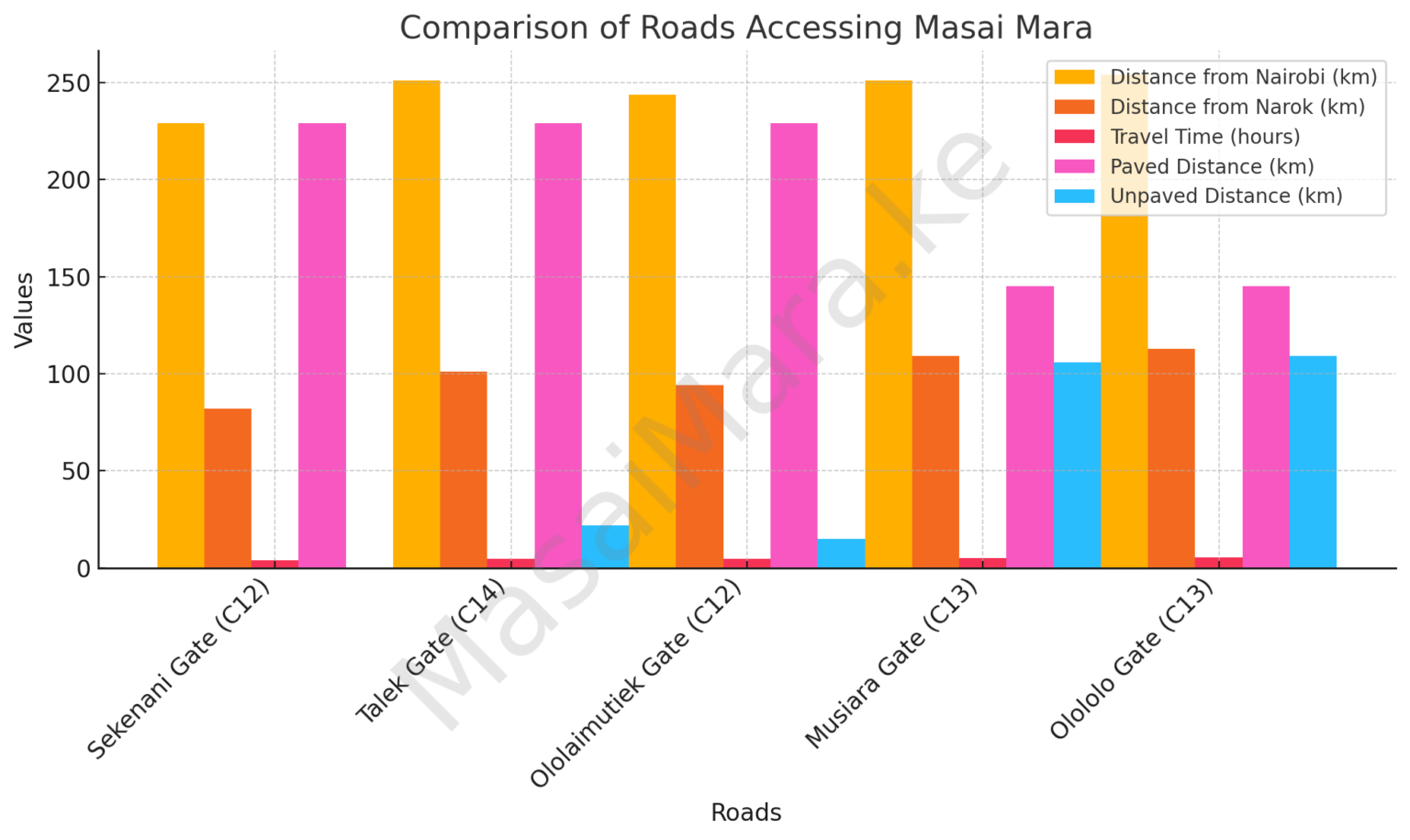
- Masai Mara has five operational road gates: Sekenani, Talek, Ololaimutiek, Musiara, Olololo (Sand River Gate is currently closed).
- From Narok, continue on B3 then turn left onto C12, C13, or C14 depending on the gate.
- Gate overview:
- Sekenani Gate (82 km from Narok; ~1.5 hrs) – via C12, fully tarmacked, most popular and convenient for central Mara.
- Ololaimutiek Gate (104 km from Narok) – via C12, then a rough 20 km unpaved spur near Ngoswani; best for southeast Mara, but road can be challenging in rains.
- Talek Gate (~22 km beyond Sekenani on C14) – unpaved section; ideal for central/northern Mara and camps along the Talek River.
- Musiara Gate (109 km from Narok) – via B3 + C13, partly unpaved; good for Mara River and Great Migration crossing areas.
- Olololo Gate (113 km from Narok) – via B3 + C13 further north; main road access to the Mara Triangle and Oloololo Escarpment; more unpaved, rougher, especially in rainy season.
Distances and drive times from Nairobi
- Sekenani Gate: ~229 km, about 4 hours; best for centrally located lodges and many popular camps.
- Talek Gate: ~251 km, about 4h 42m; good for central and northern camps along Talek River.
- Ololaimutiek Gate: ~244 km, about 4h 34m; good for southeastern section.
- Musiara Gate: ~251 km, about 5h 3m; good for northern Mara and Mara River access.
- Olololo Gate: ~254 km, about 5h 15m; ideal for Mara Triangle and escarpment lodges.
- Paving pattern: paved A104 + B3 from Nairobi to Narok and past Ololunga; final stretches to Musiara/Olololo/Talek/Ololaimutiek involve unpaved roads.
Key features of the road journey
- Route: Nairobi → A104 → Kamandura–Mai Mahiu–Narok (B3) → Narok → C12/C13/C14 to respective gates.
- The B3 escarpment is a narrow, winding, single-lane road with no emergency shoulders in many places; can be congested when vehicles break down.
- Scenic and cultural stops:
- Great Rift Valley viewpoints (three main viewpoints) – wide panoramas, photo stops.
- Italian Prisoners’ Church – small historic church built by WWII Italian POWs.
- Views of Mount Longonot and Mount Suswa – dormant stratovolcano and double-crater volcano with caves.
- Narok is the primary fuel, food, and shopping hub and the county HQ with the tourism department that oversees MMNR.
Road conditions, speed limits and tolls
- Tourist vehicles (PSV-classified) must observe 80 km/h on highways and 40 km/h inside the reserve.
- Actual travel time can stretch to 5–6 hours when you factor in traffic, stops, and rough sections.
- Roads shown with toll icons on some map apps to Musiara/Olololo are not tolled; they are unpaved rural roads.
- Unpaved sections (C13, C14, spur to Ololaimutiek) can become muddy, rutted and slow during rainy seasons.
Vehicle choice and 2WD vs 4WD
- For Nairobi–Narok–Sekenani via C12, a 2WD can be adequate for transfers only, especially in dry conditions.
- 2WD vehicles are not allowed for game drives inside the reserve; you must switch to a 4WD safari vehicle for game viewing.
- For routes using C13 (Musiara/Olololo) or C14 (Talek), a 4WD is strongly recommended due to unpaved, potentially tough terrain.
- Ideal game drive vehicles:
- Toyota Land Cruiser 79 series safari conversions – strong, high clearance, ideal for rough tracks and river crossings.
- Closed tour vans with pop-up roofs – more weather/dust protection.
- Open-sided jeeps – best for photography and unobstructed views.
4WD verification tips (especially for vans)
- Not all Toyota Hiace safari vans are 4WD; many are 2WD.
- Quick check: look for a rear differential lock housing/lever on the back axle.
- Engaging the diff lock allows equal power to both rear wheels, boosting traction on mud or steep climbs.
- When booking, confirm drivetrain (2WD vs 4WD) if your lodge is deep inside the reserve or accessed via rough roads.
Flying to Masai Mara: structure and logic
- The Mara ecosystem is divided into regions and conservancies, each served by one or more airstrips.
- Most flights depart from Nairobi Wilson (WIL), operated mainly by Safarilink, AirKenya, Mombasa Air Safari, Governors Aviation.
- Flight time: roughly 45–60 minutes, about 115 nautical miles from Nairobi to the Mara.
- Picking the right airstrip based on lodge location cuts down transfer times and avoids long bumpy road transfers.
Key airstrip regions and use-cases
- South-Eastern Mara (Sekenani / Siana areas)
- Keekorok Airstrip – serves Keekorok Lodge, Sarova Mara Game Camp, Ashnil Mara, Mara Sopa; best for Sekenani and SE Mara.
- Siana Airstrip – serves Siana Springs, Leleshwa, Mara Bushtops, Ol Seki Hemingways; ideal for Siana and neighboring conservancies.
- Southern Mara (Olderikesi / Cottar’s)
- Olderikesi Airstrip – serves Cottar’s 1920s Camp and Cottar’s Bush Villa; best for far-south Mara and Olderikesi Conservancy.
- Central Mara (Talek and central Mara River areas)
- Ol Kiombo Airstrip – for Mara Intrepids, Mara Explorer, Fig Tree, Porini Lion, Kicheche Bush; closest to Talek Gate and Talek River camps.
- Serena Airstrip – for Mara Serena, Kilima, Mara Engai, Mara Siria; good for central–western Mara and Triangle access.
- Northern Mara (Musiara / Olare Orok)
- Musiara Airstrip – for Governors’ Main, Little Governors’, Il Moran, Nkorombo; prime for Mara River crossings and northern plains.
- Olare Orok Airstrip – for Mahali Mzuri, Kicheche Bush, Olare Mara Kempinski and other luxury camps in Olare Motorogi.
- Western Mara (Mara Triangle / Oloololo Escarpment)
- Angama Airstrip – for Angama Mara, Mara West; best for the Oloololo Escarpment and western views.
- Serena Airstrip – doubles as an access point for parts of the Mara Triangle.
- Northern Conservancies (Mara North, Enonkishu, Lemek, Ol Choro)
- Ngerende Airstrip – for Ngerende Island Lodge, Mara Safari Club, Saruni Mara; serves Mara North and surrounding conservancies.
- Mara North Airstrip – used by Safarilink and AirKenya for camps like Mara Buffalo, David Livingstone, Neptune Mara Rianta, Royal Mara, Serian, Mara Tembo.
Air travel: baggage and packing rules
- 15 kg (33 lb) total luggage allowance per person, including hand luggage, on most small aircraft.
- Only soft-sided bags allowed due to restricted cargo hold space; avoid hard suitcases.
- Keep essentials like travel documents, meds, valuables, binoculars, camera in your carry-on.
- Some airlines or operators offer bag storage in Nairobi or allow excess at extra cost if space is available.
Cost comparison: air vs road
- Typical one-way flight from Wilson to the Mara: about $167–$180 per person.
- 4WD Land Cruiser rental: about $250 per vehicle per day.
- Safari van rental: starts around $180 per vehicle per day.
- Example with two travellers (one-way cost):
- Flight: $167–$180 per person.
- Land Cruiser: $125 per person (if $250 split by two).
- Safari van: $90 per person (if $180 split by two).
- Summary:
- Solo traveller – flying is usually simpler and time-efficient despite higher cost.
- Two or more travellers – road transfer quickly becomes more economical and flexible, especially with shared cost.
Environmental trade-offs
- Flying has the highest CO₂ impact per person but the shortest travel time.
- Shared 4WD/safari vans have significantly lower per-person emissions, especially with 2–6 people in the vehicle.
- For eco-conscious visitors, road transfers are the greener choice, particularly when combining multiple park visits in one road itinerary.
Why train (SGR to Suswa) is not practical
- The SGR line only goes as far as Suswa, about 1.5 hours from Nairobi.
- Suswa station does not offer direct connections toward the Mara; you would need:
- A shuttle/van from the SGR terminal to the main Suswa stage, then
- Another bus/matatu onward toward Narok and then to the gates.
- These extra transfers add cost, complexity and time.
- Direct bus/road travel Nairobi–Narok–Mara is much more straightforward for budget travellers.
Best budget public transport logic
- Take a bus from Nairobi to Narok, the main transit town and service hub.
- From Narok, continue to the reserve in Toyota Probox matatus or small shuttles serving gates such as Sekenani and Talek.
- This is more efficient than combining train + multiple local transfers, and aligns better with how local transport actually operates.
Practical decision rules for travellers
Always align your gate or airstrip with the exact location of your lodge or camp to minimise wasted travel and confusion on arrival.
Choose flying if:
You have limited time.
You are a solo traveller or do not mind paying a premium.
Your lodge is deep inside the reserve and offers direct airstrip pickup.
Choose road if:
You are two or more travellers looking for better value.
You care about lower carbon footprint.
You enjoy scenic drives, photo stops, and flexibility.
Best Routes and Roads to Get to Masai Mara National Reserve
There are several routes you can take to reach the Masai Mara National Reserve from Nairobi, each offering a different driving experience depending on road conditions, scenery, and distance. While flying is often the fastest and most comfortable way to get to the Mara, many travelers opt to drive for the adventure and flexibility it offers.
1. Narok Route (Maai Mahiu-Narok Road) – The Most Popular Route
- Distance: 250-300 km from Nairobi (depending on your destination within the Mara).
- Duration: Approximately 5-6 hours (can be longer depending on road conditions).
- Road Conditions: The first part of this route from Nairobi to Narok is paved and in relatively good condition. After Narok, the road becomes rougher, with some gravel and dirt roads leading to different gates of the Masai Mara.
- Best for: This is the most commonly used route for travelers heading to the central and northern parts of the reserve, including the Sekenani Gate (most popular), Talek Gate, and Oloolaimutia Gate. It offers great scenic views along the way, including the Great Rift Valley and Suswa hills.
2. Narok-Kisirian Route (Maai Mahiu to Narok, then through Kisirian)
- Distance: 280-310 km from Nairobi.
- Duration: Around 6-7 hours.
- Road Conditions: After Narok, this road leads towards Kisirian and then connects to the Sand River Gate or Oloololo Gate. It is less commonly used but provides access to the western part of the Mara. The road conditions after Narok can be quite rough, especially during the rainy season.
- Best for: Travelers staying in the Mara’s western regions, particularly in the private conservancies like Mara North or Olare Motorogi. This route offers fewer tourists and a quieter, scenic drive.
3. Ngong Route (via Suswa and Narok)
- Distance: 240-290 km from Nairobi.
- Duration: 6-7 hours.
- Road Conditions: This route takes you from Nairobi to Ngong, Suswa, and onwards to Narok. While it offers stunning views of the Great Rift Valley and Mount Suswa, the road conditions after Suswa are less developed, and the last part of the journey can be bumpy.
- Best for: Adventurous travelers who want to explore the less-traveled routes and enjoy incredible landscapes along the way.
4. Bomet Route (Nairobi-Mai Mahiu-Naivasha-Bomet)
- Distance: 300 km from Nairobi.
- Duration: 7-8 hours.
- Road Conditions: This is the least popular route due to its distance and rougher roads. It leads you through the towns of Bomet and Mulot, entering the Mara through the lesser-known Ololaimutiek Gate.
- Best for: Travelers staying in southern parts of the reserve or those wishing to explore areas less frequented by tourists. It is more suitable for 4×4 vehicles.
Car Hire Options for Masai Mara Safari
Car hire is a great way to explore the Masai Mara at your own pace. Several companies in Nairobi offer 4×4 vehicles, which are highly recommended for the Mara’s rough terrain, especially during the rainy season.
1. 4×4 Safari Vehicles (Recommended)
- Popular Models: Toyota Land Cruiser, Nissan Patrol, and Toyota Prado are the most commonly hired vehicles for Masai Mara safaris. They offer high ground clearance, 4-wheel drive capabilities, and rugged durability for the Mara’s rough roads.
- Cost: Prices range from $150 to $250 per day, depending on the vehicle and inclusions like fuel, driver, and insurance. For self-drive options, expect costs to be on the higher side, and ensure the car comes with recovery tools, spare tires, and an air compressor.
- Best for: Private game drives, long trips, families, and groups who want comfort and reliability on rough terrain.
2. Private Transfers with Driver
- Cost: From $200 to $400 per day, depending on the vehicle and services provided.
- Inclusions: These packages often come with a professional safari driver-guide who is knowledgeable about the roads and wildlife. They can handle navigation while you enjoy the scenery and focus on wildlife sightings.
- Best for: Travelers who prefer not to drive themselves or who want expert local knowledge during their trip.
3. Self-Drive Option
- Vehicle Type: Hiring a 4×4 is essential for a self-drive safari in the Masai Mara due to the rough roads and seasonal conditions. Self-drive enthusiasts often opt for equipped Land Cruisers or Prados with GPS, camping gear, and off-road recovery tools.
- Cost: Around $150 to $250 per day for a fully-equipped 4×4.
- Considerations:
- Navigation: While a GPS can help, having a map or using offline navigation apps is important since mobile signals are weak in many areas.
- Fuel: Make sure to fuel up in Narok or other major towns along the way, as fuel stations inside the reserve are non-existent.
- Park Rules: Always stick to designated paths and respect wildlife viewing guidelines to avoid accidents and disturbances.
Doing a Self-Drive Safari in Masai Mara
Self-driving through the Masai Mara offers flexibility and a thrilling sense of adventure, but it comes with challenges.
1. Pros of Self-Drive Safari:
- Flexibility: You can set your schedule and explore at your own pace. If you spot something interesting, you can stop for as long as you like without adhering to a group schedule.
- Personal Experience: Self-driving allows for a more intimate and personal safari experience. You are in control of the route, timing, and animal sightings.
- Adventure: For adventurous travelers, navigating the Mara’s terrain is part of the thrill.
2. Challenges of Self-Drive Safari:
- Navigating Rough Terrain: Roads inside the reserve can be tricky, especially in wet conditions. While main tracks are well-marked, some areas are difficult to access without a professional guide.
- Wildlife Safety: Knowing how to behave around wild animals, such as keeping a safe distance and avoiding stress-inducing behaviors, is crucial for your safety.
- Getting Lost: The Mara is vast, and it’s easy to lose your way. It’s important to have a map and, if possible, GPS navigation or guides from your lodge to direct you.
- Vehicle Recovery: If your vehicle breaks down or gets stuck, you’ll need to be prepared to handle it. Many self-drive rentals come with recovery kits, but you’ll need to know how to use them.
Expert Tips for Self-Driving in Masai Mara
- Plan Your Route: Know which gate you’ll be entering and exiting from. Popular gates include Sekenani, Oloolaimutia, and Talek. Plan your day’s game drive around the times animals are most active (early morning and late afternoon).
- Timing Your Game Drives: Set out early for game drives to take advantage of cooler weather and animal activity. Late afternoons are also great times for wildlife viewing as the animals become more active.
- Hiring a Guide: Even if you’re doing a self-drive, you can still hire a local guide at your lodge to accompany you. Their knowledge of animal behaviors and the landscape can significantly enhance your experience.
- Keep Your Distance: Stay at least 20 meters from wild animals. Avoid getting too close to elephants, lions, and other large wildlife, especially if they appear agitated.
Types of Rental Vehicles for Masai Mara Transfers
Choosing the right vehicle is essential for a comfortable and safe journey. The terrain leading to the Masai Mara and within the reserve is rugged, especially after Narok, requiring robust vehicles with off-road capabilities.
4×4 Safari Vehicles (Highly Recommended)
- Toyota Land Cruiser – A top choice for most safari-goers due to its durability, high ground clearance, and superior off-road capabilities. This vehicle is widely used for game drives and long-distance transfers, particularly in rough terrain.
- Toyota Prado – Another reliable 4×4 option suitable for smaller groups or families. It offers comfort and the power to handle the rough roads leading to the Mara.
- Land Rover Defender – Known for its ruggedness, this is a great vehicle for those looking for a more adventurous experience. It handles well on challenging terrains.
Safari Vans
- Minivan (Pop-up Roof) – Suitable for smaller groups or budget travelers, these safari vans are equipped with pop-up roofs for better game viewing. While less powerful than 4x4s, they can still manage the roads during the dry season.
Cost of Renting Vehicles for Masai Mara Transfers
The cost of renting a vehicle for the journey to Masai Mara can vary depending on the type of vehicle, the rental company, and whether the service includes a driver-guide. Here’s an approximate breakdown:
- 4×4 Toyota Land Cruiser: USD $200 – $350 per day (including a driver and fuel).
- Toyota Prado: USD $150 – $250 per day (including a driver and fuel).
- Safari Minivan: USD $120 – $180 per day (including a driver and fuel).
Note: It’s common for rental companies to offer packages that include a professional driver-guide who is familiar with the roads and wildlife viewing areas, which can significantly enhance your experience.
Factors to Consider When Renting a Vehicle
When planning a road transfer to Masai Mara, it’s important to keep these factors in mind to ensure a smooth and enjoyable journey:
Road Conditions
- Nairobi to Narok: This section of the road is paved and in good condition, providing a relatively smooth ride.
- Narok to Masai Mara: The last 90-100 km stretch from Narok to the various gates of the Masai Mara is rough and bumpy, especially during the rainy season. A 4×4 vehicle is highly recommended for this part of the journey.
Driver or Self-Drive?
- Professional Driver: Most travelers opt for a vehicle with a driver-guide, which is beneficial since the driver can navigate the challenging terrain and provide insights into the wildlife and local culture.
- Self-Drive: While self-drive is an option, it’s recommended only for experienced drivers familiar with off-road conditions. Additionally, having a local driver who knows the area well ensures a more relaxing journey and allows you to focus on the safari experience.
Fuel Costs
- Most rental companies provide packages that include fuel costs, but it’s important to confirm this beforehand. If fuel is not included, ensure you fill up the tank in Narok, as there are no fuel stations inside the Masai Mara Reserve.
Our Nairobi → Masai Mara Transfer Options
1. Toyota Noah Minivan (2WD) – $200 One Way
Ideal for travellers headed to camps near Sekenani, Talek, or Oloolaimutia gates via the well-maintained Narok–Sekenani all-weather road.
Key Features
- Seats up to 6 passengers comfortably
- Reclining seats, spacious cabin, smooth ride
- Fuel-efficient and cost-effective
- Excellent for highway travel and well-graded access roads
- Ample luggage space for families and small groups
Recommended When:
- Staying near Sekenani Gate, where roads are fully paved
- Budget-conscious travellers needing a safe, comfortable, private transfer
- Travelling in the dry season or avoiding remote conservancies
2. Toyota Land Cruiser (4×4 Safari Vehicle) – $300 One Way
The safari-grade Toyota Land Cruiser is the premium choice for rougher road conditions, deeper access into the Mara region, or luxury camps in conservancies.
Key Features
- Seats up to 7 passengers
- Elevated seating and extra cabin space
- High ground clearance + reinforced suspension
- Smooth handling on unpaved, rocky, or muddy roads
- Ideal for travel to Mara North Conservancy, Mara Triangle, and remote camps
Recommended When:
- Travelling in rainy seasons (Apr–May, Nov)
- Heading toward Talek Gate, Musiara, Mara North, or Aitong
- Wanting a safari experience right from Nairobi
- Carrying extra luggage or travelling as a larger group
Which Vehicle Should You Choose? (Expert Guidance)
The Toyota Noah is perfect for the Nairobi → Narok → Sekenani route, where roads are paved and consistently maintained.
The Land Cruiser is required for:
- C13 Ololunga–Aitong Road (Mara North Conservancy)
- Mara Triangle transfer routes
- Heavy rain, mud, steep sections, or long unpaved stretches
If your camp is off the main Sekenani road or deep in the conservancies, the Land Cruiser offers comfort, safety, and reliability on unpredictable terrain.
Car Hire for Masai Mara Transfers:Car Hire for Transfers From Masai Mara (Overview)
Private car hire available from Masai Mara to Nairobi, Naivasha, Nakuru, Nanyuki, Amboseli, Tsavo, Samburu, coast (Mombasa, Diani, Malindi, Watamu, Lamu), Western Kenya (Kisumu, Eldoret, Kakamega, Kisii) and more.
One-way transfers usually attract an extra day surcharge to cover return of the vehicle and driver.
Multi-destination / 5+ day itineraries (e.g., Mara → Naivasha → Amboseli → Tsavo → Coast) can attract discounted long-hire rates, making extended safaris more cost-effective than separate one-way bookings.
Vehicle Types to Consider
🚙 4WD Toyota Land Cruiser (Premium Safari Vehicle)
High ground clearance, reinforced suspension, all-terrain tires, pop-up roof, spacious interior.
Best for: Rough roads, rainy season, long distances (Amboseli, Tsavo, Samburu, Mara Triangle, Coast via bush routes).
Choose this if: You prioritise comfort, safety, and reliability on bumpy / muddy roads or are visiting remote camps.
🚐 4WD Safari Van / Toyota Hiace (Budget 4×4 Option)
4WD capability, pop-up roof, high roof, seats up to ~8, better fuel economy than a Land Cruiser.
Best for: Budget-conscious groups travelling to Nakuru, Naivasha, Nanyuki, Nairobi, Western Kenya, or parks with mostly good roads and light off-road.
Choose this if: You want a balance of price, space, and moderate off-road performance.
🚗 2WD Toyota Noah / Toyota Wish (Highway & Town Transfers)
Lower ground clearance, fuel-efficient, comfortable on tarmac and well-graded roads.
Best for: Smooth routes like Mara → Narok → Nairobi / Nakuru / Naivasha when roads are dry and you’re not doing game drives or deep off-road.
Choose this if: You’re on a tight budget and travelling mainly on paved or good all-weather roads.
Popular Routes & Suggested Vehicles
Masai Mara → Nairobi / Naivasha / Nakuru / Nanyuki
✅ Best options: 4WD Safari Van or Land Cruiser
2WD Noah/Wish possible when roads are dry and route is mostly paved.
Masai Mara → Amboseli / Tsavo / Samburu / Meru / Mount Kenya
✅ Best option: 4WD Land Cruiser
4WD Safari Van acceptable in dry conditions and for moderate off-road; avoid 2WD.
Masai Mara → Coast (Mombasa, Diani, Malindi, Watamu, Lamu)
✅ Best options: 4WD Safari Van (budget), Land Cruiser or Prado (premium).
Long distance + mixed road quality = choose comfort and reliability over ultra-low cost.
Masai Mara → Western Kenya (Kisumu, Eldoret, Kakamega, Kisii)
✅ Best options: 4WD Safari Van (groups), Land Cruiser (extra comfort on rural stretches).
Masai Mara → Narok & Nearby Towns
✅ Best options: 4WD Safari Van or 2WD Noah/Wish on good, dry roads.
Booking & Cost-Saving Tips
Expect a one-way surcharge when dropping the vehicle far from its base (e.g., Mara → Coast), since the car must return.
Plan a multi-stop itinerary (Mara → Naivasha → Amboseli → Tsavo → Coast) and negotiate long-term hire discounts instead of several separate one-way transfers.
Match vehicle to terrain:
4WD Land Cruiser for rough, muddy, or remote routes.
4WD Safari Van for most inter-park transfers on mixed roads.
2WD Noah/Wish only for tarmac-dominated routes and dry conditions.
Chauffeur-driven is strongly recommended over self-drive: no large deposits, no insurance headaches, and you benefit from a driver who knows the roads and conditions.
Why Book Your Transfer Through MasaiMara.ke?
- Licensed, vetted driver-guides with extensive Mara experience
- Direct door-to-door service from airports, hotels, or residences
- Flexible pick-up and drop-off times
- Well-maintained vehicles meeting tourism transport standards
- Roadside assistance along the Nairobi–Masai Mara corridor
- Easy coordination with game drives, park entry, and camp arrivals
Road Conditions: Nairobi to Masai Mara Overview
- A102 Highway (Nairobi → Narok): Fully paved, smooth, comfortable
- Narok → Sekenani Gate: Mostly paved, minor gravel sections
- Narok → Talek / Oloolaimutia: Mix of gravel + graded dirt
- Ololunga → Aitong (Mara North): Rough, muddy; 4×4 required
- Travel Time: ~5–6 hours depending on destination and road conditions
Vehicle Comparison Table
| Feature | Toyota Noah (2WD) | Toyota Land Cruiser (4×4) |
|---|---|---|
| Seats | Up to 6 | Up to 7 |
| Terrain Capability | Best for paved & graded roads | Excellent on rough, muddy, rocky tracks |
| Comfort | Reclining seats, quiet ride | Spacious, elevated safari seating |
| Ideal For | Sekenani, Talek, Oloolaimutia | Mara North, Mara Triangle, remote camps |
| Luggage Space | Moderate | Large |
| One-Way Transfer Rate | $200 | $300 |
Self-Drive vs Chauffeured Transfers
We provide chauffeur-driven only for Nairobi–Mara transfers to ensure safety, compliance, and reliability.
Why Chauffeured Is Better
- No deposits or insurance liability
- No navigating the Kenyan insurance system
- Avoid rough-road risks and unfamiliar terrain
- Driver-guides know the safest routes and real-time road conditions
- Stress-free travel after long flights or early departures
Need a Vehicle for Game Drives?
If you plan to continue using the vehicle inside the reserve, upgrade to the 4×4 Land Cruiser with pop-up roof for optimal game-viewing, comfort, and safety.
If you only need transport and your camp provides game drives, the Toyota Noah remains the most economical choice.
Frequently Asked Questions (FAQs)
1. How long is the drive?
5–6 hours depending on gate and road conditions.
2. Can you pick up from JKIA or Wilson Airport?
Yes — we offer airport, hotel, and residence pick-ups anywhere in Nairobi.
3. Is fuel included?
Yes, for chauffeur-driven transfers, fuel is included.
4. Do you offer roadside assistance?
Yes — assistance is available along the Nairobi–Narok–Mara route.
5. Can the Noah enter the Masai Mara Reserve?
No — 2WD vehicles are not allowed inside the reserve. Only 4×4 vehicles may enter.
Book Your Nairobi → Masai Mara Transfer
Whether you need a budget-friendly Toyota Noah or a rugged 4×4 Land Cruiser, we provide safe, reliable, and comfortable transfers for individuals, families, and safari groups.
To book:
📧 bookings@masaimara.ke
Travelling from Nairobi to the Masai Mara by road is one of Kenya’s most scenic journeys—passing the Great Rift Valley escarpment, Narok town, and the sweeping savannahs leading to Sekenani Gate, Talek Gate, and Oloolaimutia Gate. At MasaiMara.ke, we offer fully-licensed, chauffeur-driven vehicle transfers designed for comfort, safety, and reliability.
Whether you’re landing at JKIA, departing from Wilson Airport, staying at a Nairobi hotel, or leaving from a Nairobi residence, we provide flexible pick-up times and direct drop-off anywhere in the Masai Mara.
(We avoid overnight drives due to safety and wildlife crossings.)