
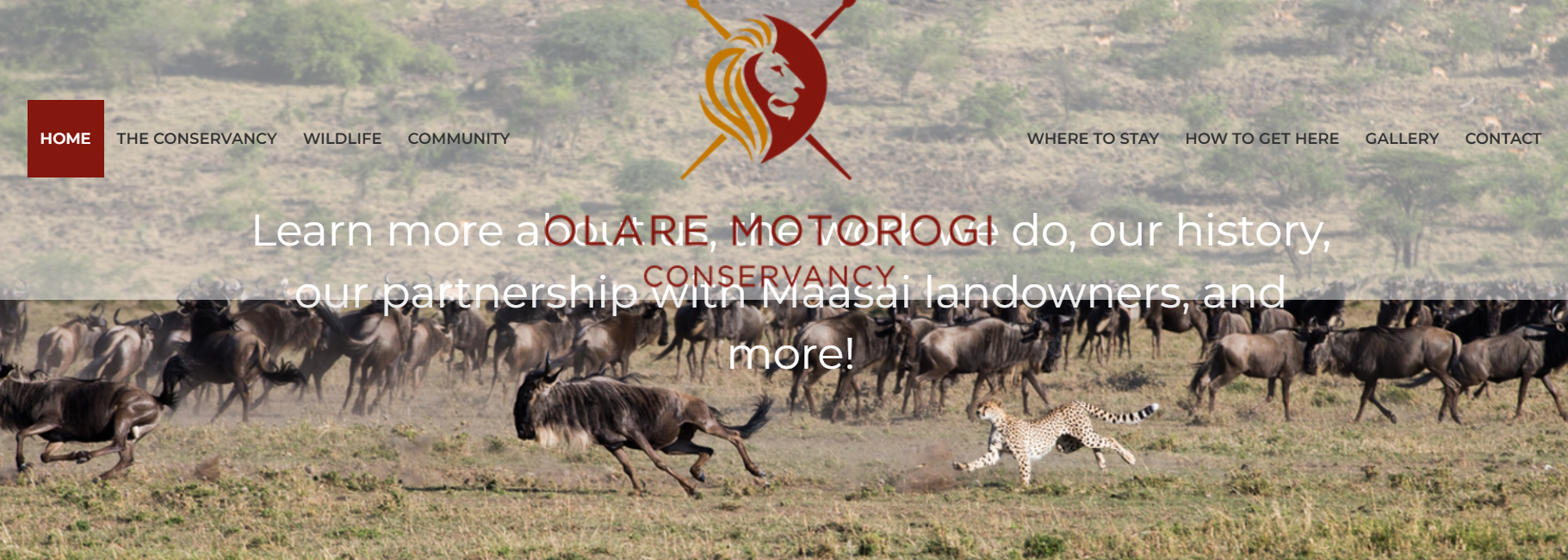
Olare Motorogi Conservancy is a premium, community-owned wildlife conservancy in Kenya’s Greater Mara ecosystem, lying directly against the Masai Mara National Reserve (MMNR) boundary. This conservancy is one of the 23+ conservancies in Masai Mara.
It is widely regarded for two things that matter to serious safari planners: exceptionally low vehicle density and consistently strong big-cat viewing—a combination created by strict tourism limits and a land-lease model that incentivizes conservation alongside pastoral livelihoods.
Olare Motorogi Conservancy — Historical Formation, Founders, Lease Model (Quick Overview)
- Founding event (May 2006): The conservancy model began with the formation of Olare Orok Conservancy in May 2006, bordering the Masai Mara National Reserve, via a brokered agreement with ~277 Maasai landowners—widely cited as a “template” deal for later Mara community conservancies.
- How “Olare Motorogi” formed: Olare Orok later expanded to include Motorogi lands, and the combined block became Olare Motorogi Conservancy (often described as a merger/management consolidation of the two adjacent conservancies).
- Who the “founders” are in practice: The effective founders are (1) the Maasai landowners who legally set aside/leased their titled parcels and (2) a consortium of tourism operators who underwrote lease payments and financed operations—an intentional “community–tourism partnership” structure rather than a single individual founder.
- Initial landowners / land tenure: The core model is individual freehold title deeds held by landowners; the conservancy is described as being owned by 300+ Maasai landowners today (reflecting growth beyond the original deal cohort).
- Size secured under conservation use: Commonly described in the ~33,000–35,000 acre class (≈14,000+ ha; ~140 km²), reflecting the combined Olare Orok + Motorogi footprint referenced across multiple technical and operator profiles.
- Management “who runs it”: Day-to-day operations are managed by Olpurkel Ltd, a not-for-profit management company; governance is via a board with equal representation from landowners and tourism partners, with representation linked to The Maa Trust.
- Tourism partner structure (original operator consortium logic): Technical descriptions of the original Olare Orok model describe landowners being paid by a consortium of five commercial tourism operators, with Olpurkel Ltd formed by tourism partners to manage payments and operations transparently.
- Lease program design: The lease system was explicitly tied to conservation performance—landowners agreed to relocate settlements and exclude/strictly control grazing within conservancy zones, making the area suitable for premium, low-impact wildlife tourism.
- Payment mechanism evolution: The conservancy shifted from a bed-night payment system to a monthly rental/lease-style payment, providing steadier, more predictable income for landowners.
- Lease payment rates (published figures): A widely cited technical case study reports landowners were paid US$41 per hectare per year (2011 value) under the Olare Orok conservancy lease model.
- Lease payout magnitude (how to present responsibly): Public literature on Mara conservancy leases reports early lease rates in the ~US$27–43 per acre per year range for some conservancies in the first years up to ~2012; if applied to a ~33,000–35,000 acre footprint, that implies low-to-mid seven-figure annual lease obligations—but exact totals vary by contract, acreage actually under lease, and year.
- Community benefit add-on (beyond leases): In addition to monthly rental payments, partner camps donate US$5 per guest per night to The Maa Trust to support community development linked to conservation success.
- Tourism caps that protect the lease model: OMC formally limits tourism to 94 beds across five partner camps, with a stated target of one game-viewing vehicle per 2,100 acres—a density-control approach designed to protect the product and reduce ecological pressure (which helps sustain lease affordability and compliance).
- Named in-conservancy camps (current partner set): Mahali Mzuri, Olare Mara Kempinski, Kicheche Bush Camp (Olare), Porini Lion Camp, Mara Plains Camp are consistently listed as the five partner camps operating under the conservancy cap.
Where it is and how it connects to MMNR
Olare Motorogi sits in the north-western Greater Mara and borders the Masai Mara National Reserve, functioning as a key wildlife dispersal zone where animals move freely between conservancy land and reserve land (no “hard boundary” for wildlife—management rules are what change).
Why this matters: when MMNR is busy—especially July to October—Olare Motorogi’s controlled capacity can deliver a markedly more private experience, while still keeping you close enough to dip into the reserve for classic river-crossing sectors when conditions are right.
Size, landscape, and habitats
Olare Motorogi is roughly 35,000 acres (≈142 km²), which aligns with commonly cited figures of about 140–142 km².
Expect a mosaic of Mara habitats that drive wildlife density and viewing variety:
- Rolling short-grass plains (high-quality grazing → high herbivore biomass → predators)
- Acacia woodlands and riverine forest strips along seasonal rivers and drainage lines
- Hills, escarpment edges, and gullies (“luggas”) that create shade, cover, and denning terrain for cats
Conservancy model, ownership, and governance
Olare Motorogi is owned by 300+ Maasai landowners holding individual title deeds, who lease land into a structured landholding arrangement that contracts a contiguous block to a management company—one of the governance innovations that helped professionalize Mara conservancy operations.
- The conservancy is managed through a not-for-profit structure (Olpurkel Ltd) with board representation shared between landowners and tourism partners, and representation linked to The Maa Trust.
- A shift toward monthly rental/lease-style income (rather than purely bed-night variability) created more predictable benefits to landowners, supporting longer-term compliance with land-use rules.
Tourism limits: why it feels “uncrowded”
Olare Motorogi explicitly caps tourism to 94 beds across five camps, and states a vehicle-density target of one game-viewing vehicle per 2,100 acres—a rare, concrete operational rule that explains the experience on the ground.
What that translates to in practice:
- More time with sightings (especially cats) without stacked vehicles
- More flexibility for guiding—tracking, repositioning, waiting out behavior, and photographing without pressure
- Less road congestion and reduced off-track impact when managed properly
Wildlife highlights
Olare Motorogi sits in a predator-rich portion of the Mara, where multiple pride territories and hunting ranges overlap, increasing the odds of meaningful behavior (territorial interactions, courtship, hunts, and cub activity).
Big cats and other predators
- Lions: High encounter rates are a defining feature; pride territories meet within the conservancy, which can create dynamic interactions.
- Cheetahs: Strong in open plains systems; research and long-term monitoring in the Greater Mara is supported from within the conservancy footprint.
- Leopards: Often associated with riverine edges and wooded drainage lines (classic ambush habitat).
- Hyenas and smaller carnivores are part of the regular predator guild in this landscape.
Herbivores and “base biomass”
The conservancy’s grasslands and water planning support strong numbers of zebra, wildebeest, giraffe, buffalo, elephant, and other plains game—key for sustaining predator density year-round.
The Great Migration
During migration months, herds can pass through conservancy corridors, creating excellent action, though the most dramatic Mara River crossing theaters may still require targeted drives into the reserve’s main river sectors depending on where crossings are occurring.
Research and conservation: the predator science footprint
A major credibility marker is that Olare Motorogi hosts the Tony Lapham Mara Predator Hub (launched Nov 2013)—a base that supports long-term, conservation-focused research and monitoring, including work associated with the Mara Cheetah Project and Mara Lion Project, intended to inform conservancy management and broader predator strategies.
Grazing, pasture management, and the “working landscape” reality
Olare Motorogi does not present conservation as “people removed, wildlife only.” It explicitly describes a holistic grazing and pasture management approach that blends conservation and pastoralism, including the “Kundi Moja” (one herd) system—controlled grazing in tight formation, moving through designated areas to reduce overgrazing and maintain pasture recovery.
From an ecological perspective, this matters because:
- Controlled grazing can maintain short-grass structure favored by certain herbivores
- Planned water catchments and fire breaks can reduce localized habitat degradation
- Predator refuge / core conservation areas are managed to reduce disturbance from livestock during critical diurnal periods
Community benefits and The Maa Trust partnership
In addition to land rental payments, partner camps donate $5 per guest per night to The Maa Trust, described as an independent non-profit focused on community development tied to conservation outcomes (education, water/sanitation, health, conservation education, livelihoods such as beadwork and honey, and bursary programs).
This is important for readers because community conservancies succeed long-term only when opportunity cost is covered and benefits are visible at household level.
What to do in Olare Motorogi
Your exact activity menu depends on your camp and conservancy rules in force at the time, but the conservancy model is designed to support a broader set of experiences than MMNR typically allows, including:
- Day game drives in low-density conditions
- Guided walking safaris (where offered and regulated)
- In many Greater Mara conservancies, night drives and limited off-road positioning are part of the value proposition (confirm with your camp/operator).
Where to stay: the five partner camps inside the conservancy
Olare Motorogi lists five partner camps, each kept small (none larger than 24 beds) and operating under the conservancy’s code of conduct: Porini Lion Camp, Kicheche Bush Olare Camp(not to be confused with Kicheche Mara North Camp), Mara Plains Camp, Olare Mara Kempinski, and Mahali Mzuri.
A practical way to help readers choose:
- Highest guiding intensity / classic bush feel: smaller “light-footprint” camps (often strongest for serious photographers)
- Top-end comfort + full-service luxury: the larger luxury tented properties (still capped in size by conservancy rules)
- Best for mixed-interest groups: camps that balance wildlife, cultural interaction, and comfort amenities
How to get there: flights, airstrip, and road access
By air (most efficient)
Olare Motorogi states it has its own bush airstrip: Olare Orok Airstrip. Scheduled flights from Wilson Airport (Nairobi) take roughly ~1 hour, with services noted from multiple circuits (and private charters available). The airstrip coordinates and altitude are provided by the conservancy.
By road (most budget-friendly)
Road access is typically 5–6 hours from Nairobi, conditions-dependent, with the usual caveats: rain can slow certain sections and travel time varies by route and stop pattern.
Olare Motorogi vs Masai Mara National Reserve
This comparison helps readers decide whether to base in the conservancy, the reserve, or combine both:
Olare Motorogi Conservancy (best for):
- Low vehicle density and privacy (explicit bed/vehicle ratios)
- Big-cat focused safaris with more flexible guiding
- Travelers who value community-based conservation mechanisms
Masai Mara National Reserve (best for):
- Broad access across the full reserve footprint
- High-season migration circuits and classic public-road networks
- Wider range of accommodation options (including budget)
Best practice: stay in Olare Motorogi for the experience quality, and plan a targeted day (or half-day) into MMNR when you specifically want reserve-only landmarks or river sectors.
Planning notes you need
- Fees and ticketing: Conservancies typically apply a conservancy fee structure that is distinct from MMNR park entry; many itineraries combine both depending on where you game drive each day. (Exact fees vary by camp, season, and packaging—avoid quoting a single figure unless you’re publishing an updated rate card.)
- Trip length: 3 nights is a strong baseline; 4–5 nights is ideal if your readers want multiple full game days without rushing.
- Seasonality: The conservancy is productive year-round; migration months add volume and drama, but excellent predator viewing is not limited to peak season.