
Ol Kinyei Conservancy is one of the original community wildlife conservancies established in the Greater Mara ecosystem, forming a critical conservation buffer that directly borders the Masai Mara National Reserve (MMNR). Known for its low-impact tourism model, strong predator presence, and deep community ownership, Ol Kinyei set the template later adopted by neighboring conservancies such as Naboisho and Olare Motorogi.
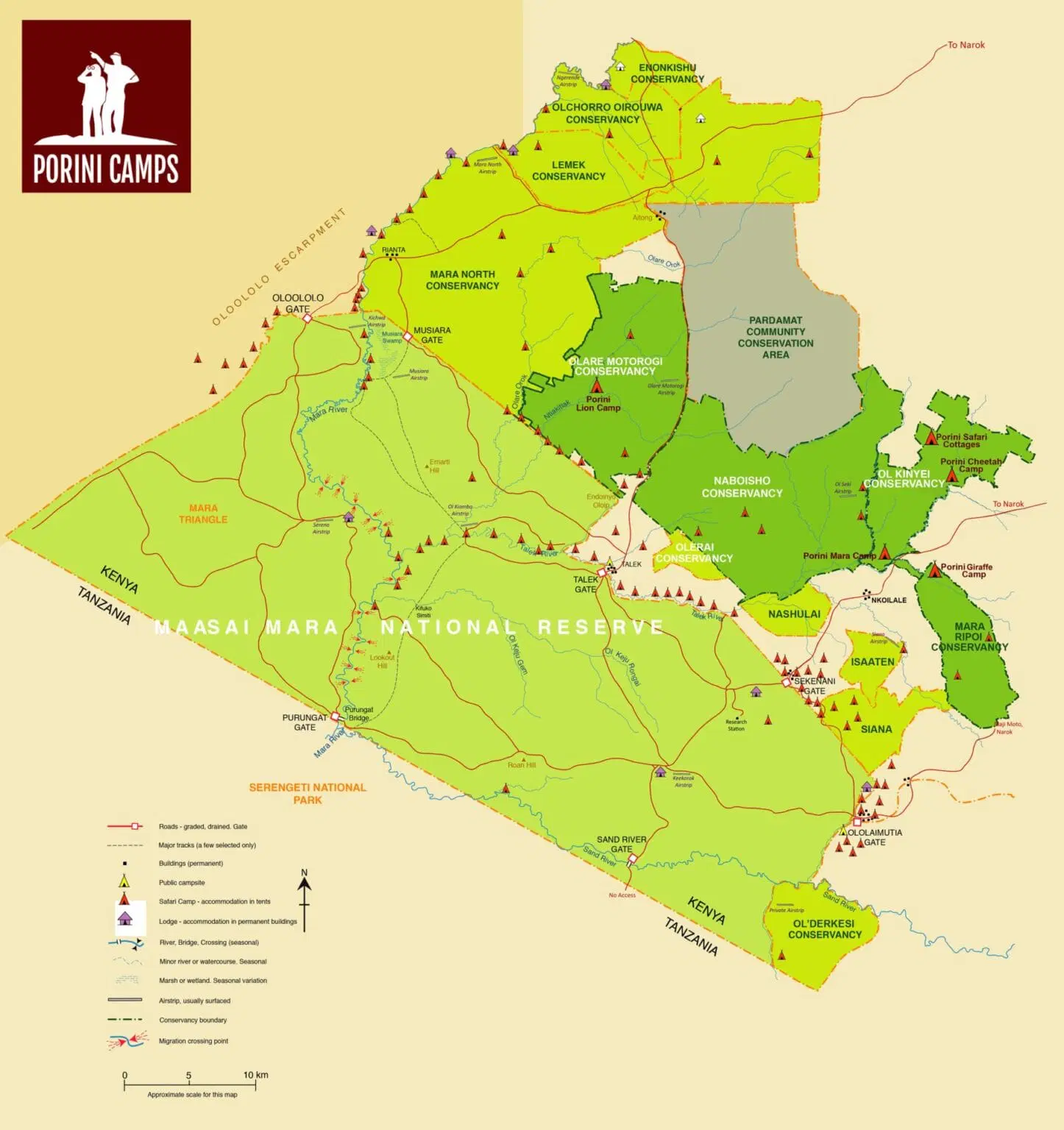
Ol Kinyei Conservancy Overview:
- Size & Ownership: ~7,544 ha; ~240 landowners
- Location: Eastern boundary of Masai Mara National Reserve
- Established: 2005 (one of the original Mara conservancies)
- Model: Community land-lease conservancy with strict low-density tourism, managed with Gamewatchers / Porini
- Wildlife: Lions, cheetahs, leopards, elephants, large plains game; strong predator hunting habitat
- Ecological Role: Key buffer and wildlife dispersal zone outside the reserve
- Tourism Style: Quiet, low-impact safaris; guided walks and night drives permitted (by rule)
- Camps Located in Ol Kinyei: Porini Cheetah Camp; Porini Mara Camp
- Best For: Privacy-focused safaris, photographers, repeat Mara visitors seeking uncrowded wildlife viewing
Why Visit Ol Kinyei in your Masai Mara Safari?
Ol Kinyei is a “classic Mara” experience with a key difference: it’s a private, Maasai-owned conservancy designed for low vehicle density, high-quality guiding, and strong incentives for habitat protection—which often translates into calmer sightings, more time on predators, and a more “wilderness-first” feel than the busy public Reserve.
Ol Kinyei Location and relationship to MMNR
Ol Kinyei Conservancy lies along the eastern and south-eastern boundary of MMNR, creating an essential wildlife dispersal and grazing corridor between the reserve and the wider Maasai pastoral landscape. Wildlife moves freely across the conservancy–reserve boundary, particularly predators and migratory herbivores.
Why this matters:
Ol Kinyei allows guests to experience classic Mara wildlife densities while avoiding the congestion often associated with the reserve during peak seasons, making it especially appealing to photographers and repeat safari travelers.
Size, landscape, and habitats at Ol Kinyei Conservancy
Ol Kinyei Conservancy covers approximately 18,700 acres (about 75 km²), making it smaller than Naboisho and Olare Motorogi but ecologically dense and highly productive.
Dominant habitat types include:
- Open savannah plains, ideal for grazing herbivores and cheetah hunting
- Acacia woodlands, offering shade and ambush cover for lions and leopards
- Seasonal rivers and luggas, supporting riverine vegetation and birdlife
- Gentle ridges and drainage lines, frequently used as predator lookout points
This compact but varied landscape results in high-quality, concentrated wildlife viewing.
Ol Kinyei Ownership, governance, and conservancy model
Founded in 2005, making it one of the pioneering Mara conservancies
Helped shape the modern conservancy model later adopted by Naboisho, Olare Motorogi, and others
Ol Kinyei is entirely community-owned, with land leased from Maasai landowners who retain individual title deeds. It was among the first conservancies in the Mara to implement a long-term land lease model, providing:
- Guaranteed, predictable monthly income to landowners
- Reduced pressure for land subdivision or agricultural conversion
- Strong incentives for compliance with conservation zoning and grazing rules
Governance is coordinated through a conservancy management structure that balances landowner representation with professional conservation and tourism management.
Overview of Gamewatchers, Founding Partner of Ol Kinyei:
- Gamewatchers Safaris is a Nairobi-based safari and conservation company widely regarded as a pioneer of the Mara conservancy model, founded by Jake Grieves‑Cook with the explicit goal of aligning high-quality safari tourism with direct economic incentives for community-led conservation.
- Gamewatchers was a founding partner of Ol Kinyei Conservancy (est. 2005), working with ~171 Maasai landowners to create one of the earliest privately protected conservancies in the Greater Mara, based on long-term land leases rather than park-fee extraction.
- The organisation operates under its Porini Camps brand, a portfolio deliberately limited to small, low-impact camps set inside private conservancies, with strict controls on bed numbers, vehicle density, and guiding standards to prioritise wildlife behaviour over volume tourism.
- Porini Mara Camp is the flagship classic tented camp in Ol Kinyei, designed for low-density predator and plains-game viewing in a traditional safari format, with a strong emphasis on expert guiding and extended sightings.
- Porini Cheetah Camp is positioned deeper within the conservancy and is purpose-built around big-cat tracking, offering a quieter, more immersive bush experience focused on cheetah, lion, and leopard behaviour.
- Porini Ol Kinyei Safari Cottages provide an exclusive-use, private-house style option (multiple en-suite bedrooms with a private chef and guide), aimed at families or small groups seeking flexibility and privacy without sacrificing conservancy access.
- Across all three properties, Gamewatchers applies a consistent operating philosophy: community lease payments, local employment (including Maasai guides and scouts), minimal permanent infrastructure, and conservation-led land use, making Ol Kinyei one of the clearest case studies of tourism-funded landscape protection in the Mara ecosystem.
Tourism limits and low-density safari experience at Ol Kinyei
Ol Kinyei enforces strict limits on tourism development, a defining feature of its long-term success:
- Maximum of ~20 guest beds across the entire conservancy
- Very low vehicle density, among the lowest in the Greater Mara
- Clear codes of conduct for guiding and wildlife encounters
What this delivers on the ground:
- Near-exclusive sightings, often with a single vehicle
- Minimal disturbance to predators and sensitive species
- A quiet, immersive safari atmosphere rarely found inside MMNR
Wildlife highlights at this Conservancy
Despite its modest size, Ol Kinyei supports exceptionally high wildlife densities, especially predators.
Predators
- Lions: Multiple resident prides with overlapping territories; frequent sightings and extended behavioural encounters
- Cheetahs: Well-adapted to the open plains; sightings often involve relaxed daytime activity
- Leopards: Regularly observed along wooded drainage lines and riverbeds
- Spotted hyenas and jackals are common and ecologically important
Herbivores
Healthy populations of wildebeest, zebra, giraffe, buffalo, elephant, eland, and gazelles provide a strong prey base year-round.
Great Migration context
During the Great Wildebeest Migration, large herds frequently pass through or graze within Ol Kinyei, particularly during early and late migration phases. While major river crossings typically occur deeper inside MMNR, Ol Kinyei offers uncrowded migration viewing in open plains.
Research, monitoring, and conservation value
Ol Kinyei has contributed to Greater Mara predator monitoring efforts, particularly lion and cheetah observation records used to inform broader ecosystem management. Its long-standing protection has made it a reference site for understanding how low-density tourism supports predator stability.
Grazing management and pastoral integration
Ol Kinyei operates as a working conservation landscape, integrating Maasai pastoralism through:
- Strictly controlled grazing periods
- Seasonal access during droughts
- Clear separation of core wildlife zones and livestock areas
This approach maintains grassland structure, reduces human–wildlife conflict, and reinforces the conservancy’s legitimacy among landowners.
Community benefits and livelihoods
Beyond land lease payments, Ol Kinyei generates tangible community benefits:
- Employment in camps and conservancy operations
- Skills development in guiding, hospitality, and conservation
- Support for local education and household resilience
Because tourism numbers are low, benefit per hectare—rather than volume—is central to the conservancy’s sustainability.
Ol Kinyei Conservancy Entry Fees 2026:
| Visitor Category | Ol Kinyei Conservancy Entry Fee | Notes |
|---|---|---|
| Non-Resident Adult (International) | USD ~70 per adult per day | Standard rate for adult visitors; valid for entry/access for the day. |
| Non-Resident Child (<12 years) | USD ~35 per child per day | Child rate (under 12); refundable/discounted compared to adult. |
| Kenyan Resident Adult | ~KES 1,500 per adult per day | Domestic resident rate equivalent (local currency). |
| Kenyan Resident Child (<12 years) | ~KES 750 per child per day | Discounted for Kenyan resident children. |
| Vehicle/Guide Fees | Varies by operator | Conservancy access fees are usually tied to lodge/camp bookings; direct vehicle entry fees may not be separately charged but can be part of package inclusions. |
Activities allowed in Ol Kinyei Conservancy
Compared to MMNR Kenya, Ol Kinyei permits a wider range of carefully regulated activities:
- Day game drives with flexible routing
- Night game drives, offering insights into nocturnal species
- Guided walking safaris, led by experienced guides and scouts
- Off-road driving, permitted under strict conservation rules
These activities allow for deeper ecological interpretation and more meaningful wildlife encounters.
Accommodation within Ol Kinyei Conservancy
Ol Kinyei is strongly associated with the Porini Camps / Gamewatchers portfolio and is marketed as hosting a small number of eco-focused properties.
Porini Mara Camp
A small tented camp positioned for classic game drives in a low-density setting. It’s repeatedly described as being within the 18,700-acre conservancy.
Porini Cheetah Camp
Often highlighted for predator-focused guiding in the conservancy context (and for travellers prioritizing a quieter, more “in-the-bush” experience).
Porini Ol Kinyei Safari Cottages
A more private, “house-style” option:
- Described as 4 cottages, each with 4 en-suite bedrooms, shared living/dining spaces, and a private kitchen/chef.
- Reviews and third-party descriptions emphasize the secluded setting and views.
How to choose
Cottages: best for families/friends who want privacy, flexible mealtimes, and an “exclusive-use” rhythm.
Camp: best if you want the traditional safari feel and a social atmosphere.
Accommodation here is best suited for:
- Experienced safari travelers
- Wildlife photographers seeking solitude
- Guests prioritizing conservation outcomes over resort-style amenities
Access: how to get to Ol Kinyei Conservancy
By air
Guests typically fly from Wilson Airport to nearby Mara airstrips, followed by a short game-drive transfer into the conservancy. Flight time is approximately 1 hour.
By road
Road transfers from Nairobi generally take 5–6 hours, depending on weather and road conditions, and are often combined with stays in adjacent Mara regions.
Ol Kinyei Conservancy vs Masai Mara National Reserve
Ol Kinyei is ideal for travelers who want:
- Maximum privacy and minimal vehicles
- Predator-focused safaris with extended sightings
- Night drives and walking safaris
- A strong sense of conservation impact
Masai Mara National Reserve is better for:
- Iconic river crossing locations
- Wider accommodation choice, including budget options
- Public-road access across a much larger area
Best approach:
Stay in Ol Kinyei for an immersive, low-density safari, and add targeted visits into MMNR for specific river or landmark experiences.
| Attribute | Ol Kinyei Conservancy | Masai Mara National Reserve |
|---|---|---|
| Legal status & management | Private, Maasai-owned conservancy under a land-lease conservation model | Public national reserve managed by Narok County |
| Approximate size | ~18,700 acres (≈ 76 km²) | ~1,510 km² (≈ 373,000 acres) |
| Land ownership | ~171 private Maasai landowners leasing land for conservation | State / county land (no private ownership) |
| Vehicle density | Very low by design (limited beds, controlled access) | High, especially in peak season (open public access) |
| Typical sightings per animal | Often 1–3 vehicles, sometimes exclusive | Can be 10–30+ vehicles at popular sightings |
| Driving rules | Off-road positioning typically allowed under conservancy rules (guide-managed) | Strictly road-only driving |
| Time spent at sightings | Flexible, extended viewing possible | Often shorter, rotational viewing due to crowding |
| Safari activities | Game drives plus conservancy activities (often including walking safaris and night drives, depending on camp permits) | Daytime game drives only; no night drives or walks |
| Wildlife experience style | Intimate, slow-paced, behaviour-focused | Large-scale, dramatic, high-energy |
| Best for | Photographers, repeat safari-goers, travellers prioritising privacy and immersion | First-time visitors, migration spectacle, iconic Mara landscapes |
| Migration viewing | Excellent plains and predator viewing; river crossings less common | Primary river-crossing arena during peak migration |
| Conservation funding model | Direct lease payments + tourism revenue to landowners | Park entry fees fund reserve management |
| Overall safari trade-off | Smaller area but higher-quality, low-pressure sightings | Vast area with exceptional wildlife density but higher crowd pressure |
Expert takeaway: Ol Kinyei trades scale for quality of experience, using low density and flexible rules to maximise time, space, and behavioural authenticity at sightings. The Masai Mara National Reserve delivers unmatched ecosystem scale and migration drama, but with higher vehicle pressure and more regulated viewing—making the two experiences complementary rather than substitutes.
Best time to visit
Ol Kinyei offers excellent wildlife viewing throughout the year:
- January–March: Quiet season, strong predator action
- July–October: Migration period with peak plains game numbers
- November–December: Green season with superb birding and dramatic skies
Because wildlife density is high year-round, Ol Kinyei is not dependent on a single seasonal event.
Why Ol Kinyei matters in the Greater Mara
Ol Kinyei Conservancy represents the foundational model of community-led conservation in the Mara:
- It demonstrated that low-volume, high-value tourism can outperform mass tourism
- It secured wildlife corridors bordering MMNR
- It delivers consistent income to Maasai landowners while protecting biodiversity
Today, Ol Kinyei remains a gold standard conservancy—quiet, authentic, and ecologically effective.
9) Practical FAQs
Can day visitors enter Ol Kinyei?
Typically, Mara conservancies are primarily for guests staying within the conservancy’s member camps, as conservancy fees and access rules are tied to those beds/leases. (Exact access rules depend on conservancy governance and camp policies—confirm with your operator.)
Is it better than the Masai Mara National Reserve?
If your priority is big landscapes + famous river sectors, the Reserve can be unbeatable. If your priority is quiet sightings + flexible guiding, conservancies tend to outperform.
What activities are usually possible?
Many conservancies support off-road positioning and often walking safaris / night drives under rules—activities generally restricted in the public Reserve.
Confirm what your specific camp is licensed to offer.
How does this help conservation in real terms?
The model is explicitly designed to convert wildlife from a “cost” (predation risk, land-use restrictions) into a paying land-use through lease payments and tourism-linked revenue, which in turn supports habitat protection and reduces pressure to subdivide or convert land.
What’s a credible proof-point that management is working?
The IUCN Green List listing is a strong signal because it evaluates governance and management effectiveness, not just marketing claims.