A conservationist’s expert guide to the legal frameworks, institutional roles, management systems, and practical actions that sustain the Masai Mara’s ecological and tourism integrity
Introduction
The Masai Mara is one of the world’s most iconic wildlife ecosystems. Its long-term survival depends not only on wildlife and landscapes, but on robust governance, disciplined administration, and accountable management. This guide explains how the Masai Mara Reserve is governed, why the key laws matter, how the Management Plan operates, how tourism is regulated, how the wider ecosystem is coordinated, what good accountability looks like, and how visitors and operators can actively support sustainable outcomes in this Narok County–managed reserve.
1. How Masai Mara National Reserve Is Governed
The Masai Mara National Reserve is managed through a multi-layered governance system. Overall leadership rests with Narok County Government, acting through its Department of Trade, Cooperative Development, Tourism & Wildlife. Day-to-day operations in some areas are delivered through delegated management arrangements. At the national level, wildlife governance is anchored in the Wildlife Conservation and Management Act, 2013, under which statutory wildlife functions are implemented by the Kenya Wildlife Service (KWS).
A. Narok County Government — the central policy authority
The Masai Mara National Reserve (MMNR) is a county-managed protected area under the authority of Narok County Government. In governance terms, the county acts as:
- The public trustee responsible for policy direction, planning, budgeting, and oversight of the Mara Reserve.
- The authority that formally adopted the MMNR Management Plan 2023–2032, making it the legal blueprint for administration of the Masai Reserve in Narok.
County responsibilities include:
- Approving and resourcing implementation of the Management Plan.
- Integrating wildlife tourism policy with wider economic, land-use, and environmental priorities.
- Providing administrative oversight of delegated management arrangements and tourism licensing systems.
B. Delegated & contractual management arrangements
While Narok County retains ultimate authority over the Narok County Reserve, some operational functions are delivered through management agreements. The best-known example is the Mara Triangle arrangement, where a contracted management entity undertakes specific protected-area tasks—security, revenue collection, and infrastructure maintenance—on behalf of the county.
Such arrangements require:
- Clear performance indicators
- Transparent revenue distribution mechanisms. Read our guide on Masai Mara National Reserve facts for details on Revenue and Visitor Numbers.
- Defined roles, responsibilities, and sanctions
Delegated management is therefore not a loss of authority; it is a governance tool for improving operational effectiveness in parts of the Masai Mara Reserve.
C. National wildlife frameworks still apply
Although the Mara Reserve(MMNR) is a county reserve, it remains fully embedded in Kenya’s national wildlife governance system, especially the Wildlife Conservation and Management Act, 2013, which:
- Sets national standards for wildlife protection
- Requires formal management planning and gazettement
- Frames enforcement duties and conservation priorities for all protected areas, including county reserves
2. Key Laws and Why They Matter
A. Wildlife Conservation & Management Act, 2013
The Masai Mara NR is administered by Narok County Government, while wildlife conservation, species protection, and statutory wildlife management functions are governed by the Wildlife Conservation and Management Act, 2013 and implemented nationally by the Kenya Wildlife Service (KWS). This Act is Kenya’s central wildlife law. It:
- Defines legal custodianship of wildlife
- Requires protected areas to adopt formal management plans
- Establishes enforcement procedures and wildlife crime penalties
Impact in the Mara:
The MMNR Management Plan 2023–2032 was formally gazetted under this Act, strengthening its legal authority and making it binding guidance for administration of the Masai Mara Reserve.
B. Narok County Tourism Act, 2017
The Narok County Tourism Act, 2017 frames how tourism services, licensing, regulation, and compliance operate across the county, including in the Narok County–managed reserve. Key features include:
- A County Tourism Board for strategic direction
- A Tourism Regulatory & Licensing Unit
- A County Tourism Tribunal for disputes
- Clear statutory authority for tourism standards and enforcement
Why it matters for the Mara:
Tourism is the economic backbone of the Masai Mara, so county-level tourism regulation directly shapes conservation incentives, operator behaviour, and compliance culture.
C. Maasai Mara National Reserve Management Plan 2023–2032
The MMNR Management Plan functions as the operational constitution of the Mara Reserve. It:
- Prescribes zoning and visitor use rules
- Establishes carrying capacity principles
- Sets monitoring indicators
- Defines management programmes and actions for ecological protection and sustainable tourism
Read details of the Masai Mara Management Plan (2023 – 2032).
3. Governance and Leadership of the Masai Mara National Reserve (Narok County)
Under Kenya’s devolved system, the Masai Mara National Reserve sits within Narok County’s executive portfolio for Trade, Cooperative Development, Tourism & Wildlife. The Tourism and Wildlife sector is identified by the county as a core driver of economic development, job creation, and poverty reduction, making it the administrative home of the Masai Mara Reserve within county government.
The sector’s strategic objectives—reducing poaching, strengthening wildlife management, improving access and connectivity, expanding wildlife dispersal areas, stabilising Mara-derived revenue across seasons, and positioning the Mara for filming and conference tourism—map directly onto the real governance challenges facing the Narok County Reserve.
At the political–executive level, the docket is led by the County Executive Committee Member (CECM) for Tourism, Wildlife and Culture, currently Robert K. Simotwo Rotich. The CECM’s role is to translate county policy into administration by:
- Overseeing the tourism and wildlife directorates
- Coordinating implementation of the MMNR Management Plan 2023–2032
- Supervising licensing and standards enforcement under the Narok County Tourism Act, 2017
- Working with operational partners and national agencies on security, conservation, and visitor management
County Executive Committee Members are part of the Governor’s executive team, appointed through gubernatorial authority. This creates a clear leadership chain:
Governor → CECM (Tourism, Wildlife & Culture) → County departments and agencies.
This executive structure is the mechanism through which law and policy are translated into budgeting, regulation, enforcement, and day-to-day management decisions in the Masai Mara NR.
Management of the Mara Triangle (Mara Conservancy)
The Mara Triangle is the western sector of the Maasai Mara ecosystem, located west of the Mara River, and forms part of the wider Maasai Mara National Reserve (MMNR). It is managed under a delegated protected-area management model in which Narok County Government retains overall authority, while Mara Conservancy, a Kenyan not-for-profit organisation, is contracted to deliver day-to-day protected-area management under a long-term Management Agreement.
Governance model and institutional roles
Mara Conservancy is governed by a Board of Directors representing central government, local government, the Maasai community, and technical experts in tourism, protected-area management, ecology, wildlife, finance, and administration. This structure is designed to balance public authority, community interests, and professional conservation management.
Under the ten-year Management Agreement with Narok County Government, Mara Conservancy is mandated to undertake all core protected-area management functions in the Triangle, including:
- Revenue collection and distribution
- Security and anti-poaching operations (including specialist canine units)
- Tourism development and visitor management
- Infrastructure maintenance and development
All new projects in the Triangle require an Environmental Impact Assessment (EIA) and approval by a joint committee comprising representatives of both Mara Conservancy and Narok County Government. This ensures that development decisions remain aligned with conservation objectives and county oversight. Mara Triangle is one of the several Masai Mara Conservancies including Ol Kinyei, Naboishao, Nashulai, Siana, Mara North, Olare Motorogi and more.
Core protected-area operations
Mara Conservancy operates the Triangle as a full protected-area management unit, with integrated responsibilities across:
Protection and security
- Ranger patrols, anti-poaching operations, and incident response
- Specialist canine units for tracking and ivory detection
- Enforcement of park rules and gate controls
Tourism and visitor management
- Regulation of visitor movement, speed limits, and off-road driving
- Management of pressure at hotspots such as river crossings and predator sightings
- Administration of park rules, filming permissions, campsites, and visitor safety systems
Infrastructure and access
- Maintenance of the road network to reduce habitat damage and off-road driving
- Upkeep of gates, ranger posts, and operational facilities
- Development and maintenance of essential conservation and tourism infrastructure
4. The Management Plan in Action
A. Zonation — spatial rules for sustainability
Zoning is the spatial constitution of the Mara Reserve:
- High Use Zones: managed tourism with infrastructure
- Low Use Zones: limited intensity to protect ecological values
- Mara River Ecological Zone: critical habitat under stricter protection
- Buffer Zones: transition areas to shield core habitats from pressure
Governance implications:
- Enforcement is zone-specific
- Penalties vary by habitat sensitivity and activity type
- Visitor movement is actively managed to protect vulnerable areas of the Masai Mara Reserve
B. Carrying capacity — the Reserve’s ecological budget
The Management Plan emphasizes that visitor pressure must match ecological resilience. Carrying capacity defines how much tourism the Masai Mara can absorb without degrading ecosystems or the visitor experience. It uses:
- Visitors per km² metrics
- Encounter rates
- Hotspot congestion measures
Good governance turns these into:
- Seasonal adjustments
- Hotspot pressure controls
- Limits on vehicles per sighting
C. Monitoring indicators — governance feedback loops
Adaptive management in the Narok County–managed reserve relies on indicators such as:
- Waiting times at gates
- Vehicle numbers at predator sightings
- Habitat condition metrics
These are not mere statistics—they are decision triggers.
5. Tourism Regulation & Licensing
Tourism regulation is a core governance frontier in the Masai Mara NR.
A. Licensing authority and compliance units
Under the Narok County Tourism Act:
- Tourism service providers require class-specific licences (camp, lodge, guide, transport).
- The county can suspend, refuse, or revoke licences for non-compliance.
- Tourism standards are statutory, not optional.
B. County Tourism Tribunal — dispute and enforcement mechanism
The Tribunal provides a formal dispute resolution platform for licensing and compliance issues—an essential tool for predictable, rules-based governance in the Mara Reserve.
C. Standards enforcement
Tourism standards have direct ecological impacts:
- Protecting riverbanks from vehicle damage
- Regulating guide conduct to reduce crowding and wildlife stress
- Enforcing proper waste and wastewater management
Regulation is only credible if it is consistent, predictable, and transparent.
6. Ecosystem Governance Beyond the Reserve
The Masai Mara does not function in isolation. The Greater Maasai Mara Ecosystem (GMME) includes:
- Community conservancies
- Wildlife dispersal areas
- Ecological corridors linking to adjacent systems, including the Serengeti
A. Conservancies — community governance around the Reserve
Community conservancies:
- Govern wildlife and grazing outside the Mara Reserve boundary
- Provide critical space for migration and dispersal
- Generate local benefits through leases, enterprises, and employment
Their governance is community-driven, with elected structures, benefit-sharing frameworks, and tourism partnerships.
B. Corridors — ecological connectivity infrastructure
Corridors maintain genetic flow and seasonal movements. Their governance requires:
- Land-use coordination
- Zoning protections
- Settlement and fencing regulation
- Incentives for wildlife-compatible livelihoods
C. Dispersal areas — the Reserve’s ecological insurance
Healthy dispersal areas mean less pressure on the Masai Mara NR core. Strong governance includes:
- Integrating conservancy plans with the MMNR Management Plan
- Incentivizing land uses that allow wildlife movement
- Monitoring expansion of incompatible land uses
7. Accountability & Transparency — what good governance looks like
Governance in the Narok County Reserve must be measurable and visible.
A. Operational reporting
- Visitor pressure by zones and seasons
- Enforcement actions and outcomes
- Revenue collected at gates and how it is used
- Patrol effort and compliance metrics
B. Ecological transparency
- Wildlife trend data
- Condition of riverine habitats
- Human–wildlife conflict reports
C. Financial accountability
- Clear tracking of ticketing revenue flows
- Transparent allocation to management, infrastructure, and community benefits
- Audits and public disclosures
Good governance means:
- Clear separation of policy, operations, and oversight
- Evidence-based decisions (data → action)
- Timely public reporting
- Predictable enforcement outcomes
8. What Visitors & Operators Can Do to Support Good Governance
For visitors
- Respect zoning and avoid sensitive areas
- Avoid contributing to crowding at predator sightings
- Support operators who prioritise conservation and compliance
For operators & guides
- Self-police at sightings and reduce congestion
- Incorporate Reserve rules into guest briefings
- Report infractions and share data with county enforcement units
For camps & lodges
- Support training on compliance and standards
- Reward guides for disciplined, conservation-oriented conduct
- Schedule departures to minimise gate congestion
9. Revenue Collection & Financial Governance in the Masai Mara
Revenue collection in the Masai Mara Reserve is a county own-source revenue (OSR) system anchored in park entry fees and related park-use charges enacted through Narok County’s fiscal instruments. County Treasury reports consistently show Mara park fees as Narok’s single largest OSR stream, making gate collections the financial backbone of conservation operations.
Legal and policy anchoring
The Narok County Tourism Act (2017) authorises the county to structure tourism-related charges, while the MMNR Management Plan 2023–2032 treats revenue systems as a core management function—linking sound ticketing to reduced leakage, better compliance, and stable funding for protection, roads, and monitoring. The Plan is gazetted under the Wildlife Conservation and Management Act (2013), giving it formal legal standing.
Who collects, and how: KAPS as the tendered collection agent
A major operational reform in the Mara Reserve is the use of Kenya Airports Parking Services (KAPS) Ltd as the contracted ticketing and revenue collection agent. In the Mara Triangle, KAPS manages ticketing and collections, a system shown to reduce irregularities and leakage. Narok County has also contracted KAPS for the Central Mara, with the strategic goal of a unified, reserve-wide, auditable collection system.
This aligns with national public finance practice, where counties outsource high-volume revenue points to digitised, auditable systems to strengthen transparency and reduce cash-handling risk.
What counts as “Mara revenue”
- Park entry fees (core stream, by visitor category and timing rules)
- Associated park-use charges (often bundled as “park fees and charges,” including vehicle or activity fees)
- Tourism levies and licensing-linked revenues under county law
Seasonality, distribution, and management risk
Revenue from the Masai Mara is highly seasonal. Management agreements acknowledge this and outline distribution mechanisms to support operations year-round. The key risk is cashflow volatility undermining protection in low season—hence the Management Plan’s emphasis on strong, predictable, unified ticketing systems.
What good financial governance looks like
- A single, digitised, reserve-wide ticketing platform
- Routine public reporting of collections, reconciliations, and allocations
- Clear visibility on reinvestment into protection, infrastructure, and ecological management
- Continued use of independent, tendered collection agents (like KAPS) with auditable systems
In the Masai Mara, revenue collection is conservation governance: when ticketing is transparent, auditable, and professionally managed, it directly strengthens the Reserve’s capacity to fund rangers, maintain roads, monitor wildlife, and uphold the standards that keep this ecosystem globally exceptional.
Masai Mara Management & Administration – Additional FAQs
❓ Who sets the rules about off-road driving, viewing distances, and speed limits?
These rules are set under Narok County’s authority as the trustee of the Masai Mara National Reserve and are implemented through the Reserve’s Management Plan and park regulations. Rangers and wardens enforce them on the ground to protect wildlife, habitats, and visitor safety.
❓ Who decides where lodges, camps, and campsites can be built?
Development inside the Reserve is governed by zoning rules in the Management Plan and county approval processes. Proposals typically require environmental assessments and must align with land-use, conservation, and tourism standards before approval.
❓ Why are some areas closed or restricted at certain times?
Temporary or permanent closures are a management tool. They are used to:
- Protect sensitive habitats
- Reduce wildlife disturbance
- Allow ecosystem recovery
- Manage safety risks (e.g., flooding, erosion, overcrowding)
These decisions are guided by the Management Plan and monitoring data.
❓ Who controls the number of vehicles at a wildlife sighting?
There is no single “traffic officer”, but crowd control is part of Reserve management and guide ethics. Rangers may intervene at extreme congestion points, and the Management Plan promotes limits on vehicles per sighting to reduce stress on wildlife and protect the visitor experience.
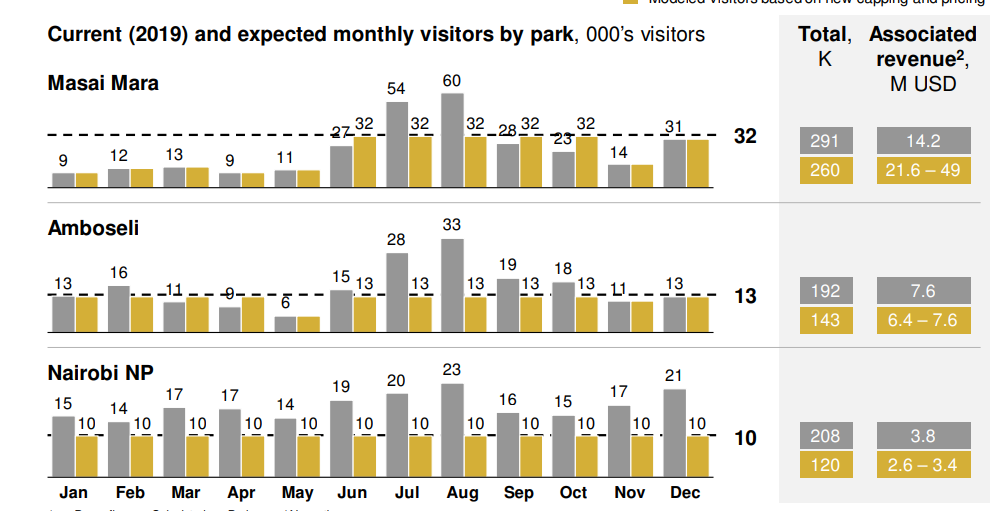
In 2023, the Government of Kenya through the Ministry of Tourism proposed that Narok County introduce a monthly visitor cap of 32,000 for the Masai Mara to help control overcrowding, particularly during peak season. The same proposal referenced comparative capacity benchmarks, recommending peak monthly limits of 13,000 visitors for Amboseli National Park and 10,000 visitors for Nairobi National Park. However, these proposed caps were not implemented.
❓ Why does the Masai Mara talk about “carrying capacity”?
Carrying capacity is the maximum level of visitor and vehicle use the ecosystem can sustain without ecological damage or loss of quality experience. Management uses this concept to guide:
- Zoning
- Seasonal controls
- Hotspot management
- Infrastructure planning
It is a planning tool, not just a theoretical idea.
❓ Who is responsible for anti-poaching and security?
Reserve-level security is coordinated under Narok County’s authority, with rangers, wardens, and enforcement teams operating in the Reserve. In some sectors (such as the Mara Triangle), these functions are delivered through delegated management. National agencies may support in serious or cross-border cases.
❓ Does Kenya Wildlife Service (KWS) run the Masai Mara?
No. The Masai Mara is a county reserve, not a national park. It is administered by Narok County Government.
However, national wildlife law still applies, and KWS has statutory roles in wildlife conservation, enforcement support, and policy coordination at the national level.
❓ Who decides how revenue from the Masai Mara is spent?
Narok County Government controls the public budgeting and allocation process. Revenue from park fees goes into the county system and is then allocated through county budgets to support:
- Conservation and security
- Roads and infrastructure
- Administration and services
- Other county priorities
In delegated areas (like the Mara Triangle), distribution rules are defined by management agreements.
❓ Why do fee rates sometimes change?
Fees in Masai Mara change based on time of the year with peak season (July to Dec) having higher rates than low-season period of Jan to June. Narok County government occassionally adjusts the rates based on:
- Conservation funding needs
- Inflation and operating costs
- Infrastructure and security requirements
- Policy decisions by the County
Fees are a management tool to balance access, sustainability, and financial viability of the Reserve.
❓ Who monitors whether management is working?
Monitoring happens through:
- Ecological indicators (habitat condition, wildlife trends)
- Tourism indicators (visitor pressure, congestion, incidents)
- Operational indicators (patrol effort, compliance, infrastructure condition)
- Financial indicators (revenue performance and controls)
These feed back into adaptive management decisions.
❓ Why is the Masai Mara managed together with conservancies and dispersal areas in planning?
Because wildlife does not recognize boundaries. The Greater Maasai Mara Ecosystem approach recognizes that:
- Migration routes
- Dispersal areas
- Community lands
- Corridors
are all essential to the Reserve’s long-term health. Good management therefore requires landscape-scale coordination, not just fence-line thinking.
❓ Who handles emergencies inside the Reserve?
Reserve management and rangers coordinate emergency response inside the park, often working with:
- Tour operators and lodges
- Local medical providers
- County or national emergency services (when needed)
Your tour operator and lodge also play a key role in guest-level emergency support.
❓ Why do management plans matter so much?
A Management Plan is not just a document—it is the legal and operational blueprint for:
- Zoning and land use
- Tourism management
- Conservation priorities
- Infrastructure development
- Monitoring and enforcement
Without a plan, management becomes reactive and ad hoc instead of strategic and accountable.
❓ Can rules be different in different parts of the Masai Mara?
Yes. Different zones and sectors of the Reserve (and conservancies) may have:
- Different access rules
- Different vehicle limits
- Different activity permissions
- Different operating hours or restrictions
This is intentional zoning-based management, not inconsistency.
❓ What is the biggest management challenge in the Masai Mara today?
From a governance perspective, the biggest challenges are:
- Balancing tourism pressure with ecological limits
- Maintaining financial stability despite seasonality
- Ensuring consistent rule enforcement
- Coordinating across multiple jurisdictions (Reserve + conservancies + communities)
These are institutional challenges, not just wildlife challenges.
❓ How can visitors support better management without even noticing?
- Choose responsible operators who follow rules
- Avoid crowding at sightings
- Respect zoning and park instructions
- Accept that some restrictions exist to protect the ecosystem
Small behaviour changes at scale make management work easier and more effective.
Masai Mara Management of Safaris– Visitor FAQs
❓ Who manages my safari when I book a trip to the Masai Mara?
Your safari is managed by your Masai Mar tour operator, Mara accommodation(lodge, hotel or camp)—the business you book with. They handle your itinerary, vehicle, guide, accommodation, logistics, and daily game drives.
Narok County Government does not run safaris and does not provide guides or vehicles to visitors. Considering a visit to Masai Mara and not sure about the cost of safari, when to visit, how to get there, or have specific info about packages such as types of packages available, itineraries, prices, inclusions and more, check out our guide on Masai Mara Packages for Safaris.
❓ What does Narok County actually manage?
Narok County Government manages the Masai Mara National Reserve as a public protected area. This includes:
- Setting and enforcing park rules
- Implementing the Reserve Management Plan
- Overseeing conservation, security, and infrastructure
- Running the park fee system for the Reserve
The County does not manage individual tours or guest bookings.
❓ When I pay park fees, who receives the money?
When you pay for:
- Masai Mara entry fees
- Camping fees
- Vehicle entry fees
- Balloon landing fees (if applicable)
Those are public conservation fees. They are collected on behalf of Narok County Government through KAPS (Kenya Airports Parking Services), the appointed revenue collection agency.
KAPS operates the ticketing and payment system at all official entry gates and airstrips. The money goes into the Narok County revenue system to support conservation, security, roads, and Reserve management.
Your tour operator may collect or process the payment for convenience, but the fee itself does not belong to the operator.
❓ Does my tour operator keep my park entry fees?
No. Park entry, vehicle entry, driver entry, camping fees, and balloon landing fees are not tour operator income.
They are county conservation fees collected via KAPS and remitted to Narok County Government.
❓ What if I’m staying in a conservancy instead of the main Reserve?
If you stay in a private or community conservancy and do game drives only inside that conservancy:
- Your safari is managed by the conservancy and your lodge/operator
- You pay conservancy fees, not Masai Mara National Reserve fees
- Those fees are channeled back to the local community, mainly through land lease payments to landowners, conservation costs, and community projects
In this case, Narok County is not managing your game drives—the conservancy is.
❓ What if my itinerary includes both a conservancy and the main Reserve?
Then you will usually pay two types of fees:
- Conservancy fees for days spent inside the conservancy (supporting community land and conservation)
- Masai Mara National Reserve fees for days spent inside the Reserve (going to Narok County via KAPS)
Your tour operator coordinates this for you, so it feels seamless even though different systems are involved.
❓ Who controls the rules inside the Masai Mara National Reserve?
The Reserve rules (speed limits, off-road driving, viewing distances, etc.) are set and enforced under Narok County’s authority as the Reserve trustee.
Your guide and operator are responsible for helping you follow those rules during your safari.
❓ Who is responsible for my safety, vehicle, and guide?
Your tour operator, lodge, or camp is responsible for:
- Your vehicle and driver-guide
- Your daily safari schedule
- Your on-the-ground guest experience
- Your logistics and accommodation
The Reserve authority focuses on park-wide management, conservation, and regulation, not individual guest services.
✅ The simple takeaway
- Your safari is run by your tour operator or lodge.
- Narok County manages the Masai Mara as a protected area, not your trip.
- Park fees go to Narok County via KAPS, the official collection agency.
- Conservancy safaris are managed by the conservancy, with fees supporting local communities.
So: operators run your safari, the County runs the Reserve, and your fees fund conservation—either through Narok County or through community conservancies, depending on where you go.
Conclusion
The future of the Masai Mara, the Mara Reserve, and the wider Greater Mara Ecosystem depends not only on wildlife and tourism demand, but on institutional discipline, legal compliance, effective planning, and accountable administration. The existing governance framework—the Wildlife Conservation and Management Act (2013), the Narok County Tourism Act (2017), and the MMNR Management Plan 2023–2032—provides the scaffolding. Success now depends on consistent implementation, transparent reporting, and shared commitment from government, operators, communities, and visitors alike.
📄 Key Laws & Legal Framework
- Wildlife Conservation and Management Act, 2013 (Kenya) — National wildlife law governing conservation and protected areas.
- Narok County Tourism Act, 2017 — Foundational county law governing tourism development, licensing, regulation, and enforcement.
📘 Reserve Management Plans
- Maasai Mara National Reserve Management Plan 2023–2032 (PDF) — The authoritative ten-year operational roadmap for the Reserve.
📊 County & Governance Planning Documents
- Narok County Integrated Development Plan (CIDP) 2023–2027 (PDF) — Five-year county development plan including tourism and conservation sectors.
- Narok County Physical & Land Use Development Plan 2023–2032 (PDF) — Part of integrated county spatial and sector planning.
🤝 Delegated Management & Governance Arrangements
- Mara Conservancy Management Agreement — Mandates Mara Conservancy to manage the Mara Triangle on behalf of Narok County (fee distribution, security, tourism, infrastructure).
- Mara Conservancy History & Governance Overview — Provides background on delegated management arrangements.
🧾 Supplementary Planning & Policy Context
Wildlife Conservation and Management (Access, Entry and Conservation) (Fees) Regulations, 2025 (PDF) — Draft regulations on access and conservation fees for parks and reserves (national framework).
📄 Key Laws & Legal Framework
- Wildlife Conservation and Management Act, 2013 (Kenya) — National wildlife law governing conservation and protected areas.
- Narok County Tourism Act, 2017 — Foundational county law governing tourism development, licensing, regulation, and enforcement.
📘 Reserve Management Plans
- Maasai Mara National Reserve Management Plan 2023–2032 (PDF) — The authoritative ten-year operational roadmap for the Reserve.
📊 County & Governance Planning Documents
- Narok County Integrated Development Plan (CIDP) 2023–2027 (PDF) — Five-year county development plan including tourism and conservation sectors.
- Narok County Physical & Land Use Development Plan 2023–2032 (PDF) — Part of integrated county spatial and sector planning.
🤝 Delegated Management & Governance Arrangements
- Mara Conservancy Management Agreement — Mandates Mara Conservancy to manage the Mara Triangle on behalf of Narok County (fee distribution, security, tourism, infrastructure).
- Mara Conservancy History & Governance Overview — Provides background on delegated management arrangements.
🧾 Supplementary Planning & Policy Context
Wildlife Conservation and Management (Access, Entry and Conservation) (Fees) Regulations, 2025 (PDF) — Draft regulations on access and conservation fees for parks and reserves (national framework).