
Masai Mara National Reserve is one of the few safari destinations in Africa where wildlife viewing is excellent all year, but the experience changes dramatically by season. The best time to visit depends on whether you prioritize the Great Migration, big cats, good weather, fewer crowds, lower prices, photography, birdwatching, or easy driving conditions.
In short:
- Best overall safari months: July–October (dry season, Migration window, best wildlife concentration)
- Best alternative with fewer crowds: January–March (predators, clear skies, quieter)
- Cheapest time to visit: April–May (long rains, low season deals)
- Best for birdwatching & green landscapes: November–April
- Best for photography: July–October (clean sightlines) and Jan–Mar / Nov (green backdrops & dramatic skies)
Below is the practical, on-the-ground month-by-month guide used by safari planners and guides.
January – Short Dry Season (Best for big cats, clear skies, and fewer crowds)
- Weather: Warm days, cool mornings, mostly dry
- Wildlife: Excellent resident game; lions, cheetahs, and leopards very active
- Crowds: Moderate, noticeably quieter than peak season
- Prices: Often better value than July–September
Why visit in January? (Best for predator sightings, photography, and avoiding peak crowds while keeping great weather and road conditions.)
Great for self-drive, family safaris, and honeymoons wanting a quieter Mara.
February – Short Dry Season (Best “insider” month for predators and photography)
- Weather: Warm, sunny, very clear light
- Wildlife: Peak big-cat action; superb visibility
- Crowds: Moderate
- Photography: Excellent light, clean backgrounds
Why visit in February? (Best balance of strong wildlife, great weather, and manageable crowds.)
One of the best months for cheetah and lion sightings and a favorite for serious photographers.
March – Transition to Long Rains (Best for value, birding, and fewer tourists)
- Weather: Warmer, more humid; showers increase later in the month
- Wildlife: Still very good; birds increase; grass starts growing
- Crowds: Low to moderate
- Prices: Often start to drop
Why visit in March? (Best for deals, quieter safaris, and mixed wildlife + birding before heavy rains arrive.)
Early March can feel like peak season; late March becomes more variable.
April – Long Rainy Season(Best for budget safaris and lush scenery, avoid crowds)
- Weather: Wettest month; heavy rains possible
- Wildlife: Still present but more dispersed; tall grass
- Roads: Muddy in places; 4×4 essential
- Crowds: Very low
- Prices: Cheapest of the year; big lodge discounts
Why visit in April? (Best for cheapest prices, solitude, and dramatic green landscapes—if you accept rain and rough roads.)
Ideal for budget travelers and birdwatchers, not for first-timers seeking easy game drives.
May – Long Rainy Season (Late May Improves):Best for quiet safaris and continued low-season deals
- Weather: Still wet, but often easing toward end of month
- Wildlife: Good general game; visibility depends on grass height
- Crowds: Very low
- Prices: Still low-season
Why visit in May? (Best for peaceful, uncrowded safaris and strong discounts, with improving conditions late in the month.)
Excellent for travelers who value privacy and price over predictability.
June – Transition to Dry Season(Best for high-quality safaris before peak crowds arrive)
- Weather: Drying out, cooler mornings, pleasant days
- Wildlife: Concentration increases around water; visibility improves
- Crowds: Moderate
- Roads: Much better than April–May
Why visit in June? (Best “sweet spot” month: near-peak wildlife quality without peak-season congestion or prices.)
Great for self-drive, photography, and travelers who want a quieter version of peak season.
July – Start of Peak Dry Season & Migration Window(Best for classic Masai Mara safari conditions)
- Weather: Cool mornings, dry days, excellent visibility
- Wildlife: Very high density; Migration often arrives
- Crowds: High, especially near rivers
- Prices: Peak season begins
Why visit in July? (Best for reliable wildlife viewing and your first real chance to see the Great Migration in the Mara.)
Also one of the best months for balloon safaris due to stable weather.
August – Peak Dry Season & Migration Drama(Best for Great Migration and possible river crossings)
- Weather: Dry, sunny, comfortable
- Wildlife: Huge herds, intense predator activity
- Crowds: Very high
- Photography: Outstanding for action and dust-light scenes
Why visit in August? (Best for bucket-list Migration safaris and the highest chance of witnessing river crossings—though never guaranteed.)
This is the most famous, most dramatic, and busiest time in the Mara.
September – Peak Continues, Often Slightly Calmer(Best balance of Migration action and slightly fewer crowds than August)
- Weather: Dry and warm
- Wildlife: Strong predator-prey interactions; herds often still present
- Crowds: High, but sometimes less intense than August
Why visit in September? (Best for Migration + big cats with a marginally better crowd balance than August.)
Excellent for travelers who want peak wildlife without the absolute peak pressure.
October – End of Dry Season(Best for great wildlife with easing crowds)
- Weather: Warm, mostly dry; occasional showers may start late month
- Wildlife: Resident game excellent; some Migration still possible
- Crowds: Moderate to high
- Prices: Sometimes slightly softer than Aug–Sep
Why visit in October? (Best for near-peak safari quality with better crowd and price balance.)
A favorite for those who want top-tier sightings without the worst congestion.
November – Short Rains Begin(Best for green landscapes, birdwatching, and quieter safaris)
- Weather: Short, sporadic showers; lots of sunshine in between
- Wildlife: Resident animals remain; migratory birds arrive
- Crowds: Low
- Scenery: Fresh, green, very photogenic
Why visit in November? (Best for birdwatching, scenic photography, and peaceful game drives with fewer vehicles.)
Great for travelers who prioritize atmosphere and space over Migration spectacle.
December – Short Rains & Festive Season(Best for holiday safaris and green-season wildlife)
- Weather: Warm with occasional rain
- Wildlife: Resident predators and herbivores very active
- Crowds: Moderate to high around Christmas/New Year
- Experience: Lively lodges, festive atmosphere
Why visit in December? (Best for combining good wildlife, green scenery, and a festive safari experience.)
Popular for family trips and holiday travel.
Best Time to Visit Masai Mara by Travel Goal
| Travel Goal | Best Months | Why |
|---|---|---|
| Great Migration & river crossings | July–September | Highest chance of herds + crossing drama |
| Best overall safari conditions | July–October | Dry roads, short grass, high wildlife density |
| Big cats & predators | January–March, Aug–Sept | Strong hunting activity, great visibility |
| Cheapest time to visit | April–May | Low season discounts up to ~50% |
| Fewer crowds | April–May, November, January | Quieter parks, less vehicle congestion |
| Photography (clean action shots) | July–October | Short grass, dust light, clear views |
| Photography (green landscapes) | Nov–March, April–May | Dramatic skies, lush scenery |
| Birdwatching | November–April | Migratory species present |
| Self-drive safaris | June–October, Jan–Feb | Best road conditions |
| Balloon safaris | July–October, Jan–March | Most reliable flying weather |
| Family safaris | January–March, December | Gentler pace, fewer crowds or holiday vibe |
| Honeymoon safaris | June, October, February | Great wildlife + better privacy balance |
Masai Mara Seasons at a Glance
Masai Mara has two key climate rhythms that shape safari quality:
- Dry season: June–October (main dry), plus January–March (short dry)
- Rainy season: April–May (long rains), November–December (short rains)
Quick season comparison table
| Season | Months | What It’s Best For | What to Watch For |
|---|---|---|---|
| Main Dry Season | Jun–Oct | Best overall game viewing, easiest roads, Migration window | Higher prices, more crowds (Jul–Sep) |
| Short Rains | Nov–Dec | Green landscapes, birding, fewer crowds | Sporadic showers, some muddy tracks |
| Short Dry Season | Jan–Mar | Big cats, clear skies, quieter drives | Warmer midday heat, no “peak” Migration crowds |
| Long Rains | Apr–May | Lowest prices, lush scenery, birding | Muddy/impassable roads in places, tall grass |
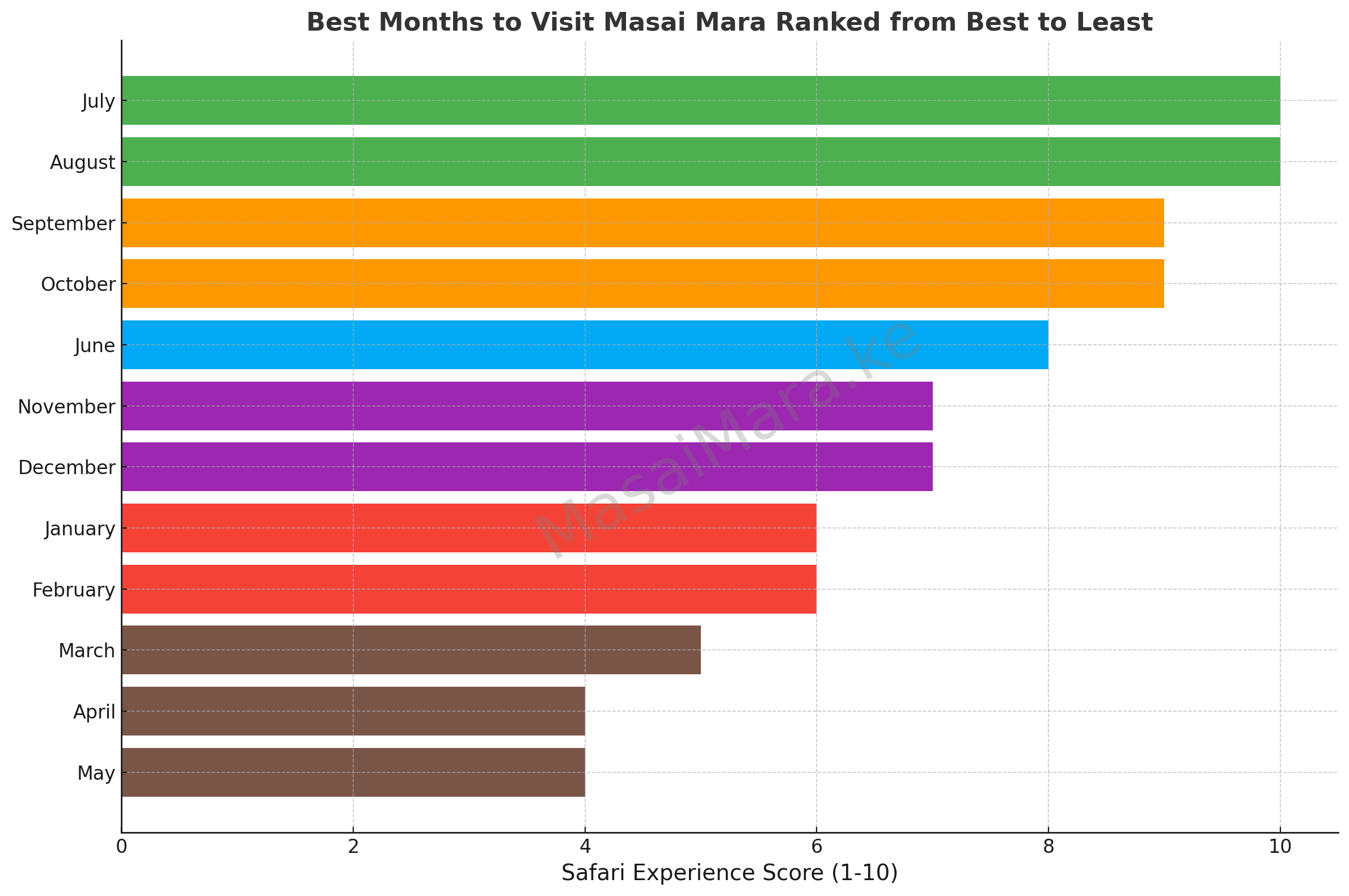
MasaiMara.ke Safari Experience Score (simple decision tool)

Use this as a quick “quality vs predictability” guide (10 = best overall safari conditions).
| Period | Safari Experience Score | Why |
|---|---|---|
| July–October | 10/10 | Dry, high wildlife concentration; Migration drama |
| June | 8/10 | Dry season quality begins; fewer crowds than peak |
| January–March | 7/10 | Strong predator sightings + clear skies + fewer crowds |
| November–December | 7/10 | Fresh green Mara, birding, quieter drives |
| April–May | 5/10 | Cheapest + lush, but most road/weather variability |
Best Time to Visit Masai Mara for Photography
Photography in the Mara isn’t just “dry season = best.” The best month depends on the look you want: clean sightlines and action, or green backdrops and dramatic skies.
Dry-season photography (classic “BBC Mara” look)
Best months: July–October
Why: short grass, higher wildlife concentration, predictable movement, and clear backgrounds—plus Migration action opportunities. Many photo-focused camps describe July–October as the “action season,” with dust, crossings, and predator chases being the defining visual themes.
Trade-off (from reviews/forums): late dry season can become very dusty, which can reduce crispness and make light harsher (and travelers sometimes call it “poor photography” compared to greener months).
Green-season photography (lush, cinematic, “National Geographic color”)
Best months: January–March, November
Why: greener plains, dramatic cloud structure, cleaner air after showers, and softer light windows (especially mornings/late afternoons). Photo-oriented guides often frame Nov–Mar as a hidden gem for “mood” and layered landscapes.
Rainy-season “storm photography” (for experienced travelers)
Best months: April–May
Why: the Mara can look spectacular—deep greens, heavy skies, and rare atmospheric moments. But it’s also the period most likely to disrupt game-drive routing due to mud/track closures.
Pro photography tip (crowd physics): In August–September, you’ll often get the action—but also more vehicles. If you want cleaner compositions, consider June or October for similar wildlife quality with better spacing, or focus on quieter zones away from the busiest river “hotspots.”
Best Time to Visit Masai Mara for Birdwatching
Best months: November–April
Why: migratory birds arrive and many species are active in breeding behavior; bird lists spike in the greener months. This Nov–Apr window is consistently cited by camp birding guides as prime season.
Extra nuance birders care about
- April–May & November can be especially productive because bird activity rises with rain-driven food abundance and breeding displays.
- Birding is good year-round, but the Mara feels most “alive” for birds when the grass is green and insects are abundant.
Cheapest Time to Visit Masai Mara
Cheapest months: April–May
Why: long rains bring the lowest demand and the biggest low-season discounts; many travelers choose these months specifically for value, accepting that some roads can become difficult.
Next-best value: March, November, early December
Why: shoulder/short-rains periods can offer meaningful savings without the full intensity of April–May conditions (and with plenty of sunshine between showers).
High Season vs Low Season in Masai Mara
This is the section that converts because it answers what people actually mean by “Is it worth it?”
High season (typically July–October; peak Jul–Sep)
Pros
- Best road reliability, visibility, and wildlife concentration
- Best chance of encountering Migration herds in the Mara
Cons
- Crowds around marquee sightings (especially river areas)
- Higher rates and earlier booking requirements
Low season (April–May; parts of Nov–Dec; sometimes March)
Pros
- Big savings, fewer vehicles, greener scenery
- Birding is often better in green months
Cons
- Game drives become more “tactical” (road selection matters)
- Tall grass can make predator spotting harder; routing can be weather-driven
Unique perspective (reviews pattern): Most “low season disappointment” isn’t about wildlife. It’s about logistics—getting stuck, slower drives, or not reaching certain areas after heavy rain.
Best Months for Big Cats (and for Lion vs Cheetah vs Leopard)
Big cats are present all year, but the ease and style of sightings shifts.
Best months for big cats overall
January–March and July–October
Why: visibility is generally strong in these drier windows and prey movement concentrates, which increases hunt opportunities and repeat sightings.
Lion: best time
July–October, plus January–February
Why: in dry months lions are easier to track (short grass, concentrated prey). Jan–Feb also tends to offer clear conditions and reliable resident pride viewing.
Cheetah: best time
January–March and June–September
Why: cheetahs benefit from open plains and visibility—shorter grass months increase the odds of seeing stalking and chase behavior.
Leopard: best time
June–October, plus January–February
Why: leopards are always elusive, but drier months make it easier to spot them in riverine woodland edges and on trees, and guides can cover more ground on reliable tracks.
Important truth to state clearly: If your goal is specifically cheetah and clean action photography, don’t automatically choose August. In peak months, you may find more vehicles around headline sightings. Many photographers purposely target June (pre-peak) or September (still excellent) for a better balance of action and space.
Great Migration & Mara River Crossings
Migration months in the Mara
Most likely: July–October
Best months for river-crossing probability
Late July–August–September (and sometimes into October)
Why: multiple operator guides describe July/Aug as prime crossing months, with September/October often providing strong action with slightly less “peak pressure.”
Unique, well-informed caveat: A “crossing” is not scheduled. Even in peak months, you can see enormous herds without a crossing that day. Positioning, patience, and guide strategy matter as much as the calendar.
Road Conditions in Rainy Season
This section is essential for managing expectations (and protecting reviews).
What to know about April–May (long rains)
- The Mara’s black cotton soil can become extremely slick and sticky after heavy rain—vehicles can bog down and some tracks become impractical. This is a recurring theme in traveler discussions.
- Game drives may shift to firmer routes, higher ground, or better-drained areas.
Practical guidance to add
- 4×4 is non-negotiable in wet months; avoid low-clearance vehicles.
- Plan with flexibility: in rainy season, the “best” areas are sometimes the ones you can reach safely.
How to phrase it accurately: rain rarely ruins the whole day—what it changes is where you can go and how long it takes to get there.
Best Time for a Hot Air Balloon Safari in Masai Mara
Best months: July–October, with January–March as a strong second choice.
Why: ballooning is most consistent in stable, drier weather with predictable mornings; peak months also align with Migration spectacle from the air. Operators and camps often frame the dry season as the most reliable window.
Best Time to Visit Masai Mara With Family
Best months: June–October and January–March
Why: fewer weather disruptions, more comfortable day-to-day logistics, and easier wildlife spotting (which matters when kids have shorter patience for long tracking). The dry season also keeps drives smoother and more predictable.
Best “family balance” months: June and October
Why: excellent game viewing with a better crowd/price balance than Aug–Sep.
Best Time to Visit Masai Mara for Fewer Crowds
If you want quieter sightings and less vehicle congestion:
Best low-crowd months
- April–May (very quiet, but weather risk)
- November (green, calmer, good birding)
- January (excellent safari quality, typically less congested than peak)
Best “smart compromise” months
- June and October: near-peak wildlife quality with less intense crowding than Aug–Sep.
Best Months of the Dry Season in Masai Mara
Main dry season (most reliable safari driving + sightlines)
June–October
Peak “dry season + Migration overlap”
July–September
🧭 Masai Mara Safari Decision Hub
| Your Safari Goal | Best Months | Why This Window Works | What to Expect | Jump To |
|---|---|---|---|---|
| Great Migration & River Crossings | Late Jul – Sep (often into Oct) | Highest probability of herds in the Mara; best odds for crossings (never guaranteed) | Big herds, predator pressure, busiest areas near rivers | See July–October |
| Best Overall Safari Conditions | Jun – Oct | Dry roads, short grass, high wildlife concentration | Reliable sightings, easier driving, higher prices in peak | See June–October |
| Big Cats (All Species) | Jan – Mar & Jul – Oct | Clear sightlines + concentrated prey movement | Strong lion/cheetah/leopard activity | See Jan–Mar and Jul–Oct |
| Lions (Prides, Hunts) | Jul – Oct, Jan – Feb | Dry months = easier tracking; prey concentrates | Pride interactions, territorial behavior | See Jan–Feb and Jul–Oct |
| Cheetahs (Chases, Open Plains) | Jan – Mar, Jun – Sep | Shorter grass + open plains improve hunt visibility | Stalking and chase sequences more likely | See Jan–Mar and Jun–Sep |
| Leopards (Elusive, Riverine Zones) | Jun – Oct, Jan – Feb | Better track access + cleaner sightlines in dry months | Tree sightings, riverine patrols | See Jan–Feb and Jun–Oct |
| Photography (Clean Action) | Jul – Oct | Short grass, predictable movement, Migration drama | Dust, action, classic “Mara” look | See Jul–Oct |
| Photography (Green, Cinematic) | Jan – Mar, Nov | Lush backdrops, dramatic skies, softer light | Fewer vehicles, richer colors | See Jan–Mar and November |
| Birdwatching | Nov – Apr | Migratory birds present; breeding activity | Big lists, active wetlands and grasslands | See Nov–Apr |
| Cheapest Time / Best Deals | Apr – May (then Mar, Nov) | Low season + long rains = deepest discounts | Muddy tracks possible; quieter parks | See April–May |
| Fewer Crowds / Quiet Safaris | Apr – May, Nov, Jan | Low demand or shoulder periods | More space at sightings; flexible routing | See April–May, November, January |
| Family-Friendly Conditions | Jun – Oct, Jan – Mar | Drier roads, easier wildlife viewing, predictable days | Smoother logistics, longer comfortable drives | See Jan–Mar and Jun–Oct |
| Hot Air Balloon Safari | Jul – Oct (also Jan – Mar) | Most stable mornings for flights | Best reliability + epic aerial views | See Jan–Mar and Jul–Oct |
| Self-Drive Friendly Months | Jun – Oct, Jan – Feb | Firm tracks, fewer bog-down risks | Easier navigation, wider route options | See Jan–Feb and Jun–Oct |
| Green Landscapes & Atmosphere | Nov – Mar, Apr – May | Rains refresh plains; dramatic skies | Lush scenery; variable access | See Nov–May |
| Avoid Peak Prices | Mar, Nov, Apr – May | Shoulder/low seasons reduce rates | Trade some predictability for savings | See March, November, April–May |
Masai Mara, Kenya’s most iconic safari destination, offers spectacular wildlife viewing year-round. Famous for the Great Migration, high predator density, and diverse landscapes, it’s a dream destination for safari lovers. But when is the best time to visit?
This comprehensive guide will help you plan your perfect Masai Mara safari, covering seasonal highlights, weather patterns, wildlife activity, crowd levels, and expert tips for an unforgettable adventure.
🌍 Best Time to Visit Masai Mara
The Short Answer:
The best time to visit Masai Mara is during the dry season (June to October), especially July to September, when the Great Migration is at its peak. This is when over 1.5 million wildebeest, zebras, and gazelles move into the Mara, leading to dramatic river crossings and intense predator-prey action. Wildlife is highly concentrated, making it the prime safari season.
The second-best time to visit is January to March, during the calving season. This is when thousands of baby wildebeest, zebras, and gazelles are born, attracting predators like lions, cheetahs, and hyenas, leading to thrilling hunts. With fewer tourists and clear skies, it’s an excellent time for photography and big cat sightings.
For budget travelers, the best time is April to May, during the long rainy season. Though some roads get muddy and wildlife is more dispersed, lodges offer huge discounts, the scenery is lush, and birdwatching is at its best.
However, Masai Mara is a year-round safari destination, and each season offers unique experiences, from lush green landscapes in the rainy season to predator action during the migration.
📅 Masai Mara Seasons
Masai Mara has two main seasons: the dry season (June–October, January–March) and the rainy season (April–May, November–December). The long dry season (June–October) is best for wildlife viewing, with the Great Migration peaking from July to September. The short rains (November–December) bring lush landscapes, migratory birds, and fewer crowds.
The short dry season (January–March) marks calving season, attracting predators like lions and cheetahs. The long rains (April–May) offer budget-friendly safaris, rich birdlife, and vibrant scenery, though some roads become muddy. Each season provides a unique safari experience, making Masai Mara a year-round destination.
1. Long Dry Season (June – October) ⏳
Best for: The Great Migration, predator action, and clear weather.
Weather: Sunny, dry, with cool mornings and evenings.
✔ Peak of the Great Migration – Over 1.5 million wildebeest, zebras, and gazelles cross the Mara River from Tanzania’s Serengeti into Kenya’s Masai Mara.
✔ Predator paradise – Lions, leopards, cheetahs, and crocodiles hunt migrating herds.
✔ Excellent game viewing – Grass is short, and animals gather around permanent water sources.
✔ Cool temperatures – Daytime highs of 25°C (77°F), cool mornings (10°C/50°F).
📌 Why Visit?
✔ Best chance to witness the river crossings (July–September).
✔ Dry weather = easier wildlife spotting and better road conditions.
✔ High predator activity, making it a thrilling time for safari photography.
🔺 Downside:
❌ Peak season = more tourists and higher lodge prices.
2. Short Rainy Season (November – December) 🌧️
Best for: Green landscapes, fewer tourists, and birdwatching.
Weather: Short rains, but mostly warm and sunny.
✔ Lush green landscapes – The Mara transforms into a vibrant paradise.
✔ Good game viewing – Many animals remain, but the migration moves south.
✔ Birdwatching season begins – Migratory birds arrive from Europe and Asia.
✔ Fewer tourists – Lower prices and quieter safaris.
📌 Why Visit?
✔ Avoid crowds while still seeing the Big Five.
✔ Dramatic scenery for photographers.
✔ Good value for money – Lodges may offer discounts.
🔺 Downside:
❌ Some dirt roads become muddy and challenging.
❌ Migration has left, but resident wildlife is still abundant.
3. Short Dry Season (January – March) ☀️
Best for: Calving season, predator action, and fewer crowds.
Weather: Warm and dry, occasional showers.
✔ Calving season (February-March) – Thousands of baby wildebeest, zebras, and gazelles are born.
✔ Predator peak – Lions, cheetahs, and leopards target vulnerable young prey.
✔ Clear skies – Fantastic for photography.
✔ Warm temperatures – 26-30°C (79-86°F), mild mornings.
📌 Why Visit?
✔ Best for seeing baby animals and dramatic predator-prey interactions.
✔ Great weather and fewer crowds than migration season.
✔ Good deals on accommodations.
🔺 Downside:
❌ No Great Migration, but resident wildlife is still excellent.
4. Long Rainy Season (April – May) 🌦️
Best for: Budget travelers, lush scenery, and birdwatching.
Weather: Heavy rains, cooler temperatures.
✔ Lush green landscapes – The Mara is at its most scenic.
✔ Cheapest time to visit – Lodges offer low-season discounts.
✔ Fewer tourists – Private game drives with little vehicle congestion.
✔ Birdwatching paradise – Migratory birds and vibrant ecosystems.
📌 Why Visit?
✔ Best time for budget travelers – Luxury lodges offer discounts.
✔ Photographers’ dream – Dramatic lighting and green landscapes.
✔ Peaceful safari experience – No crowds.
🔺 Downside:
❌ Heavy rain can make some roads impassable.
❌ Wildlife can be harder to spot in tall grass.
❌ Migration is absent, but the Big Five and resident predators remain.
🌦️ Masai Mara Weather & Climate
| Season | Months | Weather | Wildlife Activity | Crowds |
|---|---|---|---|---|
| Long Dry Season | June – October | Cool mornings, warm days, little rain | Best time for the Great Migration, big cats, and easy spotting | High |
| Short Rainy Season | November – December | Brief afternoon showers, mostly sunny | Migratory birds arrive, lush landscapes | Low |
| Short Dry Season | January – March | Warm, dry, occasional brief showers | Calving season = high predator activity | Moderate |
| Long Rainy Season | April – May | Heavy rains, cloudy days | Lush, green landscapes, fewer crowds | Low |
📌 Pro Tip: Mornings can be chilly, especially in June – August, so pack warm layers for early game drives.
✅ When to Visit Masai Mara (Month-by-Month Breakdown)
| Month | Best For |
|---|---|
| January – March | Calving season, great predator action, fewer crowds |
| April – May | Budget safaris, birdwatching, lush scenery |
| June – October | Best time for the Great Migration, predator-prey action, and clear weather |
| November – December | Green landscapes, migratory birds, fewer tourists |
Masai Mara Month-by-Month Breakdown
| Month | Season | Weather | Wildlife Activity | Crowds |
|---|---|---|---|---|
| January | Short Dry Season | Hot, dry, sunny | Great game viewing, calving season | Moderate |
| February | Short Dry Season | Warm, clear skies | Excellent wildlife sightings, predator activity | Moderate |
| March | Start of Long Rains | Occasional showers | Wildlife dispersed, but still visible | Fewer tourists |
| April | Long Rainy Season | Heavy rainfall | Lush scenery, some animals harder to spot | Low |
| May | Long Rainy Season | Wet, green landscapes | Good birdwatching, fewer animals visible | Low |
| June | End of Long Rains | Drying up, cooler temps | Increasing wildlife sightings as land dries | Moderate |
| July | Long Dry Season | Cool, dry, clear skies | Best time for the Great Migration, predator-prey action | High |
| August | Long Dry Season | Sunny, crisp mornings | Peak of the Great Migration, river crossings | High |
| September | Long Dry Season | Warm, little rain | Excellent for predators and prey interactions | High |
| October | End of Dry Season | Warm, dry, occasional showers | Great wildlife concentration, some migration still present | Moderate |
| November | Short Rainy Season | Afternoon showers | Bird migration, lush greenery | Low |
| December | Short Rainy Season | Warm, sporadic rain | Good game viewing, festive season vibes, resident wildlife thriving | Moderate |
Which Month is Best to Visit Masai Mara: Month-by-Month Summary
Masai Mara is a year-round safari destination, offering diverse wildlife experiences depending on the season. From the Great Migration’s dramatic river crossings to calving season’s predator action, every month has something unique to offer.
This expert guide breaks down each month’s weather, wildlife highlights, travel experience, and packing tips to help you choose the best time for your safari.
📅 January – Calving Season Begins
✔ Weather: Warm, dry, with occasional showers (25-30°C / 77-86°F).
✔ Wildlife: The calving season starts, with thousands of newborn wildebeest, zebras, and gazelles. Predators like lions and cheetahs are highly active.
✔ Wildlife Experience: Fantastic for big cat sightings, as lions, leopards, and cheetahs take advantage of easy prey.
✔ Packing Tips: Light clothing for hot days, a fleece/jacket for chilly mornings, sunscreen, and a good camera for predator action.
✔ Why Visit? Calving season = high predator activity. Fewer tourists than peak months, making for quieter game drives.
📅 February – Peak of Calving Season & Predator Action
✔ Weather: Warm and sunny, with clear skies (25-30°C / 77-86°F).
✔ Wildlife: Many newborn animals, which means intense predator-prey interactions.
✔ Wildlife Experience: Expect thrilling chases as cheetahs hunt vulnerable young prey.
✔ Packing Tips: Light layers, wide-brimmed hat, polarized sunglasses, and a good zoom lens for predator photography.
✔ Why Visit? One of the best months for predator viewing and an excellent time for photographers due to the bright, clear days.
📅 March – Transition to the Long Rains
✔ Weather: Warmer, with increasing humidity and scattered showers (25-32°C / 77-89°F).
✔ Wildlife: Calving season is winding down, and resident wildlife remains active.
✔ Wildlife Experience: Excellent for birdwatching as migratory birds begin to arrive. Some roads start to get muddy.
✔ Packing Tips: Waterproof jacket, binoculars for birding, and sturdy boots for muddy terrain.
✔ Why Visit? Fewer crowds, good wildlife sightings, and great discounts on safari lodges.
📅 April – Start of the Long Rainy Season
✔ Weather: Heavy rains, cooler temperatures (20-28°C / 68-82°F).
✔ Wildlife: Lush, green landscapes make for beautiful scenery, but wildlife is more spread out.
✔ Wildlife Experience: Birdwatching is exceptional, and baby animals are still abundant.
✔ Packing Tips: Rain gear, waterproof boots, and insect repellent. Roads can be muddy, so a 4×4 is essential.
✔ Why Visit? Budget travelers benefit from low-season discounts, and the scenery is spectacular for photography.
📅 May – Lush Landscapes & Low Crowds
✔ Weather: Peak of the rainy season, frequent downpours (20-28°C / 68-82°F).
✔ Wildlife: Animals disperse, enjoying the plentiful water sources.
✔ Wildlife Experience: The green season is stunning for landscape photography.
✔ Packing Tips: Waterproof backpack, long-sleeve shirts for mosquito protection, and waterproof covers for cameras.
✔ Why Visit? Quiet safaris, affordable lodges, and birding paradise.
📅 June – Drying Up & Pre-Migration Excitement
✔ Weather: Rains taper off, cooler temperatures (18-26°C / 64-79°F).
✔ Wildlife: Big herds start moving towards northern Serengeti, signaling the upcoming Great Migration.
✔ Wildlife Experience: Increased predator activity, and elephants are frequently seen near rivers.
✔ Packing Tips: Light layers for warm days, a fleece for cool mornings, and a good pair of sunglasses.
✔ Why Visit? Transition into the high season with lower tourist numbers, making it a great time to visit before peak crowds arrive.
📅 July – The Great Migration Begins
✔ Weather: Cool mornings, warm afternoons (15-25°C / 59-77°F).
✔ Wildlife: The Great Migration arrives, with herds crossing into Kenya from Tanzania.
✔ Wildlife Experience: Best time to see massive herds of wildebeest, zebras, and gazelles.
✔ Packing Tips: Warm layers for morning drives, high-SPF sunscreen, and a zoom lens for migration photography.
✔ Why Visit? Prime time for safari-goers, with spectacular migration scenes and frequent river crossings.
📅 August – Peak of the Great Migration & River Crossings
✔ Weather: Dry, sunny, and comfortable (15-27°C / 59-81°F).
✔ Wildlife: Millions of animals gather near the Mara River.
✔ Wildlife Experience: High drama at the river crossings, where crocodiles ambush wildebeest.
✔ Packing Tips: Light breathable clothing, a hat, insect repellent, and extra batteries for photography.
✔ Why Visit? Best time for high-action predator-prey encounters and dramatic river crossings.
📅 September – Great Migration Continues
✔ Weather: Warm and dry (16-28°C / 61-82°F).
✔ Wildlife: Wildebeest herds move further into Masai Mara, and predators remain active.
✔ Wildlife Experience: One of the best months for big cat sightings.
✔ Packing Tips: Sunscreen, neutral-colored clothing, and a lightweight rain jacket.
✔ Why Visit? Less crowded than August, but still peak wildlife activity.
📅 October – The Migration Begins Moving South
✔ Weather: Warmer days, occasional rain (18-30°C / 64-86°F).
✔ Wildlife: Migration herds start returning to Tanzania, but resident wildlife is abundant.
✔ Wildlife Experience: Big cats and elephants dominate the sightings.
✔ Packing Tips: Light layers, comfortable shoes for bush walks, and insect repellent.
✔ Why Visit? Great for those who want to experience the Mara with fewer crowds.
📅 November – The Short Rains Begin
✔ Weather: Afternoon showers, warm (20-30°C / 68-86°F).
✔ Wildlife: Some migration herds remain, while birding season starts.
✔ Wildlife Experience: Lush landscapes and migratory birds arrive in large numbers.
✔ Packing Tips: Waterproof gear, binoculars, and a lightweight rain jacket.
✔ Why Visit? Excellent birdwatching and a quieter safari experience.
📅 December – Festive Safari & Green Season
✔ Weather: Warm, sporadic rain (20-30°C / 68-86°F).
✔ Wildlife: Resident wildlife, elephants, and big cats remain active.
✔ Wildlife Experience: Festive atmosphere, great for family safaris.
✔ Packing Tips: Light rain gear, sunscreen, and safari-friendly shoes.
✔ Why Visit? Festive holiday season with lively safari lodges and good wildlife.
Final Verdict: When Should You Visit Masai Mara?
✔ For the Great Migration: July – October.
✔ For Predator Action: January – March.
✔ For Birdwatching & Green Landscapes: November – April.
✔ For Budget Safaris: April – June.
🚗 Self-Drive vs. Guided Tours: Which Season is Best?
✔ Self-Drive: Best during the dry season (June – October, January – March). Roads are in good condition.
✔ Guided Tours: Great year-round – Guides know where to find wildlife even in rainy months.
📌 4×4 vehicles are mandatory in rainy seasons.
🎯 Expert Tips for the Best Masai Mara Experience
✔ For the Great Migration: Visit in July – October for the most thrilling safari action.
✔ For Predator Sightings: January – March is best, as predators hunt baby animals.
✔ For Birdwatching: November – April, when migratory birds arrive.
✔ For Budget Travelers: April – June offers low-season discounts.
✔ For Photography: Dry season (July – October) provides the best lighting and visibility.
✅ Final Verdict: When Should You Visit Masai Mara?
✔ Best Overall Safari: July – October (Great Migration, best wildlife action).
✔ For Calving & Predator Action: January – March.
✔ For Green Landscapes & Birds: November – April.
✔ For Budget-Friendly Travel: April – June.
No matter when you visit, Masai Mara delivers an unforgettable safari experience. Every season offers something special, making it one of Africa’s best year-round destinations for wildlife lovers, photographers, and adventurers.
Common FAQs on the Best Time to Visit Masai Mara
1. What is the absolute best month to visit Masai Mara?
✔ August to September is considered the absolute best time to visit because it’s the peak of the Great Migration when wildebeest cross the Mara River, facing predators like lions and crocodiles. This is when game viewing is at its most dramatic.
2. When is the worst time to visit Masai Mara?
✔ There is no truly bad time, but April and May (long rainy season) are the least ideal for first-time visitors because heavy rains can make roads muddy, wildlife more spread out, and game drives challenging. However, this season is great for budget travelers and birdwatchers.
3. Is Masai Mara good in December?
✔ Yes! December falls in the short rainy season, but rains are usually brief, and the park remains lush and full of wildlife. Predators are active, and migratory birds arrive, making it a great time for photographers and birdwatchers.
4. Is it better to visit Masai Mara in January or July?
✔ July is better for witnessing the Great Migration, but January is great for fewer crowds and predator activity.
✔ In January, the calving season begins, making it perfect for predator-prey action.
✔ If you prefer dramatic river crossings, visit in July; if you prefer big cats and young animals, visit in January.
5. What is the cheapest time to visit Masai Mara?
✔ The cheapest time to visit Masai Mara is April to May (long rainy season) when lodges offer low-season discounts of up to 50% off.
✔ November–December also sees lower prices compared to peak migration season.
6. How does the weather affect game drives in Masai Mara?
✔ Dry Season (June–October, January–March): Best conditions—clear roads, dry terrain, and excellent wildlife sightings.
✔ Rainy Season (April–May, November–December): Some roads can be muddy, requiring 4×4 vehicles, and wildlife may be harder to spot in tall grass.
7. What is the best time for photography in Masai Mara?
✔ July to October (dry season) offers clear skies and dramatic wildlife scenes, making it ideal for migration and predator shots.
✔ November to April (rainy seasons) provide stunning green landscapes, moody skies, and vibrant birdlife, great for scenic photography.
8. What’s the best time to visit Masai Mara for birdwatching?
✔ November to April is best for birdwatching, as migratory birds from Europe and Asia arrive.
✔ Wetlands and riverbanks are filled with diverse species, and resident raptors, kingfishers, and secretary birds are active year-round.
9. Are animals harder to see in the rainy season?
✔ Not necessarily, but they are more spread out due to abundant water sources.
✔ Tall grass can make spotting predators more challenging, but elephants, giraffes, and buffaloes remain easy to see.
10. Is there a best time to visit Masai Mara for fewer tourists?
✔ April–May (long rains) and November–December (short rains) have the fewest visitors.
✔ January–March also has fewer tourists than peak migration season, but still great wildlife action.
11. Is Masai Mara crowded during the Great Migration?
✔ Yes, July–October is the busiest period, especially near the Mara River crossings.
✔ Private conservancies (like Naboisho, Olare Motorogi) offer a more exclusive experience with fewer vehicles.
12. If I can’t visit during the Great Migration, will I still see wildlife?
✔ Yes! Masai Mara has incredible wildlife year-round, including the Big Five.
✔ Resident predators (lions, leopards, cheetahs) remain active year-round.
13. What’s the best time for family safaris in Masai Mara?
✔ January–March (calving season) is best for families with children, as game drives are less crowded, and young animals make for gentler wildlife viewing.
✔ July–October (Great Migration) is exciting, but game drives can be long and tiring for younger kids.
14. When is the best time for a honeymoon safari in Masai Mara?
✔ June–October offers the best wildlife experiences, but January–March is more private and intimate with fewer tourists.
✔ Luxury lodges like Angama Mara, Mahali Mzuri, and Sala’s Camp offer romantic honeymoon packages with exclusive game drives.
15. When should I book my Masai Mara safari?
✔ For peak season (July–October), book at least 6–12 months in advance.
✔ For low season (April–May, November–December), you can book last-minute and still find good deals.
16. How do moon phases affect safaris in Masai Mara?
✔ Full moons (especially in July–October) provide excellent visibility for night safaris and stunning moonlit landscapes.
✔ New moons create darker conditions, making nocturnal predator sightings more exciting.
17. What’s the best time for a walking safari in Masai Mara?
✔ Dry season (June–October, January–March) is best because the ground is firm, and visibility is higher.
✔ Rainy months (April–May) can make walking safaris more difficult due to muddy terrain.
18. What’s the best time for a hot air balloon safari in Masai Mara?
✔ July–October is the most popular time, offering breathtaking views of the migration herds.
✔ January–March provides clear skies and beautiful sunrises, making it great for aerial photography.
19. If I only have 3 days, when should I visit Masai Mara?
✔ July–October for the Great Migration (high action, dramatic river crossings).
✔ January–March for predator sightings and fewer crowds.
20. What is the best time to combine Masai Mara with other destinations?
✔ Masai Mara + Serengeti: July–October (follow the Great Migration).
✔ Masai Mara + Amboseli: January–March or July–October (for clear Kilimanjaro views).
✔ Masai Mara + Diani Beach: November–March (warm coastal weather after a safari).