
The Operational Blueprint for Managing the Masai Mara
Why the Management Plan Matters
The MMNR Management Plan 2023–2032 is the authoritative, legally approved roadmap guiding how the Masai Mara National Reserve is conserved, used, and governed over a ten-year period.
Unlike legislation, which sets powers and institutions, the Management Plan defines what happens on the ground: where tourism is allowed, how many visitors the Reserve can carry, how wildlife is protected, how communities benefit, and how day-to-day operations are run.
It is the most important practical management instrument for addressing over-tourism, habitat degradation, wildlife decline, and governance fragmentation in the Mara.
How the MMNR Management Plan Relates to the Narok County Tourism Act (2017)
The Narok County Tourism Act, 2017 provides the legal authority and institutions through which Narok County regulates tourism. It establishes who has power to license, regulate, monitor, and enforce tourism activities across the county.
The Maasai Mara National Reserve (MMNR) Management Plan 2023–2032 is the Reserve-specific operational instrument that applies this authority inside the Maasai Mara. It sets out how tourism and conservation are managed on the ground—defining visitor limits, zoning, permitted activities, accommodation controls, and day-to-day management rules.
In short:
- Tourism Act → Legal authority and county-wide tourism governance
- MMNR Management Plan → Practical rules for managing tourism and conservation inside the Reserve
All tourism licensing, standards, and enforcement under the Tourism Act must align with the prescriptions in the MMNR Management Plan when operating in the Reserve
Brief History of the MMNR Management Plan (2023–2032)
- 2007–2012: Former Narok and Trans Mara county councils, with the Mara Conservancy and African Wildlife Foundation, initiate development of a new management plan through a participatory process.
- 2013–2014: Planning stalls due to Kenya’s devolution and dissolution of county councils.
- 2015–2016: Narok County updates the draft, but work pauses again ahead of the 2017 elections.
- 2020: Planning resumes following the COVID-19 tourism collapse, highlighting the need for stronger regulation and financial resilience.
- 2022–2023: Final review and approval by the Narok County Assembly; formally adopted and signed into effect in February 2023.
The result is the first fully approved, stakeholder-developed MMNR management plan in over 40 years, legally binding and designed to guide conservation and tourism management through 2032
1. Legal Status and Authority of the Plan
- Approved by the Narok County Assembly and signed into effect in February 2023
- Developed in accordance with the Wildlife Conservation and Management Act (2013) and the KWS Protected Area Planning Framework (PAPF)
- Binding on Reserve management, county authorities, tourism operators, and partners
The plan has a 10-year lifespan, with a mandatory mid-term review after 5 years to allow adaptive management based on monitoring results and emerging threats
2. Why a New Management Plan Was Necessary
The Plan responds to unprecedented pressures facing the MMNR, including:
- Severe overcrowding at wildlife sightings and river crossings (often exceeding 150 vehicles at a single crossing)
- Declining wildlife populations, including herbivores and large carnivores
- Tourism-driven habitat degradation, off-road driving, and wildlife harassment
- River system stress, especially reduced flows and pollution in the Mara River
- Encroachment, grazing, and land-use change in the wider Mara ecosystem
- Fragmented management between the Central Mara and Mara Triangle
Without intervention, the Plan warns that these trends threaten both biodiversity and the economic viability of the Mara as Kenya’s flagship tourism destination.
State of Wildlife Decline in the Maasai Mara
Evidence from the MMNR Management Plan (2023–2032)
Why This Matters
The Maasai Mara remains one of Africa’s most important wildlife landscapes, yet the Management Plan confirms that key species and habitats are already in decline. These trends directly threaten ecological integrity, tourism quality, and long-term economic sustainability.
Key Species Declines
🦁 Lions (Panthera leo)
- ~40% population decline inside the MMNR over the last 20 years
- Decline undermines the Mara’s role as a stronghold for large carnivores
- Linked to habitat loss, reduced prey, human–wildlife conflict, and increasing disturbance
🐆 Cheetahs (Acinonyx jubatus)
- Documented population concerns, particularly in the Mara Triangle
- Likely drivers include competition with other predators and human disturbance
- Identified as a priority for monitoring and targeted management
🦏 Black Rhino (Diceros bicornis michaeli)
- Critically Endangered
- MMNR holds one of only two indigenous black rhino populations in Kenya
- Population remains small and vulnerable
- Woodland loss is reducing habitat quality and constraining recovery
🦌 Roan Antelope (Hippotragus equinus)
- Locally extinct within the MMNR
- Last recorded sightings in the late 1980s
- Decline attributed to habitat loss and historical hunting
- Reintroduction identified as a long-term priority, subject to feasibility
🦌 Greater Kudu (Tragelaphus strepsiceros)
- Locally extinct within the MMNR
- Formerly common in eastern Mara woodlands
- Small populations persist outside the Reserve
- Woodland and bushland degradation implicated
Habitat and Ecosystem Decline
🌳 Woodland and Thicket Loss
- Significant decline in:
- Acacia woodlands
- Croton–Euclea thickets
- Balanites species
- These habitats are critical for:
- Browsers (giraffe, impala)
- Black rhino (≈25% of diet)
- Habitat loss is increasing competition among herbivores and cascading through the food web
What the Evidence Shows (Bottom Line)
- Wildlife declines in the Maasai Mara are already occurring, not theoretical
- Losses include:
- Major carnivore declines
- Local extinction of large herbivores
- Degradation of key habitats
- These trends validate the Management Plan’s emphasis on:
- Visitor carrying capacity limits
- Strict zonation
- Controls on tourism growth
- Ecosystem-wide, unified management
3. Vision, Purpose, and Core Aims
Overarching Purpose
The Plan defines the MMNR as:
A keystone of the greater Mara–Serengeti ecosystem, a refuge for the Great Migration, a driver of sustainable economic benefits, and a living cultural heritage of the Maasai people.
Core Aims
The Plan seeks to:
- Conserve globally significant biodiversity
- Maintain the MMNR as Kenya’s flagship tourism destination
- Optimise revenues while protecting ecological integrity
- Provide a clear, practical framework for day-to-day management
These aims balance conservation, tourism quality, and community benefit, rather than prioritising visitor volume alone.
4. Managing the Mara as One Ecological Unit
A central principle of the Plan is unified management of the Reserve.
Historically, management diverged between:
- Central Mara (Narok)
- Mara Triangle (managed by the Mara Conservancy)
The Plan explicitly seeks to:
- Harmonise rules, standards, and enforcement
- Coordinate operations and staffing
- Present the MMNR as one visitor destination and one ecological system
This is critical for ecological integrity, visitor clarity, and operational efficiency.
5. Visitor Carrying Capacity: The Core Control Mechanism
Why Carrying Capacity Matters
The Plan recognises that tourism pressure is the single greatest internal threat to the MMNR.
Key Findings
- Pre-COVID high-season visitor densities in parts of the Reserve exceeded 2–3 visitors per km²
- Comparable conservancies operate at 0.5–0.6 visitors per km²
- The optimal carrying capacity for the MMNR is estimated at 1–1.2 visitors per km²
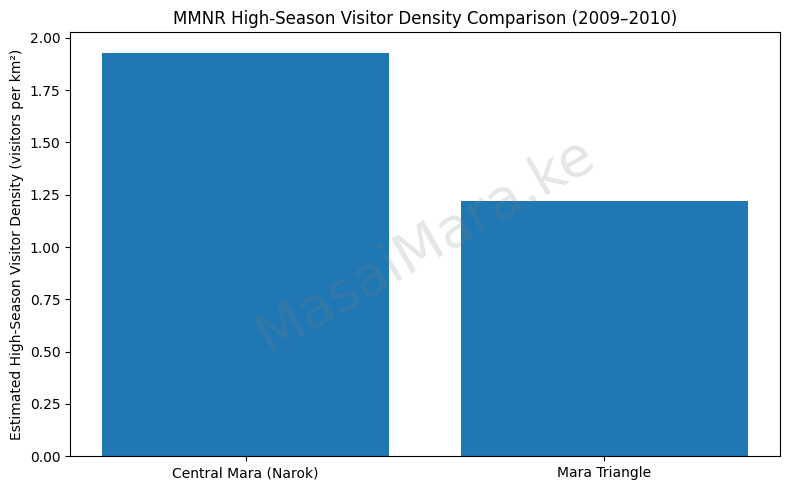
The visitor-use estimates from 2009–2010 reveal a clear and structurally important imbalance in tourism pressure within the Maasai Mara National Reserve. Despite covering just over twice the area of the Mara Triangle (1,072 km² versus 488 km²), the Central Mara (Narok) section was receiving more than three times as many high-season visitors per day (approximately 2,074 compared to 593).
This translated into an estimated visitor density of 1.93 visitors per km² in Central Mara, significantly higher than the 1.22 visitors per km² recorded in the Mara Triangle. From a management perspective, this disparity helps explain why overcrowding, vehicle congestion, and habitat degradation have historically been most acute in the Central Mara, particularly around key wildlife attractions such as river crossings and predator sightings.
The figures provide strong empirical support for the MMNR Management Plan’s emphasis on visitor carrying capacity, zonation, and harmonised Reserve-wide management, demonstrating that without deliberate controls, tourism pressure concentrates unevenly, undermining both ecological integrity and the quality of the visitor experience.
Exceeding this threshold degrades:
- Wildlife behaviour and habitats
- Visitor experience
- Long-term tourism revenues
The carrying capacity is treated as a monitoring target, not a fixed number, allowing adjustment based on ecological and visitor-experience indicators.
6. Zonation and Visitor Use Scheme
To operationalise carrying capacity, the Plan establishes four Reserve-wide zones, each with specific rules:
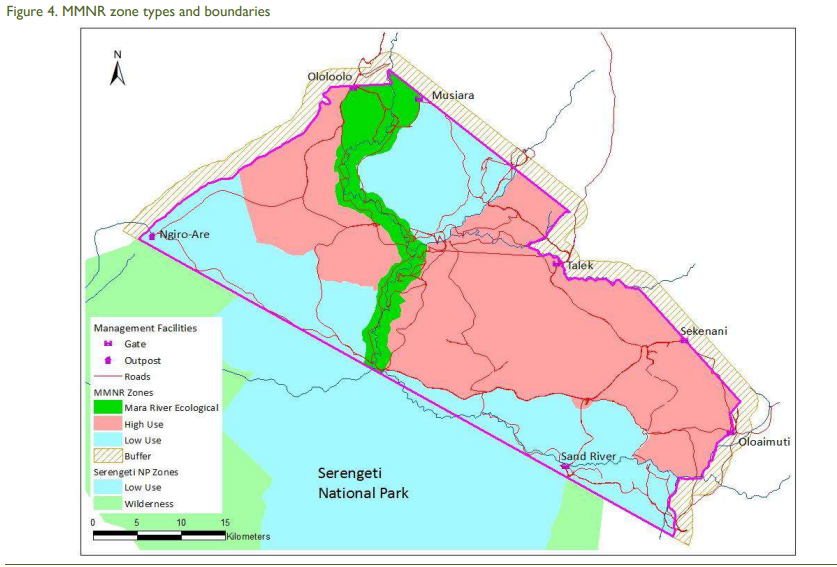
6.1 High Use Zone
- Main tourism concentration areas
- Focus on infrastructure, roads, and visitor management
- Actively managed to reduce congestion and improve experience
6.2 Low Use Zone
- Low visitation, high wilderness value
- Emphasis on ecological protection and exploration
- Lower visitor densities
6.3 Mara River Ecological Zone
- Highest ecological sensitivity
- Protects riverine forests, rhino habitat, and migration crossings
- Strict controls on vehicle numbers and behaviour
6.4 MMNR Buffer Zone
- Two-kilometre zone surrounding the Reserve (excluding Serengeti border)
- Major source of tourism pressure due to unregulated development
- Plan prioritises influencing land-use and development here
Critical Prescription
- No new tourism accommodation
- No expansion of existing bed capacity
- Applies across all zones for the duration of the Plan
This is one of the strongest and most consequential prescriptions in the entire document.
7. What Tourism Activities Are (and Are Not) Allowed
Permitted
- Daytime game drives
- Sightseeing balloon flights (under strict controls)
Prohibited
- Walking safaris
- Night drives
- Horseback safaris
These restrictions deliberately shift niche tourism activities to community conservancies, supporting livelihood diversification outside the Reserve while reducing internal pressure
8. The Four Management Programmes
The Plan is implemented through four integrated programmes, each with objectives, actions, and monitoring indicators.
8.1 Ecological Management Programme
Focuses on:
- Priority species (e.g. critically endangered Black rhino)
- Habitat integrity and fire management
- Protection of the Mara River and its catchment
- Reintroduction of locally extinct species
- Strengthening applied research and monitoring
8.2 Tourism Management Programme
Addresses:
- Visitor congestion and vehicle behaviour
- Infrastructure and road management
- Regulation of driver-guides and tour vehicles
- Accommodation standards and audits
- Improved ticketing, revenue collection, and customer care
8.3 Community Outreach & Partnership Programme
Aims to:
- Strengthen community–Reserve relationships
- Improve benefit-sharing mechanisms
- Reduce human–wildlife conflict
- Support community conservancies and cultural tourism
- Expand education and conservation awareness
8.4 Protected Area Operations Programme
Underpins implementation through:
- Harmonised management systems across the Reserve
- Security, anti-poaching, and visitor safety
- Staffing, training, and specialist recruitment
- Road and infrastructure maintenance
- Inter-agency collaboration, including cross-border coordination
Each programme includes a monitoring framework to track progress and enable adaptive management
9. Implementation, Monitoring, and Review
Rolling Action Plans
- Implemented through 3-year rolling action plans
- Updated annually
- Reviewed by county leadership and stakeholders
Monitoring
- Uses defined indicators for ecology, tourism, operations, and community outcomes
- Ensures decisions are evidence-based rather than reactive
Mid-Term Review
- Mandatory evaluation after 5 years
- Allows prescriptions and actions to be revised based on results and changing conditions
10. Why This Plan Is Central to the MMNR Governance Framework
Together with the Narok County Tourism Act, the MMNR Management Plan:
- Sets enforceable limits on tourism growth
- Provides legal backing for controlling over-development
- Aligns conservation, tourism, and community objectives
- Enables unified management of the entire Reserve
- Creates a pathway toward lower-volume, higher-value tourism
It is the operational heart of sustainable management in the Masai Mara.