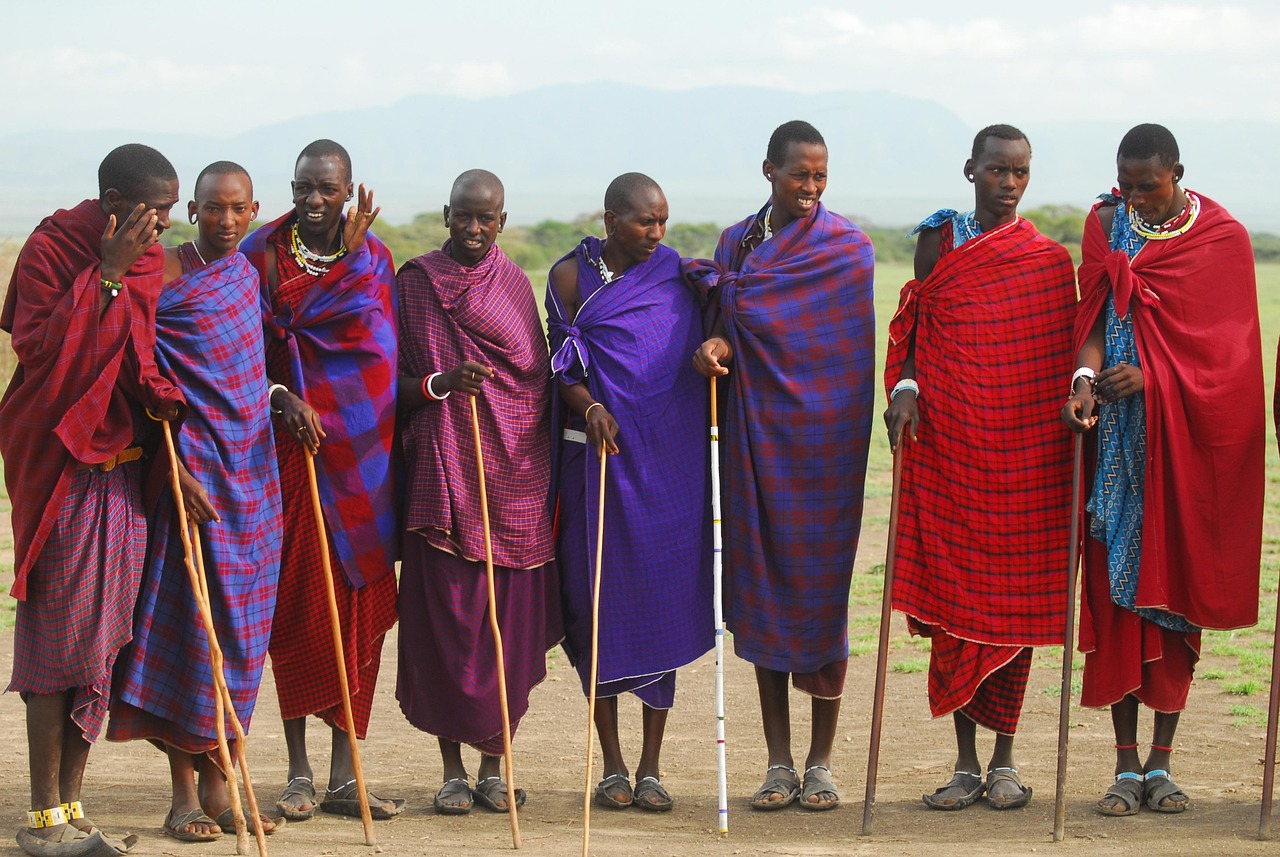
This page traces who the Maasai are, how “Maasai” identity formed historically, and how Maasailand expanded and contracted around what is today the Maasai Mara Ecosystem including the Masai Mara National Reserve(MMNR). It explains why land and mobility remain the central thread linking Maasai origins to the contemporary Mara landscape, where wildlife conservation, pastoral livelihoods, and tourism now intersect. The guide synthesizes linguistic and ethnohistorical scholarship, colonial-era records, and key historical analyses, while also highlighting where the evidence is strongest—and where it remains debated or contested.
1) Who are the Maasai? People, language, and the problem of “origins”
Maasai identity is both linguistic and historical. The Maasai are Maa-speaking pastoral peoples of southern Kenya and northern Tanzania, widely categorized within the Eastern Nilotic language family. That linguistic affiliation matters because it anchors Maasai origins in a broader history of Nilotic-speaking pastoral migrations across northeastern Africa, while also distinguishing Maasai histories from Bantu- and Cushitic-speaking neighbors whose movements and economies followed different trajectories.
But “the Maasai” were not always a single, fixed ethnic unit. A key point from modern pastoral historiography is that the Maasai emerged historically from a wider Iloikop/Loikop pastoral world: the idea of “being Maasai” consolidated over time through alliance, conflict, and the forging of shared institutions and ritual authority. This is why origins are best treated as a process—not a single birthplace.
Key entity anchors (Origins & Identity)
- Maa language; Eastern Nilotic peoples; Nilotic migrations
- Iloikop/Loikop pastoral world; formation of “Maasai” as a political-cultural identity
- Iloshon (Maasai sections) as historically shaped communities (e.g., Purko, Loita, Siria), rather than timeless tribes
2) Early movements into the Rift Valley: what we can say with confidence
Across East Africa, the long arc of pastoral history includes repeated movements of people and herds driven by rainfall variability, disease ecology, and inter-group relations. For Maa-speaking pastoralists, this appears as gradual southward movement into the Rift Valley region, with settlement and rangeland use structured by mobility rather than permanent, bounded occupation. In other words, “where they came from” cannot be mapped like a modern border; it is better understood as routes, seasonal ranges, and political landscapes changing over generations.
3) The Iloikop Wars and the making of Maasai power in the 19th century
A pivotal nineteenth-century episode in Maasai ethnogenesis and territorial influence is the complex of conflicts often labeled the Iloikop Wars (roughly mid-19th century, with climactic phases into the 1870s). These conflicts involved Maasai sections and related pastoral communities (including those later described as “Kwavi/Loikop” in older sources), and they reshaped alliances, leadership, and access to grazing territories.
What matters for a serious account is not just “who fought whom,” but the pastoral political economy underneath: competition over pasture, water, and herd security in environments where drought and disease can rapidly turn neighbors into raiders—and allies into rivals. Oral history and historical anthropology emphasize that Maasai expansion after these conflicts could leave sections overextended, with new territories difficult to occupy and defend, especially under mounting pressure from other groups and ecological stress.
Entity topics to include here
- Iloikop/Loikop identity; Laikipiak (Ilaikipiak) conflict histories
- Prophetic–ritual leadership (laibon) in alliance formation and war mobilization
- Age-set organization as a social technology for coordination and security
4) “Emutai” (c. 1883–1902): disease, drought, famine, and a historical rupture
Maasai historical memory and scholarship converge on the late nineteenth century as a period of severe crisis often referred to in Maa as Emutai—a time marked by interlocking disasters: rinderpest (cattle plague) with cascading famine, smallpox, and broader ecological collapse. For a pastoral society, mass cattle mortality is not a sectoral shock; it is an existential shock affecting food, wealth, marriage transactions, political authority, and the capacity to recover after conflict.
The broader African rinderpest panzootic (1888–1897) is widely recognized as one of the most devastating livestock epidemics in sub-Saharan Africa, with exceptionally high mortality among cattle and significant knock-on effects for human societies reliant on bovines. The Maasai were among the groups for whom these losses were especially catastrophic, precisely because cattle sat at the center of economy and social reproduction.
Anthropologically, Emutai is crucial because it helps explain why Maasai political relations with the early colonial state were not simply “conquest by force,” but often an unstable mixture of weakening pastoral resilience, opportunistic settler demands, strategic accommodation, and contested “treaty” arrangements.
5) Colonial Maasailand: treaties, removals, and the remaking of land
5.1 The 1904 and 1911 Maasai Agreements: land as a colonial instrument
In the early colonial period, the British sought to reorganize people and land to facilitate administration and, importantly, to open high-potential areas for European settlement. Under the 1904 agreement framework, Maasai sections were pushed out of parts of the central Rift Valley into designated “reserves,” with assurances framed in permanence; later, the 1911 agreement enabled (and rationalized) a second large relocation—most famously the removal from Laikipia southwards.
Lydia Hughes’s detailed archival reconstruction is especially important here: she describes the two-stage displacement and the coercive realities accompanying the second move, noting the dramatic scale of land loss and the political logic of concentrating Maasai populations for control, taxation, and settler land access.
5.2 Maasai legal action (1913): contesting colonial legality
Contrary to simplistic narratives that portray Maasai as politically passive, the early twentieth century includes a remarkable episode: Maasai plaintiffs took the colonial government to the High Court (1913) to contest the legality of the relocations, including the validity of the 1911 agreement and the loss of Laikipia. The judgment and related materials circulated internationally (including in the American Journal of International Law).
Anthropologically, this matters because it shows Maasai political agency operating through colonial legal forms, not only through armed resistance. It also demonstrates how “treaties” functioned in practice: as instruments of state formation and land transfer, routinely contested by the governed.
5.3 Maasailand becomes “wildlife space”
Over the twentieth century, conservation governance layered new restrictions on Maasai land use. The Maasai Mara—now a global icon—was historically part of pastoral rangelands and seasonal movement systems. Colonial and postcolonial conservation frameworks increasingly treated such landscapes as wildlife-first spaces, often in tension with pastoral mobility. This is the long prehistory to contemporary debates about the Mara Reserve vs conservancies, grazing access, and “who the Mara is for.”
6) Post-independence transformations: group ranches, subdivision, and new inequalities
A central post-independence institutional change was the creation of group ranches, intended to formalize communal tenure and enable planned development. Over time, many group ranches were subdivided into individual titles, a shift that profoundly altered Maasai social and economic life.
From an anthropological perspective, subdivision is not simply “modernization.” It is a structural change that:
- reduces rangeland flexibility (less room to move herds in drought years),
- increases fencing and fragmentation (affecting both livestock mobility and wildlife corridors), and
- creates sharper wealth differentiation as some households consolidate land while others become land-poor.
These dynamics are foundational for understanding the contemporary Mara landscape—especially the rise of conservancies as one response to fragmentation (and a new arena for conflict over land, benefit-sharing, and governance).
7) Maasai sections (iloshon): why local history matters in the Mara region
A frequent weakness in generic writing is treating the Maasai as a single uniform group. In reality, Maasai identity is lived through sections (iloshon) with distinct local histories, political lineages, and territories. Within the greater Mara region, sections such as Purko, Loita, and Siria often feature in historical narratives of movement, alliance, and land tenure. Good history in the Mara context therefore tracks:
- which sections historically used which grazing areas,
- how relocations affected different sections unevenly, and
- how post-independence land tenure changes played out in specific places (Loita Hills, Trans Mara, etc.).