An on-the-ground guide from your hosts in the Mara—written with an anthropologist’s lens, for travelers who want to understand (not just “see”) culture.
The Maasai Mara is famous for wildlife, but it is also a lived cultural landscape. Maasai communities have shaped these rangelands through pastoral knowledge, seasonal movement, social institutions, and a moral economy centered on livestock and land. What visitors encounter today—dress, beadwork, song, homesteads, ceremonies, and conservancy life—is not a museum culture. It is a living society navigating tourism, conservation, schooling, markets, climate variability, and land tenure change, while still drawing strength from deep-rooted institutions and values.
This guide explains Maasai cultural life in the Mara in a way that respects both continuity and change—and helps you engage ethically as a guest.
Table of contents
- Cultural identity and what “Maasai” means in daily life
- The enkang (manyatta): home, family, and the social world
- Age-sets, life stages, and social authority
- Cattle, pastoralism, and the moral economy
- Dress, color, beadwork, and meaning
- Song, dance, oral tradition, and Maa language
- Belief, ritual, and Enkai (Engai)
- Rites of passage and ceremonies (what’s public vs private)
- Foodways and hospitality
- Gender, work, and changing roles
- Culture in the Mara today: tourism, conservancies, and representation
- Visiting respectfully: etiquette, photos, and fair payments
- Glossary of key Maa cultural terms
- FAQs (what visitors often ask)
1) Cultural identity: “Maasai” is not one uniform template
In the Mara region, Maasai identity is expressed through:
- Maa language (with regional dialects) and a shared moral vocabulary around land, cattle, and respect.
- Sections (iloshon) and local histories—communities around Narok/Trans Mara/Loita have distinct trajectories, even when cultural institutions are shared.
- A way of life historically organized around pastoral mobility—the practical art of living with uncertain rainfall and protecting herds across seasons.
What this means for visitors: you’ll see recognizable “Maasai” cultural elements across the Mara, but practices and interpretations vary by place, family, church affiliation, schooling, and involvement in conservancies.
2) The enkang (manyatta): the homestead as a moral and economic unit
The enkang (often called “manyatta”) is more than housing. It is:
- A social institution: family life, child socialization, and elders’ authority operate through homestead relations.
- An economic system: livestock handling, milk economies, beadwork production, and household labor are coordinated here.
- A protective architecture: thorn fencing and settlement layout are designed around livestock security and nightly routines.
When a visitor enters a homestead, you are entering a space that is simultaneously private, productive, and symbolic. The most respectful visits are those that treat the enkang as a home—because it is.
3) Age-sets and life stages: how society organizes responsibility
Maasai society is famously structured through age-sets and age grades. Practically, this system:
- Organizes labor and responsibility across the life course.
- Produces a shared identity among age-mates.
- Shapes authority: elders hold decision-making legitimacy in many community arenas.
You will often hear visitors speak only about “warriors,” but the deeper point is institutional: age-sets are a governance system—one of the reasons Maasai society historically coordinated grazing, security, and social order across wide rangelands.
Note: Some ceremonies are public-facing or appropriate to describe; others are private, family-led, or sensitive. A good cultural experience respects those boundaries.
4) Cattle and pastoralism: culture is built around livestock—and land
For the Maasai, cattle are not merely “assets.” They sit inside a broader moral economy where:
- Milk is nourishment and a symbol of well-being.
- Livestock exchanges support social bonds, marriage relations, and obligations.
- Wealth is historically measured by the ability to maintain herds through drought and disease cycles.
Pastoralism is also an environmental knowledge system: reading grass conditions, water points, disease risk, and seasonal movement. Modern pressures—land subdivision, restricted mobility, recurrent drought—have pushed many households toward mixed livelihoods (including cultivation and tourism-linked work).
5) Dress, color, beadwork: not decoration—communication
Shúkà and visible identity
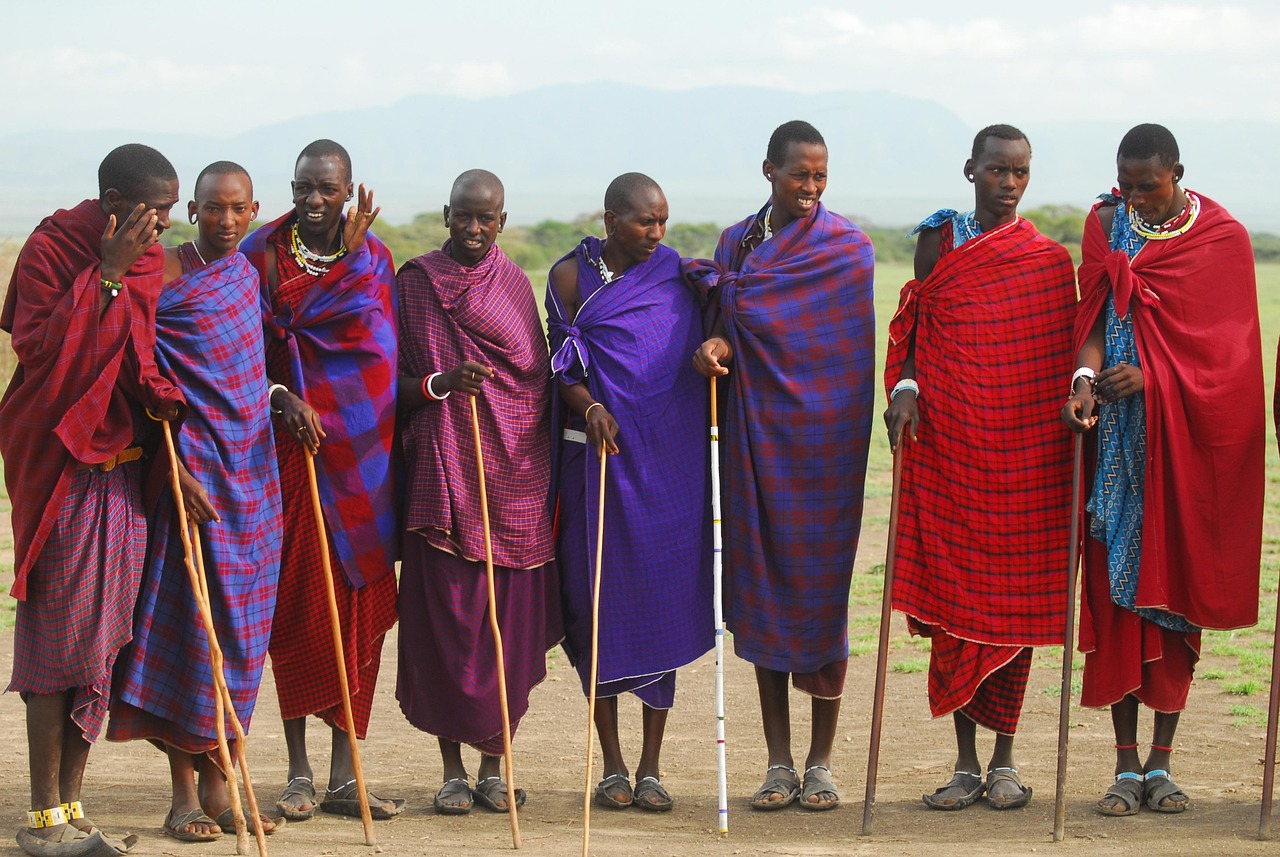
The iconic red (and increasingly blue/checked) shúkà is part of a broader visual language: what you wear can signal age, status, occasion, and identity.
Beadwork as social text
Maasai beadwork is often described as “beautiful,” but it is also semiotic—it carries meaning and social information. Commonly cited color associations include:
- Red: bravery, unity (often linked to blood and communal life)
- Blue: sky/rain, sustenance for people and livestock
- White: purity/peace/health, strongly associated with milk
- Green: land, growth, life
These meanings are widely explained in Maasai community and heritage contexts (though interpretations can vary).
Who makes beadwork? Predominantly women, often as both cultural practice and income stream. In many parts of the Mara, beadwork groups also function as informal savings and mutual support networks.
Visitor tip: If you buy beadwork, buy directly from makers or verified community groups where pricing and benefit-sharing are transparent.
6) Music, dance, and oral tradition: performance and pedagogy
Visitors often encounter the adumu (jumping dance) and group singing. Seen anthropologically, these are not just “performances”:
- Songs can encode praise, moral commentary, and communal memory.
- Call-and-response structures build group cohesion.
- Dance and voice can be part of ceremonies, celebration, or welcome.
Maasai oral culture is also famous for proverbs—a condensed form of social teaching. Several public collections and exhibitions illustrate how proverbs preserve ethics, humor, and social reasoning in Maa.
7) Belief and worldview: Enkai (Engai), rain, and moral order
Maasai religious thought has historically centered on Enkai/Engai, often associated with rain, fertility, and the ordering of life. Belief is not separable from ecology: rain is not merely weather—it is the condition for grass, cattle health, milk, and social stability.
Today, many Maasai are also Christian (in varied forms), and religious life can be multi-layered: Christian practice may coexist with cultural traditions, elders’ blessings, and local moral frameworks.
8) Rites of passage and ceremonies: what’s appropriate to discuss
Maasai rites of passage are deeply significant, but visitors should be careful not to treat them as tourist spectacles.
Commonly referenced ceremonies in public-facing explanations include sequences around childhood-to-adulthood transitions and community milestones. Some sources list ceremonies such as Enkipaata, Emuratare, Eunoto and others, with variations in naming and emphasis.
A crucial note on sensitive practices
Older ethnographic and museum sources describe practices that some Maasai communities historically observed (including forms of female initiation). Many of these practices have been widely contested and have changed significantly over time, influenced by law, education, public health, and community-led reform. If you want to address this topic on MasaiMara.ke, the most responsible approach is:
- Keep it factual and brief,
- Emphasize contemporary change and community debate, and
- Avoid voyeuristic detail.
(If you want, I can draft a short, careful sidebar in that tone for the page.)
9) Foodways and hospitality
Hospitality in the Mara is practical: offering tea, conversation, and a welcome into social space is part of being a host community.
Historically pastoral foods emphasized milk, meat, and animal products, but diets today are diverse and commonly include maize meal, tea with sugar, rice, beans, and market foods—reflecting broader shifts in livelihoods and cash economies.
10) Gender and work: roles, obligations, and change
Gendered work has long structured daily life:
- Men have historically been strongly associated with livestock security, herding decisions, and public deliberation (especially in elder councils).
- Women’s work has often been central to household continuity—building/maintaining domestic spaces, childcare, milk processing, and beadwork economies.
Scholarship on Maasai gender relations stresses that these roles are not static; they have shifted through colonialism, missionization, labor migration, education, and market integration.
11) Maasai culture in the Mara today: conservancies, tourism, and representation
In the Maasai Mara ecosystem, “culture” is now lived inside a complex modern political economy:
- Conservancies lease land from Maasai landowners for wildlife conservation and tourism, creating new income streams and governance arrangements.
- Tourism provides jobs and markets, but can also pressure communities to perform a simplified “authentic Maasai” image for outsiders.
- Representation becomes a practical issue: who speaks for community? who benefits? what counts as respectful engagement?
The most meaningful cultural experiences in the Mara are those that recognize Maasai people as contemporary hosts and decision-makers—not as props in a safari narrative.
12) Visiting respectfully: practical etiquette for guests
If you publish only one section for visitor behavior, make it this one.
Before you take photos
- Ask first—always.
- Explain what the photo is for.
- Accept “no” gracefully.
About payments and “fees”
- If you are visiting a community site or cultural experience, ensure the fee structure is clear: who receives it, how it is shared, and what it supports.
- Avoid bargaining in ways that undervalue labor and cultural work; it often reinforces unequal power dynamics.
Questions to avoid (or ask differently)
Instead of “Do you still live traditionally?” try:
- “How has life changed here in the last 10–20 years?”
- “What do you hope tourism gets right about your community?”
- “What are the biggest challenges for herding and land today?”
13) Glossary (useful Maa cultural terms)
- Maa – the Maasai language
- Enkang / manyatta – homestead
- Ilmoran – warriors (age-grade)
- Iloshon – Maasai sections
- Enkai/Engai – deity associated with rain and moral order
- Eunoto / Emuratare – commonly referenced ceremonies (terms and practices vary)
14) FAQs for MasaiMara.ke visitors
Is the jumping dance “the Maasai dance”?
It’s one visible element (often called adumu) within a much broader musical and ceremonial tradition.
Are cultural villages always “authentic”?
Authenticity is not a costume—it’s about community control, consent, fair benefit-sharing, and respectful interpretation. Some experiences are excellent; others are performative in ways communities themselves debate.
Do all Maasai people live the same way?
No. Livelihoods and daily life differ by location, education, land access, conservancy involvement, religion, and household history.