A Deep Dive Into EV Technology, Costs, Performance, Environmental Impact, and the Future of Safari Mobility
Electric safari vehicles (EVs) are rapidly transforming the safari experience across Kenya and East Africa. From quieter wildlife sightings to dramatically lower operating costs, EVs represent one of the most significant innovations in safari mobility since the introduction of the 4×4 Land Cruiser in the 1980s.
Yet their adoption in the Masai Mara is still emerging—limited by cost, charging infrastructure, and range constraints. This comprehensive guide explains everything safari operators, conservationists, and travelers should know before transitioning to electric vehicles.
1. Why Electric Safari Vehicles Matter
Electric vehicles offer far-reaching advantages for wildlife tourism—environmentally, financially, and operationally.
1. Zero Emissions
EVs eliminate tailpipe emissions entirely, unlike diesel engines that release CO₂, NOx, and particulate matter.
- Safari driving is fuel-intensive; electrification can cut thousands of kilograms of CO₂ annually.
- In fragile ecosystems, cleaner air directly benefits wildlife, vegetation, and human health.
- According to the International Energy Agency (IEA), transport accounts for nearly 24% of global CO2 emissions, with diesel engines being a significant contributor. Replacing diesel safari vehicles with electric alternatives directly cuts down these harmful emissions.
2. Ultra-Quiet Wildlife Viewing
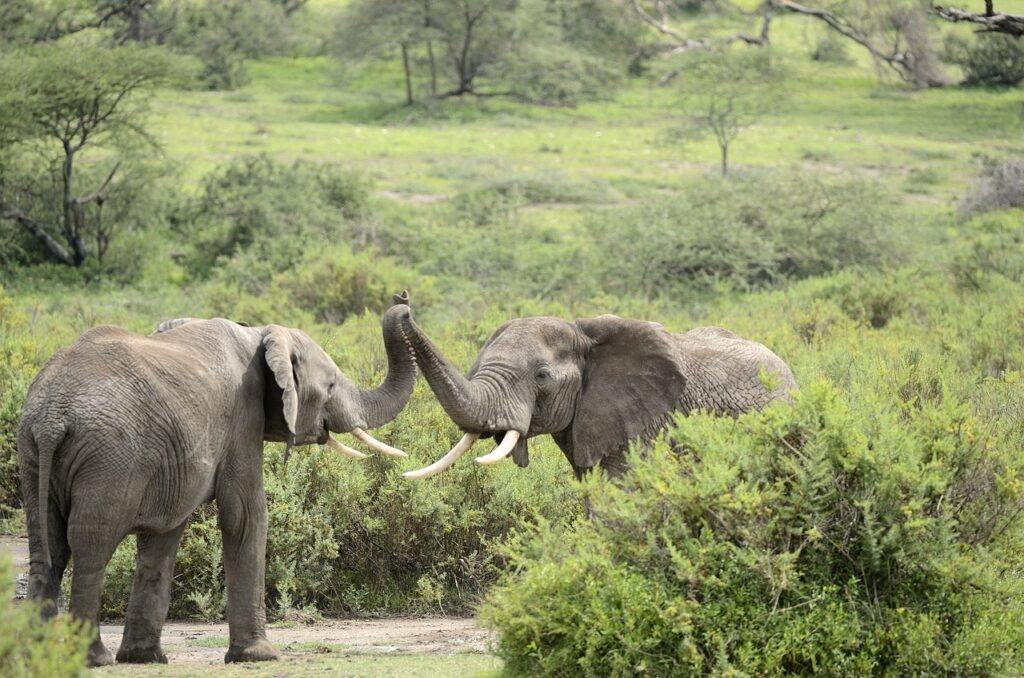
EVs are almost silent. Wildlife remains calmer, sightings last longer, and predators behave more naturally.
- Quiet operation is cited by camps like Emboo River Camp, Chobe Game Lodge(Botswana) and Campi ya Kanzi as a major guest experience advantage.
- Reduced stress on wildlife aligns with modern conservation-focused tourism.
3. Renewable Solar Power Integration
EVs can be charged using solar energy, making game drives carbon-neutral.
- Camps like Campi ya Kanzi built large solar arrays to power Rivian EV fleets.
- Solar eliminates diesel dependency and improves long-term sustainability.
4. Lower Operating & Maintenance Costs
EVs have far fewer moving parts, meaning:
- Lower servicing frequency
- Fewer breakdowns
- Cheaper energy costs per kilometer
Across thousands of safari kilometers per year, savings are substantial.
5. Long-Term Sustainability
EVs support carbon neutrality goals for protected areas.
- Many camps now view electrification as part of their long-term ESG strategy.
- EVs reduce noise pollution, fuel spills, and ecosystem disturbance.
2. EV Safari Technology Basics
Modern electric safari vehicles fall into two categories:
A. Retrofitted Electric Safari Vehicles
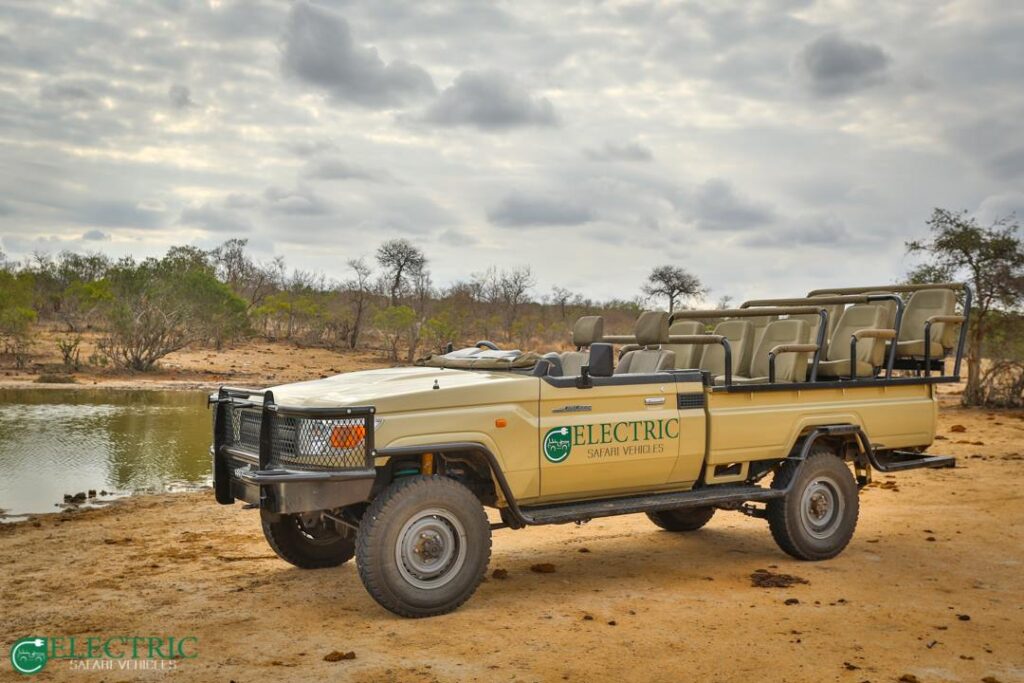
Traditional Land Cruisers or Land Rovers are converted to electric by replacing the internal combustion engine with:
- Electric motor
- Battery packs
- Charging system
- Digital dashboards
Typical retrofit cost: US$30,000–$45,000
(Emboo River was among the first Kenyan lodges to pioneer full retrofits.)
Advantages
- Much cheaper than buying a new EV
- Reuses existing safari chassis
- Maintains classic open-side design
- Ideal for camps with solar infrastructure
- Payback in ~3–4 years due to reduced fuel and maintenance costs
Limitations
- Older bodies still require maintenance
- Range may be shorter than purpose-built EVs
- Conversion quality varies by supplier
B. Purpose-Built Electric Safari Vehicles
These are EVs designed from scratch for rugged off-road use (e.g., Rivian R1T safari conversions at Campi ya Kanzi).
Advantages
- High-capacity batteries (300–400+ miles)
- Purpose-built for extreme terrain
- Superior torque for climbing and sand
- Silent, smooth, premium guest experience
- Longer lifespan and less mechanical wear
Limitations
- Very high upfront cost: US$70,000–$100,000+
- Limited models available in Africa
- Still dependent on onsite charging infrastructure
3. Can EVs Handle Long-Distance Safaris?
Yes—but with limitations. EVs excel on short–medium game drives but require planning for long-range, multi-day safaris.
Range Constraints
- Rated range: 300–400 miles
- Real off-road range: significantly lower due to mud, hills, sand, heavy loads
Factors that reduce range:
- Frequent acceleration/braking at sightings
- Fully loaded safari vehicles
- Deep mud or steep inclines
- High temperatures
Charging Challenges
- Few public chargers in safari regions
- Most EV operations rely entirely on solar at the lodge
- Charging takes 4–12 hours depending on system
- Fast-charging is rare in wilderness areas
Ideal Use Case
EVs are perfect for:
- Morning + afternoon game drives
- Conservancy-based safaris
- Camps committed to solar power
For cross-country, multi-park safaris, diesel remains more practical—for now.
4. EVs vs Hybrid vs Diesel Safari Vehicles
Below is the essential comparison from all analyses above.
A. Electric Vehicles (EVs)
Pros
- Zero emissions
- Silent operation
- Low running costs
- Low maintenance
- Best guest experience
Cons
- Range decreases in tough terrain
- Long charging times
- High upfront costs
- Requires on-site solar or charging
Best For: Eco-lodges, short–medium drives, conservation camps.
B. Diesel (Fossil-Fuel) Vehicles
Pros
- Best off-road reliability
- Instant refuelling anywhere
- Long range (400–500+ km)
- Widely available parts & mechanics
Cons
- High emissions
- Engine noise disturbs wildlife
- High fuel cost
- Frequent maintenance
Best For: Long-distance safaris and remote routes.
Read about our Diesel-powered Land Cruiser Rentals
C. Hybrid Vehicles
Pros
- Better fuel economy
- Lower emissions
- Extended range
- Quick refuelling
Cons
- Not usually safari-modified
- Complex systems harder to repair
- Limited electric-only range
Best For: Light off-road safaris focused on efficiency.
Comparison Table for Off-Road Safari Use
| Feature | Electric Vehicles (EVs) | Fossil-Fuel Vehicles | Hybrid Vehicles |
|---|---|---|---|
| Fuel/Power Source | Electric battery | Gasoline/Diesel | Gasoline/Diesel + Electric |
| Emissions | Zero tailpipe emissions | High emissions | Reduced emissions |
| Range | 200-400 miles per charge | 400-500 miles per tank | 400-500 miles (combined) |
| Refueling Time | 4-12 hours (charging) | 5-10 minutes | 5-10 minutes (fuel) |
| Off-Road Capability | Moderate (dependent on model) | High (4WD options) | Moderate (varies by model) |
| Maintenance | Low (fewer moving parts) | High (frequent maintenance) | Moderate (dual systems) |
| Noise | Silent | Loud (can disturb wildlife) | Moderate (depends on mode) |
5. Cost Comparison: EV vs Diesel Safari Vehicles
Full-Day Game Drive (120–160 km)
Based on typical Masai Mara usage:
| Vehicle Type | Energy/Fuel Used | Cost per Full-Day Drive |
|---|---|---|
| Electric Safari Vehicle | 30–40 kWh | $6 – $9.20 |
| 2013 Diesel Land Cruiser 79 | 16–20 L diesel | $24.80 – $31.00 |
| 2024 Land Cruiser 300 | 12–15 L diesel | $18.60 – $23.25 |
Result:
- EVs are 3–4× cheaper to operate than older Land Cruisers.
- EVs are 2–3× cheaper than new diesel models.
- Over months of safari operations, savings are immense.
Retrofit Payback
- Retrofit cost: ~US$37,000
- Running cost reduction: 80–90% per year
- Payback: ~3–5 years
For high-use safari fleets, the economics strongly favour electrification.
6. Fuel Efficiency of Diesel Cruisers: Understanding the Baseline
Typical Land Cruiser Safari Consumption
- 2013 Land Cruiser 79 (4.2L): 8–10 km/L
- Full-day safari (160 km): 16–20 L diesel
2024 Land Cruiser Efficiency
- New 3.3L Twin-Turbo V6 diesel: 11–13 km/L
- Higher efficiency due to turbo, 10-speed gearbox, lighter chassis, advanced injection
Still no match for EV cost savings or emission reduction.
7. Environmental Impact: Why EVs Are the Future
Electric safari vehicles deliver significant ecological benefits:
Cleaner Air
- No diesel soot or NOx
- Improved human & wildlife health
Reduced Noise Pollution
- Wildlife stays calm
- Natural behaviour observed longer
Carbon-Neutral Potential
- When paired with solar micro-grids
- Perfect for conservancies moving toward net-zero strategies
Lower Physical Footprint
- Fewer spare parts
- Less oil, grease, and waste
Stronger Conservation Alignment
Camps like Campi ya Kanzi tie EV adoption to broader conservation efforts through organizations like the Maasai Wilderness Conservation Trust.
8. Limitations: Why EV Adoption Is Still Slow
Despite clear benefits, challenges remain:
- High upfront cost
- Limited EV models designed for safaris
- Sparse charging infrastructure in East Africa
- Range constraints on long, remote routes
- Need for solar installations
- Limited EV repair expertise in rural areas
However, interest is rising rapidly—and early adopters enjoy strong branding advantages.
9. The Future of Electric Safaris in the Masai Mara
The shift to electric safari vehicles is accelerating due to:
1. Falling Battery Costs
By 2030, battery prices may be <50% of today’s cost.
2. Increasing Solar Adoption
Camps discovering that solar + EVs drastically cut operational costs.
3. Growing Guest Demand for Sustainable Travel
Eco-conscious travellers increasingly preference EV game drives.
4. Emerging EV Retrofit Industry in Kenya
Local firms (e.g., Opibus/ROAM) already retrofit vehicles for fleets.
5. Potential EV Charging Hub Projects
Plans like the Sekenani Gateway Solar EV Charging Hub (in discussions with Kambu Mara Camp) could unlock EV use across the entire reserve.
10. Should Your Camp Switch to Electric Safari Vehicles?
Choose EVs if you want:
✓ Lower operating costs
✓ Premium guest experience
✓ Quiet wildlife encounters
✓ Strong sustainability credentials
✓ Short–medium daily driving distances
Choose Diesel if you need:
✓ Very long-distance routes
✓ Multi-day overland safaris
✓ Remote or seasonal track access
✓ Fast refuelling anytime, anywhere
Choose Hybrid for:
✓ Moderate off-roading
✓ Reduced emissions without new infrastructure
11. EV Performance in Extreme Weather and Tough Safari Terrain
Cold Weather
- EV batteries lose efficiency in freezing conditions, reducing range by 20–40% as chemical reactions slow.
- Heating the cabin and battery increases energy consumption.
- Modern EVs use battery preconditioning and heat pumps to maintain efficiency.
Hot Weather
- Extreme heat accelerates battery degradation and reduces long-term capacity.
- EVs rely heavily on liquid thermal management systems to avoid overheating.
- Air conditioning draws additional energy but typically less than heating in cold climates.
Wet, Muddy & Humid Conditions
- EVs are well-sealed; motors and batteries are protected against moisture, enabling safe water fording.
- Instant torque provides superior traction on slippery surfaces compared to diesel engines.
- AWD systems, traction control, and high ground clearance (e.g., Rivian R1T/S) make them capable on muddy trails.
- Mud increases energy use and reduces range due to higher rolling resistance.
High Altitude
- Unlike combustion engines that lose performance with reduced oxygen, EVs maintain full power at elevation.
- This makes EVs ideal for regions with variable altitude such as Mara escarpments or Laikipia.
Design Limitations for Off-Road Use
- Battery weight increases the risk of sinking in soft terrain and raises recovery difficulty.
- Low-mounted battery packs can be vulnerable to rock strikes if ground clearance is insufficient.
- Single-speed drivetrains lack traditional low-range gearing, limiting steep technical climbs unless compensated by advanced software.
- Range anxiety remains a challenge on extended remote routes without charging access.
- Charging time (4–12 hours) can limit back-to-back game drives unless solar infrastructure is robust.
Mud Performance: Strengths and Weaknesses of EV Safari Vehicles
Strengths
- Instant torque → rapid traction response.
- AWD electric drivetrains distribute power precisely to each wheel.
- Excellent stability from low center of gravity.
- Strong water resistance and sealed electronics.
- Suitable for mud when equipped with safari-spec tires.
Weaknesses
- Higher power draw → noticeable range reduction.
- Heavy battery systems can sink into deep mud more easily than lighter diesel vehicles.
- Recovery logistics for EVs are more complex due to weight.
Overall: Modern EVs like Rivian or retrofitted Land Cruisers handle mud very well, but continuous deep-mud operations still favour diesel 4WDs for range reliability.
12. 2WD vs 4WD: Carbon Emissions for Safari Transfers
2WD Minivan (Toyota Noah / Hiace)
- Highly fuel-efficient → emits ~50.8 kg CO₂ from Nairobi–Mara (~240 km).
- Suitable for paved roads and mild gravel.
- Not allowed inside Masai Mara Reserve for game drives.
4WD Land Cruiser 79 Series
- Emits ~109.5 kg CO₂ for the same trip due to heavier build and off-road capability.
- Essential for Mara terrain, rainy season mud, and reserve regulations.
Key Insight:
4WDs emit more but are necessary for safe game drives; emissions should be offset rather than avoided.
Tree-Planting Offsets
- One tree absorbs ~22 kg CO₂/year.
- Offsetting a Nairobi–Mara trip:
- 2WD: plant ~3 trees
- 4WD: plant 5–6 trees
13. Reducing Emissions in Fossil-Powered Safari Vehicles
Safari operators can meaningfully cut emissions while transitioning to EVs:
- Regular maintenance → efficient combustion and lower fuel waste.
- Eco-driving techniques → steady speeds, reduced idling.
- Lighter loads → less engine strain.
- Fuel additives → cleaner fuel combustion.
- Low-emission fuels / biodiesel → reduced carbon intensity.
- Correct tire pressure → improves fuel economy by 3–5%.
- Emission control retrofits → catalytic converters, DPFs.
- Low-resistance tires → reduce rolling resistance by up to 10%.
These steps help bridge the gap while infrastructure for full EV adoption grows.
Final Verdict
Electric safari vehicles are a major step toward quiet, low-impact, carbon-neutral safaris. They offer unmatched benefits in stable, infrastructure-supported environments like eco-lodges with solar micro-grids. However, their limitations—range, charging time, heavy weight, and cost—mean diesel 4WDs remain essential for long, rugged, or remote safaris.
Diesel vehicles still dominate long-distance, remote, or high-load safaris, but EV adoption will expand quickly as costs fall, solar systems improve, and more purpose-built models enter the African market.
Safari operators who adopt EVs early gain:
- Lower operating costs
- Stronger conservation impact
- Better guest experiences
- Long-term competitive advantage
The Masai Mara is positioned to become one of Africa’s first carbon-neutral safari destinations, and electric vehicles will play a central role in achieving that vision.
[chbs_booking_form booking_form_id="23598"]