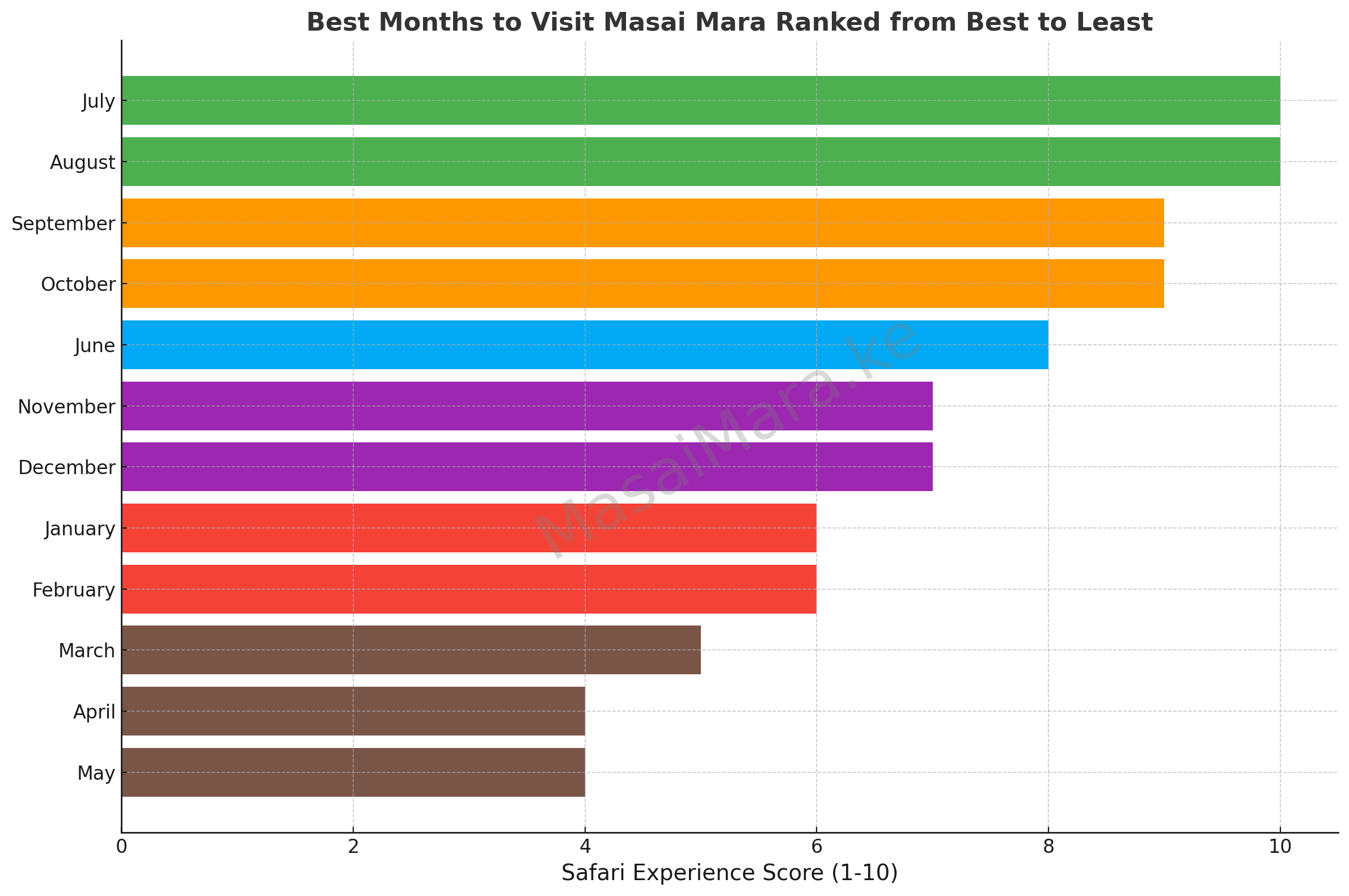

This is an expert commentary on the recent article published by Business Daily on May 6, 2026, titled “Maasai Mara visitors drop as tourists favour Amboseli, Tanzania.” The article highlights a sharp decline in visits to the Masai Mara after Narok County revised park entry charges in 2024, with some travelers now choosing Amboseli or Tanzania as more affordable alternatives.
At MasaiMara.ke, we follow these changes closely because park entry rules, pricing, ticket validity, and visitor requirements directly affect how people plan a Mara safari. For the latest practical fee guidance, see our updated Masai Mara entry fees guide. This article takes a wider view: what does the fall in visitor numbers mean, and is it likely to push Narok County Government to reduce entry fees?
First, let’s look at the data.
What do the visitor numbers show?
The Masai Mara did not start declining immediately after the pandemic recovery. In fact, the Reserve grew sharply from 2021 to 2023 before the downturn began.
| Year | Masai Mara visitors | Change from previous year |
|---|---|---|
| 2021 | 119,500 | — |
| 2022 | 249,900 | +109.1% |
| 2023 | 420,100 | +68.1% |
| 2024 | 343,100 | -18.3% |
| 2025 | 213,300 | -37.8% |
The pattern is clear. Masai Mara visitor numbers more than doubled between 2021 and 2022, then rose again in 2023 to reach about 420,100 visitors. The decline began in 2024, the year the new fee structure took effect, and became much sharper in 2025. By 2025, the Mara had lost about 49.2% of its 2023 visitor volume.
The visitor drop began in the same year that the revised fee structure took effect, so anyone planning a trip should first check the current Masai Mara park entry fees before comparing safari packages or travel seasons.

That timing matters. It does not prove that fees are the only reason for the decline, but it strongly suggests that price became a major travel-decision factor, especially for budget travellers, families, group tours, and non-resident visitors comparing Kenya with Tanzania or Amboseli.
Was the Masai Mara decline unique, or was it countrywide?
The decline was not countrywide. That is the most important point in the data.
Across Kenya, visits to national parks and game reserves increased from 3.64 million in 2023 to 3.74 million in 2024, then rose again to 3.95 million in 2025. That means the wider parks-and-reserves category grew by about 8.7% between 2023 and 2025, while the Masai Mara fell by 49.2% over the same period.
| Park / Reserve | 2023 visitors | 2024 visitors | 2025 visitors | 2023–2024 change | 2024–2025 change | 2023–2025 change |
|---|---|---|---|---|---|---|
| Nairobi National Park | 402,700 | 431,200 | 459,900 | +7.1% | +6.7% | +14.2% |
| Nairobi Safari Walk | 216,600 | 286,700 | 286,100 | +32.4% | -0.2% | +32.1% |
| Nairobi Mini Orphanage | 470,800 | 455,600 | 489,900 | -3.2% | +7.5% | +4.1% |
| Amboseli | 222,900 | 266,100 | 295,900 | +19.4% | +11.2% | +32.8% |
| Tsavo West | 79,800 | 89,600 | 95,300 | +12.3% | +6.4% | +19.4% |
| Tsavo East | 243,300 | 238,500 | 265,800 | -2.0% | +11.4% | +9.2% |
| Aberdare | 47,900 | 47,700 | 51,500 | -0.4% | +8.0% | +7.5% |
| Lake Nakuru | 265,800 | 293,100 | 340,100 | +10.3% | +16.0% | +28.0% |
| Masai Mara | 420,100 | 343,100 | 213,300 | -18.3% | -37.8% | -49.2% |
| Haller’s Park | 161,400 | 169,900 | 144,600 | +5.3% | -14.9% | -10.4% |
| Malindi Marine | 28,100 | 29,700 | 33,800 | +5.7% | +13.8% | +20.3% |
| Lake Bogoria | 32,000 | 25,100 | 19,800 | -21.6% | -21.1% | -38.1% |
| Meru | 20,600 | 20,700 | 23,700 | +0.5% | +14.5% | +15.0% |
| Shimba Hills | 21,200 | 20,400 | 22,500 | -3.8% | +10.3% | +6.1% |
| Mt Kenya | 27,600 | 28,000 | 35,800 | +1.4% | +27.9% | +29.7% |
| Samburu | 9,200 | 17,600 | 20,900 | +91.3% | +18.7% | +127.2% |
| Kisite / Mpunguti | 87,500 | 96,600 | 99,900 | +10.4% | +3.4% | +14.2% |
| Mombasa Marine | 51,400 | 65,500 | 71,300 | +27.4% | +8.9% | +38.7% |
| Watamu Marine | 82,100 | 84,200 | 97,600 | +2.6% | +15.9% | +18.9% |
| Hell’s Gate | 230,900 | 270,300 | 340,800 | +17.1% | +26.1% | +47.6% |
| Impala Sanctuary, Kisumu | 294,900 | 309,700 | 363,400 | +5.0% | +17.3% | +23.2% |
| Mt Longonot | 85,900 | 80,700 | 93,200 | -6.1% | +15.5% | +8.5% |
| Others | 135,300 | 138,500 | 151,600 | +2.4% | +9.5% | +12.0% |
The comparison makes the Mara’s decline stand out. Amboseli grew by 32.8% between 2023 and 2025. Lake Nakuru grew by 28.0%. Hell’s Gate grew by 47.6%. Nairobi National Park grew by 14.2%. Even the national total continued rising.

The Masai Mara was therefore not simply caught in a weak tourism market. It moved in the opposite direction from the wider sector.
The mathematical signal: the Mara is an outlier
A simple index makes the point clearer.
If we set 2023 = 100, Kenya’s total park-and-reserve visits rose to 108.7 by 2025. The Masai Mara fell to 50.8.
That gives the Mara a relative performance coefficient of:
50.8 ÷ 108.7 = 0.47
In plain English, the Mara performed at only about 47% of the level expected if it had followed the national park-and-reserve trend. Or put another way, after adjusting for the wider sector’s growth, the Mara was about 53% below trend by 2025.
The outlier effect is even clearer in the 2024–2025 movement. Across the parks and reserves in the table, the typical direction was still positive. The Mara’s -37.8% fall in 2025 was more than three standard deviations below the average movement among the listed sites, which is a very strong statistical signal. This is not just normal fluctuation. It is a structural break.
Has the fee increase caused Narok County revenue to fall?
Not necessarily.
This is where the debate becomes more economic than emotional. Visitor numbers have clearly fallen, but county revenue does not move only with headcount. It also depends on the fee per visitor, the number of non-resident adults, the season of travel, repeat entry days, children versus adults, resident categories, and other revenue streams.
The revenue debate depends heavily on the difference between low-season, high-season, resident, non-resident, adult, and child rates, which we explain separately in our full Masai Mara entry fees guide.

Before the revision, foreign non-resident adults paid a flat rate of about USD 80. Under the revised structure, the non-resident adult rate moved to USD 100 in the lower season and USD 200 in the higher season, with the high-season rate representing a 150% increase over the old USD 80 rate.
This is why falling visitor numbers do not automatically mean falling revenue.
To avoid mixing policy analysis with practical fee instructions, this article uses simplified revenue scenarios, while the exact visitor categories and current rates are covered in our updated guide to Masai Mara Reserve entry fees
| Scenario | Visitor count | Illustrative fee | Approximate gross gate revenue |
|---|---|---|---|
| 2023 visitors at old USD 80 rate | 420,100 | USD 80 | USD 33.6 million |
| 2025 visitors at USD 100 | 213,300 | USD 100 | USD 21.3 million |
| 2025 visitors at blended USD 150 | 213,300 | USD 150 | USD 32.0 million |
| 2025 visitors at USD 200 | 213,300 | USD 200 | USD 42.7 million |
This is not an official revenue statement. It is a simplified illustration.
But it explains why Narok County may not feel the same level of financial pressure that guides, camps, and budget operators are feeling. If a smaller number of visitors pay much higher fees, especially during the migration season, the county can lose traffic while protecting a large share of gate revenue.
The break-even point is also revealing. If the old benchmark was 420,100 visitors paying USD 80, the county needed about 336,000 visitors at USD 100, 224,000 visitors at USD 150, or only 168,000 visitors at USD 200 to match the old gross figure.
That is the core of the “high-value, low-volume” argument.
Why Narok County may not reduce the prices quickly
There are three reasons Narok County may avoid a quick reversal.
First, the county appears to have moved intentionally toward a yield-based model. The idea is not simply to attract as many vehicles as possible, but to earn more per visitor while reducing pressure on the Reserve. Business Daily quoted Narok County’s tourism leadership describing the revised fees as part of a “high-value, low-volume tourism model.”
Second, the county may believe the revenue arithmetic still works. If revenue remains close to previous levels, or even improves during high-season months, the county has less fiscal reason to reverse course.
Third, the new pricing aligns with the direction of the Masai Mara National Reserve Management Plan 2023–2032, which places much greater emphasis on carrying capacity, visitor density, tourism impacts, and better management of pressure inside the Reserve. The management plan was approved as a long-term roadmap for the Reserve and the wider Mara ecosystem, not as a short-term tourism marketing document.
This is also why Governor Patrick Ntutu’s recent visit to Talek, Sekenani, and Nkoilale is important. Local guides who have lost business over the past year reportedly asked him to consider lowering entry fees. That plea reflects real pressure from the ground. However, the Governor did not make a clear public commitment to any foreseeable fee reduction. That silence matters because it suggests the county is not yet ready to abandon the current pricing model.
In conservation terms, fewer vehicles can be an ecological gain
The Masai Mara’s tourism problem has never been lack of global demand. The deeper problem has been how demand concentrates inside the Reserve, especially during migration season.
When too many vehicles gather around a cheetah, lion kill, leopard sighting, or Mara River crossing, the cost is not only aesthetic. It affects wildlife behaviour, guide discipline, grassland condition, soil compaction, off-road track formation, and the feeling of wilderness that makes the Mara valuable in the first place.
The Management Plan specifically treats visitor density and tourism impact as management concerns. It identifies the need to manage vehicle numbers, visitor experience, wildlife disturbance, unofficial tracks, congestion at key sites, and revenue per visitor as part of the Reserve’s long-term carrying-capacity challenge.
That is the ecological argument behind high pricing. A lower number of visitors can mean:
| Reduced pressure | Why it matters |
|---|---|
| Fewer vehicles at sightings | Less stress around predators, hunts, kills, and river crossings |
| Less off-road driving pressure | Lower risk of grassland scarring and soil compaction |
| Less congestion in the central reserve | Better game-viewing quality and easier rule enforcement |
| Less pressure during migration season | Better control around the Mara River and high-demand crossing zones |
| Higher revenue per visitor | More money can be raised from fewer ecological impacts, if revenue is transparently reinvested |
This is the part of the debate that is often missed. If fees only reduce access without improving conservation, the public will see them as punitive. But if higher fees reduce overcrowding, support ranger operations, improve roads, fund habitat protection, and strengthen community benefits, then they can be defended as a conservation tool.
But the local pain is real
The county-level argument does not erase the local pain.
Guides, small camps, cultural bomas, curio sellers, mechanics, food suppliers, photographers, casual workers, and small tour operators depend on visitor volume. A county government can earn similar revenue from fewer visitors, but a local guide cannot earn the same income if fewer clients book game drives.
That is the distribution problem.
The fee increase may make sense on a conservation balance sheet and still hurt the people living around the Reserve. That tension is now visible around Talek, Sekenani, and Nkoilale, where many local tourism workers feel the decline directly.
For them, the question is not whether the Mara should be protected. It is whether the costs of protection are being shared fairly.
The real policy question is not “high fees or low fees”
The better question is: what fee structure protects the Mara without pricing out too many travellers or weakening local livelihoods?
A full return to low fees could bring back the same overcrowding problem that damaged the Reserve’s visitor experience. But keeping fees high without local support could create resentment and reduce the economic link between conservation and community benefit.
A more balanced model could include:
| Policy option | Why it may help |
|---|---|
| Keep peak migration-season fees higher | Protect the Reserve during the months of highest vehicle pressure |
| Offer better green-season pricing | Shift some demand into quieter months |
| Consider multi-day discounts | Encourage longer stays without punishing every extra day |
| Create family-sensitive pricing | Reduce the burden on families without collapsing the premium model |
| Support licensed local guides | Keep local expertise inside the tourism economy |
| Publish revenue-use reports | Show how higher fees support conservation, roads, rangers, and communities |
| Enforce vehicle limits at sightings | Make sure lower volume actually improves the safari experience |
The Mara should not compete only on price. It should compete on wildlife quality, guiding standards, conservation credibility, migration interpretation, ecosystem protection, and the quality of the safari experience. But if the county wants a high-value model, the benefits must be visible to communities around the Reserve.

What this means for budget travellers
The Masai Mara is now more expensive than it was before 2024, especially for non-resident visitors travelling in peak season. That does not mean budget travellers should avoid the Mara. It means they need to plan more carefully.
The entry fee is only one part of the total safari cost. Travellers can still reduce the overall cost by choosing budget accommodation, joining a well-priced road package, travelling in a small group, avoiding unnecessary extra entry days, and selecting an itinerary that uses time inside the Reserve efficiently.
For visitors comparing options, MasaiMara.ke can assist with low-cost Mara packages, including the 3-day Masai Mara budget safari and the 4-day Masai Mara safari. These itineraries help keep transport, accommodation, and logistics practical while still giving visitors a proper Mara experience.
The lowest-cost packages can start from about USD 397 per person, depending on dates, group size, accommodation availability, and the final itinerary. Park entry fees remain separate and should always be checked against the latest official rules before travel.
The Mara remains one of Africa’s great safari landscapes, but the new pricing environment means visitors should plan carefully, compare seasons, and confirm the latest Masai Mara entry fees and ticket rules before finalizing a trip.
Expert conclusion
The fall in Masai Mara visitor numbers is not a normal market dip. The data shows a clear structural break beginning in 2024, while the wider Kenyan parks-and-reserves category continued to grow. Amboseli’s rise over the same period makes the shift even more visible.
But the conclusion should not be too simplistic. Narok County may be receiving fewer visitors while still protecting much of its gate revenue because the price per visitor has increased sharply. From a conservation economics perspective, that is the logic of a high-value, low-volume model.
The unresolved issue is fairness. Fewer vehicles can genuinely help the Mara ecosystem, especially in crowded migration-season zones. But fewer tourists also mean fewer work days for local guides and fewer sales for small businesses around Talek, Sekenani, and Nkoilale.
For now, the county has little obvious incentive to rush into a fee reduction unless the revenue numbers weaken, political pressure grows, or local livelihood concerns become too large to ignore. The more likely path is not a complete reversal, but pressure for a smarter pricing structure: one that protects peak-season carrying capacity, supports green-season travel, and gives local tourism workers a clearer share of the benefits.
For travellers, the message is simple: the Mara is still worth visiting, but it now rewards careful planning. Check the current Masai Mara entry fees, choose the right season, and use a budget-conscious itinerary if cost is a major concern.